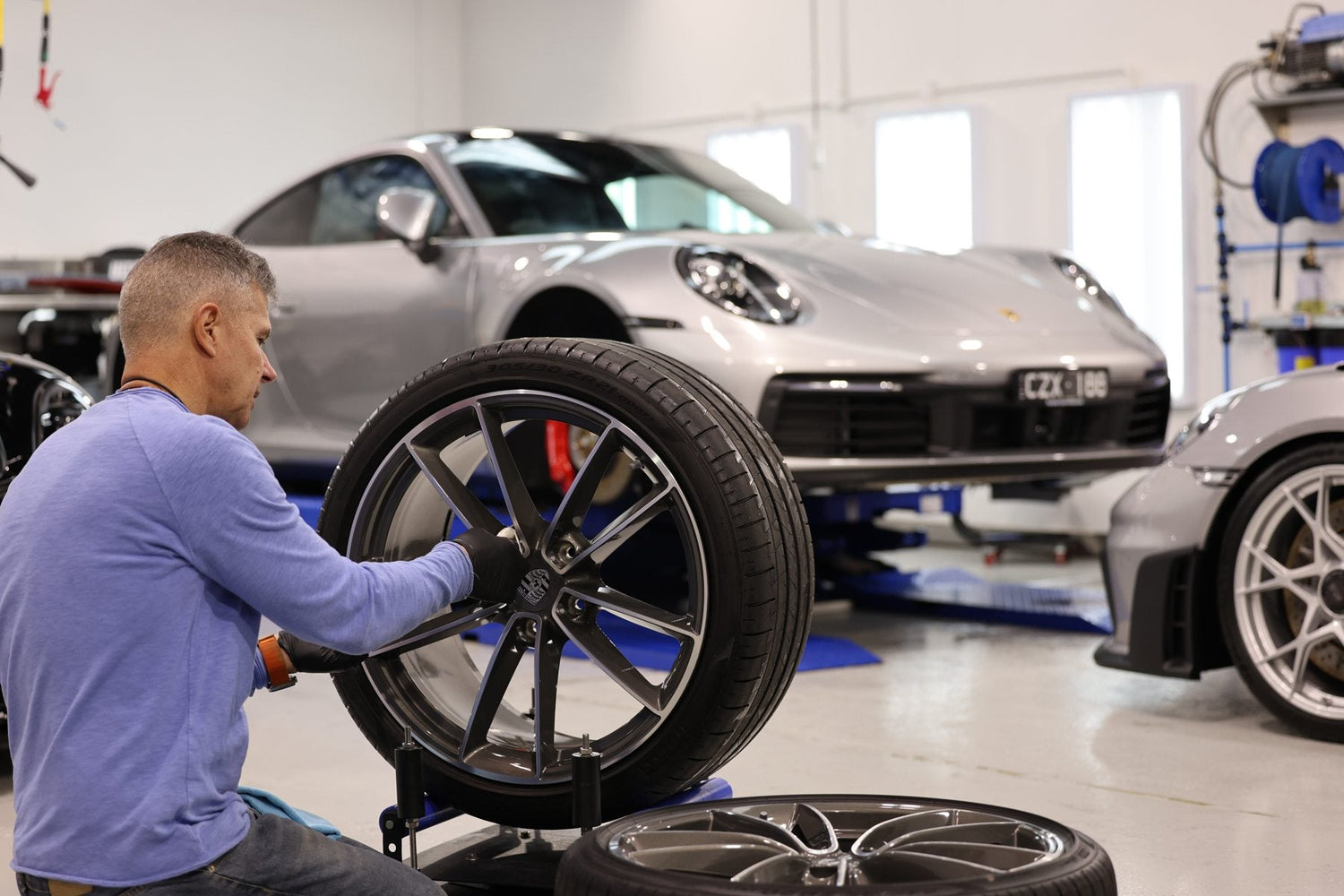
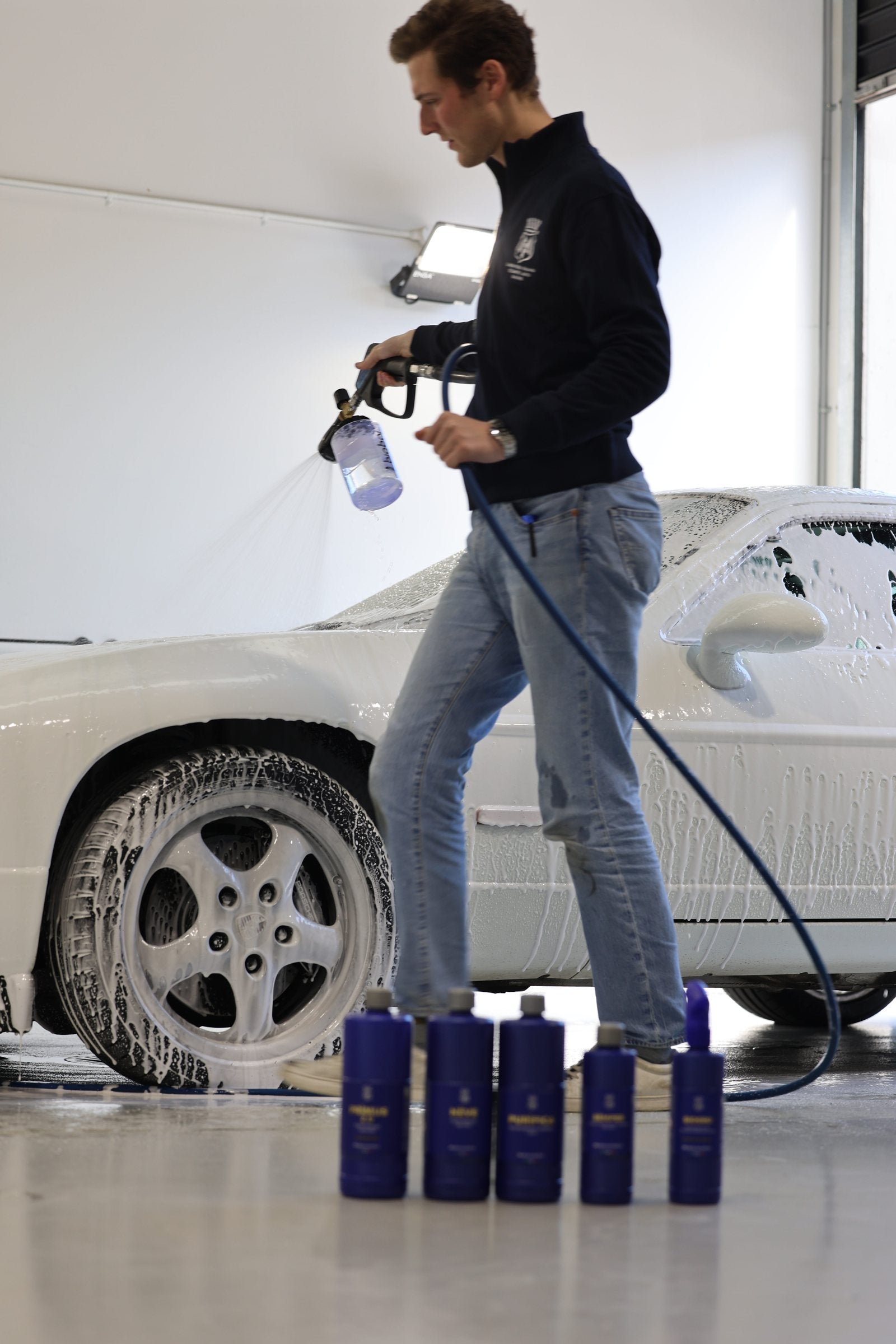
Wheels are where ingredient choice stops being academic. Bare alloy, anodised finishes, painted calipers, clear-coated rims, steel fasteners and rubber all sit within reach of the same spray — and this is the one category in detailing that contains a genuine chemical hazard to the person holding the bottle.
This chapter ranks the acids and the iron-removal chemistry from what good formulation looks like down to what we will not sell, explains what the purple in an iron remover actually is, and puts our own range on the same scale. It is part of our car care chemistry handbook. If you want the product-type comparison instead — alkaline versus acid versus iron remover versus maintenance — that is in how to choose the right wheel cleaner.
Seven things worth knowing before you spray anything on an alloy.
Hydrofluoric acid and ammonium bifluoride are the only true never. ABF dissociates to HF in water, so "acid-free fluoride" is marketing, not chemistry.
HF causes systemic hypocalcaemia from burns under 2.5% of body surface area, often with little immediate pain. This is not a paint-damage warning. It is a medical one.
Hydrochloric acid belongs nowhere near a wheel. GM's own service bulletin says acid wheel cleaners permanently stain chrome, that the damage is not warrantable, and that they can craze and discolour caliper paint.
"Iron remover" means thioglycolate. It works as a reducing agent and a chelator, which is why it beats citric acid and EDTA on bonded iron.
You do not need an acid to clean a wheel. A neutral thioglycolate product does the whole job at pH 7–8 with nothing acidic touching alloy, paint or coating.
The purple is a contamination indicator, not a chemistry lesson. When the colour stops appearing, the product has stopped working.
Every wheel cleaner in our store is fluoride-free. That is deliberate, it is not negotiable, and it means saying no to a product from a brand we otherwise carry in full.

Hydrofluoric acid and ammonium bifluoride
A peer-reviewed review — one the International Carwash Association hosts on its own website — states that ammonium bifluoride "essentially dissociates into HF when dissolved in water" and is "therefore not recommended to be considered as an alternative for HF", calling the belief that it is safer "a dangerous misconception". Oregon OSHA put it more bluntly: ABF is "often substituted for HF and passed off as an 'acid-free' ingredient", but "ABF's fluoride ions are just as hazardous as those of HF."
What it does to a person. Fluoride ion penetrates skin, often with little immediate pain, and then strips calcium out of the body: 2HF + Ca²⁺ → CaF₂, with each fluoride ion capable of tying up multiple calcium ions as fluorapatite — the mineral your bones are made of. The industry's own medical treatment guidance records that severe hypocalcaemia can occur within one to two hours from burns covering less than 2.5% of body surface area, and that the resulting metabolic collapse and cardiac arrhythmia "may result in a fatal outcome if not recognized and treated."
What it does to a wheel. It etches alloy, attacks the clear coat on clear-coated rims, and permanently dulls the finish. The wheel looks spectacular once and never looks right again.
Fluoride chemistry does not go in our building and we will not sell it. If a wheel cleaner is startlingly cheap, works startlingly fast, and the safety data sheet mentions fluorides — including any bifluoride, ammonium fluoride, or "acid-free" fluoride wording — put it down.
You will read on a lot of detailing sites — and in an earlier version of our own internal notes — that the International Carwash Association formally recommended the industry stop using HF and ABF. We went looking for that statement and could not find it. The only trace is a single uncited sentence in a 2015 trade magazine article, and the peer-reviewed HF review the ICA hosts on its own site says the opposite: that the association "does not take a stand to the use of any particular chemical product." The hazard data above is thoroughly documented and stands on its own. The attribution does not, so we removed it. If we cannot source it, we do not print it.
The acids, best to worst
Acids do the job alkalis cannot: mineral and inorganic contamination. Limescale and water spotting, brake dust bonded into a wheel face, alkaline residue left behind by the previous step. Used correctly an acid stage is one of the most useful things in professional detailing. Bought on price, it is the fastest way to destroy a set of wheels.
Citric acid and gluconic acid
Weak organic acids (citric pKa₁ 3.13) that chelate as well as acidify, so they lift metal ions rather than just dissolving everything in reach. The mildest genuinely useful option on metal, and the reason so many "buffered noble acid" products are built around organic acid chemistry.
Buffered acid systems in a certified formulation
The point is not the acid, it is the buffering. A properly buffered acid product can sit below pH 3 and still pass independent material-compatibility testing against paint, alloy, trim, rubber and film, because the formulation controls what the acid is allowed to reach.
Sulfamic acid
The sensible strong descaler. Stronger than phosphoric (pKa₁ 0.99 against 2.16), but a stable non-volatile solid rather than a fuming liquid, classified only as a skin and eye irritant rather than corrosive, and it will not release chlorine gas if it meets bleach. Where a job genuinely needs descaling strength, this is the grown-up choice.
Phosphoric acid
A moderate mineral acid, effective on scale and light oxide, and the backbone of many wheel and rust products. Aggressiveness scales sharply with concentration and dwell — this is one where the ratio and the clock matter more than the ingredient name.
Acetic acid
Weak, cheap and smells like a chip shop. Fine for light mineral deposits and pH trimming; rarely strong enough to be the answer on its own.
Oxalic acid
Genuinely good at rust and iron staining — it converts rust to soluble iron oxalate that rinses away, which is why it dominates timber and masonry rust-stain products. But it is acutely toxic (oral LD50 in rat about 1,080 mg/kg), causes serious eye damage, and soluble oxalate is a systemic poison that drives hypocalcaemia and calcium oxalate crystal deposition in the kidneys. We treat it as a specialist restoration chemical with gloves and eye protection, not a routine detailing product — and it is not a standard wheel-cleaner acid despite what you will read.
Hydrochloric acid
A fully dissociated strong mineral acid, volatile, and still turning up in cheap wheel cleaners. GM's own technical service bulletin names hydrochloric, hydrofluoric and phosphoric acid among the substances that damage plated wheels, states that "most acid based cleaners will permanently stain chrome wheels", that "stained wheels are not warrantable", and that acidic wheel cleaners can "craze, crack, or discolor the paint on the brake calipers". There is nothing HCl does on a wheel that a well-formulated product cannot do without it.
Hydrofluoric acid · ammonium bifluoride · any fluoride wheel chemistry
See the box above. This is the one line in this handbook with no nuance behind it.

Thioglycolate: the name behind the purple
Iron removers are the one category where the marketing name and the chemistry have completely parted ways. Whatever the bottle says — fallout remover, rust remover, wheel cleaner with colour indicator — the active is almost always a thioglycolate salt: sodium thioglycolate or ammonium thioglycolate, the salts of thioglycolic acid.
What makes it good at this job is that it does two things at once. Arkema, who manufacture the acid, describe it precisely: thioglycolic acid "reduces Fe³⁺ (ferric) ions to chelated Fe²⁺ (ferrous) ions that remain in solution", and is "more efficient than classic ferric ion chelating agents" such as citric acid and EDTA. It is a reducing agent and a chelator. That combination is why a thioglycolate product lifts iron that has already bonded into the paint or the wheel face, and why a plain acid or a plain chelator does not.
The internet is confident about which oxidation state of iron produces the purple colour. The literature is not. The classical pharmacopoeial iron limit test attributes the colour to the ferrous complex in an ammoniacal medium; a published spectrophotometric method describes a red-purple chelate at 535 nm forming in alkaline medium, with the ferric complex auto-reducing to a colourless ferrous one. Both readings are in print and they do not agree.
What we can tell you without hedging is that the "colour develops in alkaline conditions" line circulating in detailing content is simply wrong for the products you buy: commercial iron removers sit anywhere from around pH 3 to pH 7.5 and develop the purple perfectly well. Use the colour as a contamination indicator, not as a chemistry lesson — and when the colour stops appearing, the product has stopped working.
How to say it, and what to search for
THIO — GLYCOLIC. Say it in three pieces: thigh-oh · gly · col-ic. And when you read a safety data sheet, search for "thioglycolate" as well as "thioglycolic acid" — the finished product almost always contains the salt, not the parent acid, so searching only for the acid returns nothing and people conclude the product is "acid-free" when the active is right there.
Two practical notes. The mercaptan smell is intrinsic to the chemistry, not a sign of a cheap product — low-odour versions are masked, not different. And some formulations carry a skin sensitiser classification, so gloves are not optional on a heavy decon day.
The boardWhere our wheel and iron products land
Koch Chemie RRR · pH 7–8, acid-free
A thioglycolate iron remover that does the whole job at neutral pH. Nothing acidic touches the paint, the alloy or the coating; the chemistry is doing the work. If you only own one decontamination product, a neutral iron remover is the one to own.
Labocosmetica SIDERO · dual action
Iron removal plus a documented anti-limescale action, in a clinging low-odour gel with the colour change. It also came out as the most cost-effective iron remover per litre of working solution in the store when we ran the numbers in our cost-per-car breakdown — by a factor of nearly five over the next option. That is a real finding and it did not favour the cheapest bottle.
Bilt Hamber Korrosol and Maniac Line Iron Remover
The same acid-free approach at two different price points. Korrosol is pH-balanced and coating-safe; the Maniac Line product is the value option and does the job on ordinary fallout. Neither needs an acid to work.
Koch Chemie MWC Magic Wheel Cleaner · pH 5–6
Mildly acidic, acid-free in the sense that matters, and formulated to cling without drying — which is the practical difference between a wheel cleaner that works and one that streaks. Safe on all wheel types.
Bilt Hamber Auto-Wheel · P&S Brake Buster · Koch ReactiveWheelCleaner
Three non-acid reactive cleaners that combine thioglycolate iron removal with a wheel-cleaner surfactant package, so one product does the decontamination and the wash. Brake Buster is coating-safe and the one most often reached for on a customer car with protection on the wheels.
MIRCH Grime Reaper and Maniac Line Wheel & Tyre
Alkaline wheel and tyre cleaners for the other half of the problem — tyre browning, road grime and oily deposits, which are organic and do not respond to iron chemistry at all. The Grime Reaper is Australian-made and the cheapest route here at 1:3 to 1:10 depending on the job. Dragon Blood is MIRCH's reactive option if you want the colour change.
Koch Chemie Triple Acid Star
We will name this one, because it makes the point better than anything else could. Koch Chemie is one of only four brands we carry in full range — we rate them enormously. They also make an acid wheel cleaner whose own safety data sheet declares phosphoric acid at 10–25%, hydrochloric acid at 5–10% and hydrofluoric acid below 0.5%, at pH 0, classified as causing severe skin burns and eye damage. We do not bring it into the country and we will not order it in. We judge products, not brands — and that cuts both ways.
Alkaline first for the organic film and tyre browning, then the iron remover for the bonded ferrous contamination, then rinse. Running the iron remover first means you spend an expensive product dissolving road grime it was never designed to touch, and you will not see the colour change properly through the dirt. Most people get twice the life out of an iron remover simply by cleaning the wheel before they decontaminate it.
Send us a photo of your wheels
Diamond-cut, powder-coated, painted, polished, anodised or bare — the right product changes with each of them, and so does the wrong one. We will tell you what to use and what to keep away from them, whether or not you buy it from us.
Is ammonium bifluoride safer than hydrofluoric acid in a wheel cleaner?
No. Ammonium bifluoride dissociates into hydrofluoric acid when dissolved in water, so a product built on ABF is a hydrofluoric acid product. A peer-reviewed review hosted by the International Carwash Association calls the belief that it is a safer alternative "a dangerous misconception", and Oregon OSHA note that ABF is often "passed off as an 'acid-free' ingredient" while its fluoride ions are just as hazardous. Fluoride penetrates skin with little immediate pain and then strips calcium from the body as calcium fluoride and fluorapatite; severe hypocalcaemia can develop within one to two hours from burns covering less than 2.5% of body surface area. It also permanently etches alloy and attacks the clear coat on clear-coated wheels.
Can acid wheel cleaners damage your wheels permanently?
Yes, and the vehicle manufacturers say so themselves. GM's technical service bulletin names hydrofluoric, hydrochloric and phosphoric acid among substances that damage chrome plating, states that "most acid based cleaners will permanently stain chrome wheels", that "stained wheels are not warrantable" and that "damage from wheel cleaners is not covered under the vehicle new car warranty", and warns that acidic wheel cleaners can "craze, crack, or discolor the paint on the brake calipers". Diamond-cut and clear-coated wheels are particularly exposed because the damage happens under or through a thin lacquer layer, where it cannot be polished out.
What is the purple colour in an iron remover?
It is an iron-thioglycolate complex forming as the product reacts with bonded ferrous contamination. The active is a thioglycolate salt — sodium or ammonium thioglycolate — which works as both a reducing agent and a chelator, and that is why it lifts iron that citric acid or EDTA cannot. The oxidation state responsible for the colour is genuinely contested in the published literature, so treat any confident claim about that as unsourced. What is reliable is the practical reading: the colour is a contamination indicator, and when it stops appearing the product has finished working. Search safety data sheets for "thioglycolate", not just "thioglycolic acid" — finished products contain the salt.
Do you need an acid wheel cleaner at all?
Usually not. A neutral thioglycolate iron remover at pH 7 to 8 removes bonded ferrous contamination with nothing acidic touching the alloy, the paint or the coating, and an alkaline wheel and tyre cleaner handles the organic side — road grime, oily deposits and tyre browning. Between those two you have covered almost every wheel-cleaning job on a road car. Acids earn their place on genuine mineral scale and heavy inorganic deposits, and even then a buffered organic acid does the work without the risks that mineral acids carry.
Why does my iron remover smell so bad?
The smell is intrinsic to the chemistry rather than a sign of a cheap product. Thioglycolate is a mercaptan — a sulfur compound — and neat thioglycolic acid is described as having a strong, characteristically disagreeable mercaptan odour. Low-odour versions on the market are masked with fragrance rather than built on different chemistry. Worth knowing alongside it: some thioglycolate formulations carry a skin sensitiser classification, so gloves matter on a heavy decontamination day, and the product should not be allowed to dry on the surface.
Should you use an iron remover before or after washing the wheels?
After. Running an iron remover onto a dirty wheel spends an expensive, specific product dissolving road grime it was never designed to touch, and the colour change is hard to read through the dirt so you cannot tell when it has finished. The efficient order is an alkaline wheel and tyre cleaner first for the organic film and tyre browning, a rinse, then the iron remover on a clean surface where it only has to deal with the bonded ferrous contamination. Most people get roughly twice the life out of an iron remover by doing it in that order.
Genuino, Opembe, Njaji, McClain & Suib, J. Ind. Eng. Chem. 2012, on HF and ammonium bifluoride (hosted by the International Carwash Association) · Oregon OSHA, hydrofluoric acid and ammonium bifluoride guidance · industry medical treatment guidance for hydrofluoric acid exposure · GM Technical Service Bulletin, NHTSA MC-10137600, on wheel cleaner damage · Koch-Chemie Triple Acid Star safety data sheet · Arkema technical literature, thioglycolic acid · pharmacopoeial iron limit test and published spectrophotometric method literature on iron-thioglycolate complexes · commercial iron remover safety data sheets for pH ranges and hazard classification · NIOSH and supplier documentation for oxalic acid toxicity · published pKa data for sulfamic, oxalic, phosphoric and citric acids · manufacturer technical data for the products named.

Leave a comment
This site is protected by hCaptcha and the hCaptcha Privacy Policy and Terms of Service apply.