
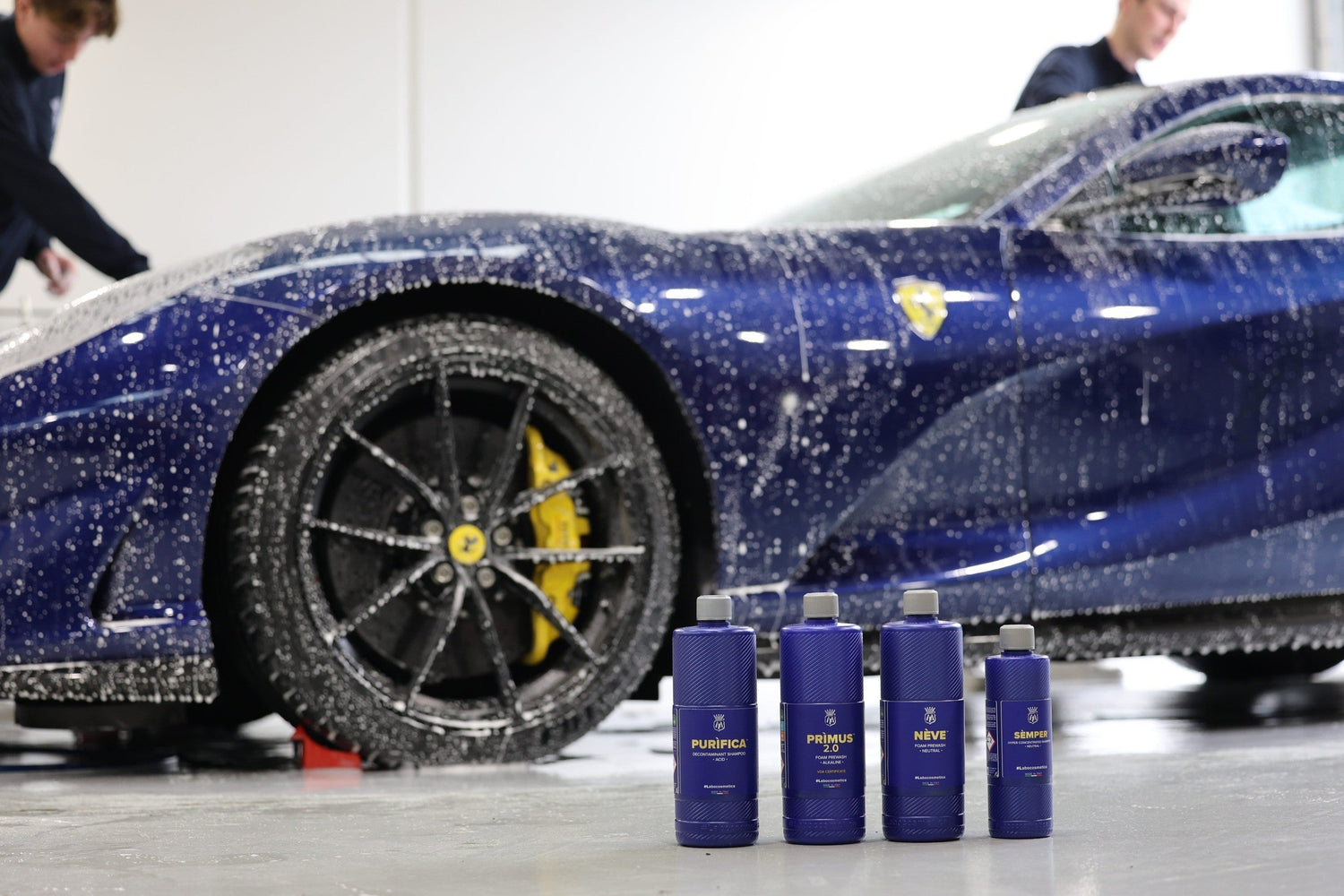
Every bottle in this industry is sold to you on a number, a colour or a smell. pH 2. pH 12. Cherry. Purple. Almost none of it is sold to you on what is actually inside — which is the only thing that decides whether the product cleans your car or quietly damages it.
This is the reference we keep in the studio, written out and split into chapters. Each one takes a category you actually buy — pre-wash, wheels, glass, shampoo, polish — and works through what is in the bottle, ranked from this is what good formulation looks like down to we will not sell this. Then it puts our own products on the same scale so you can see where they land, including where a cheaper brand beats a dearer one.
Paolo has a chemistry degree, and the range is stocked on this basis rather than on brand loyalty. Start here for the framework that applies to every category, then go to the chapter you need.
Six things worth knowing before you read any label again.
pH is a starting point, not a verdict. The hazard classification rules themselves say so — a pH below 2 or above 11.5 only presumes corrosivity, and the presumption is overturned by measuring acid or alkali reserve.
The active ingredient decides everything. Two pre-washes at pH 12 can behave completely differently depending on whether that alkalinity comes from caustic soda or from an inhibited surfactant and builder package.
Charge predicts behaviour. Anionics clean, cationics cling, nonionics degrease and wet, amphoterics support. Four words that explain most of what a product will do.
Dilution and dwell move aggressiveness more than pH does. Concentration and contact time are the two variables almost nobody controls and almost everybody blames the product for.
An SDS is a safety document, not a recipe. Use it to rule ingredients in. "It's not on the SDS" is weak evidence that something is absent.
If we cannot source a claim, we do not print it. There are several places in these chapters where we say the industry's favourite fact is unverifiable. That is deliberate.

The handbook, by category
Snow Foams & Alkaline Pre-Wash — why sodium hydroxide is the ingredient to avoid, why sodium metasilicate is the one almost everybody has backwards, and where Primus, Koch AF, Kraken Blizzard, Touch-Less and GSF sit against each other.
Wheel Cleaners & Iron Removers — the acids ranked, why hydrofluoric acid and ammonium bifluoride are the only true never, what GM's own bulletin says about acid wheel cleaners, and what the purple in an iron remover actually is.
Glass Cleaning — the six components of a proper automotive glass cleaner, the glycol ether distinction that matters, why ammonia is optional, and why cerium oxide rather than alumina does the polishing.
Polishing Compounds — what the abrasive actually is, what "diminishing" really describes, what a filler is and when it costs you money, and the eight-micron number that should govern how often you correct a car.
Shampoos & Surfactants — the four families in detail, which ones we want to see and which we will not stock, and the cationic deposition trick behind "coating restorers" that bead instantly and then stop.
Chelators, Solvents & Reading an SDS — the quiet ingredients nobody markets, why GLDA and MGDA are on good labels and NTA is not, and how to read a safety data sheet in two minutes.
Why pH alone cannot tell you whether something is corrosive
This is not a detailing opinion. It is written into the hazard classification rules that govern every label in this country.
Under GHS — as implemented in both the US OSHA Hazard Communication standard and the EU CLP regulation — a pH of 2 or below, or 11.5 or above, creates a presumption of skin corrosion or serious eye damage. Both texts immediately qualify it. OSHA's wording: extremes of pH "may indicate skin effects, especially when associated with significant buffering capacity", and "if consideration of alkali/acid reserve suggests the substance or mixture may not be corrosive despite the low or high pH value, then further evaluation may be necessary." CLP says the same thing about eye damage.
pH tells you where the reaction starts. Acid or alkali reserve tells you how long it can keep going.
Acid reserve and alkali reserve are measured by titration — how much neutralising agent it takes to bring the product back into the pH 4 to 10 range, expressed as millilitres of titrant per 100 mL of product. Two products at pH 12.2 behave completely differently depending on that number: the one with little buffering neutralises almost as soon as it meets soil, water and the surface, while the one with a large alkali reserve keeps regenerating its hydroxide concentration and stays caustic for as long as it is wet.
Which is why the pH figure on the front of a bottle is the least useful number in this trade, and why a VDA-certified pre-wash can sit at pH 11 and be safer on your trim than a supermarket product at pH 9.
What is the active? Sodium hydroxide at pH 11 and an inhibited alkaline surfactant system at pH 11 are not the same product in any meaningful sense.
How much reserve is behind it? A buffered system holds its working pH through the job. A lightly buffered one gives up its strength to the first thing it touches.
What else is controlling it? Silicates protecting aluminium, chelators tying up hardness so surfactants can work, inhibitors — all doing real work the pH number cannot show you.
And then: dwell, dilution, temperature and substrate. These move aggressiveness far more than a point of pH does.
We wrote the practical version of this argument in our acid, neutral or alkaline framework, and put six real snow foams from pH 3 to 13 side by side in the snow foam comparison. These chapters are the ingredient-level version of the same point.
The languageSurfactants: the four families, in one table
Every cleaning product on your shelf is built around surfactants. A surfactant molecule has two ends — one that gets along with water, one that gets along with oil — and it works by parking itself at the boundary between them, lifting oily soil off the paint and holding it in suspension until you rinse.
They are classified by the electrical charge on the water-loving head, and that single property predicts most of the product's behaviour:
The memory rule we teach in the class is four words long: anionics clean, cationics cling, nonionics degrease and wet, amphoterics support. Mix an anionic and a cationic in the same bottle and they neutralise each other and drop out of solution — which is exactly why a strongly cationic product is rarely also a strong cleaner. The full treatment, family by family, is in the shampoo chapter.
The listTwenty ingredients worth learning first
If you memorise nothing else from this handbook, memorise these. Between them they account for most of what is in most bottles in most detailing cupboards in the country.

We only stock brands we know work, and we are comfortable selling anything in the store. But we do have favourites and we will tell you which and why. Recommendations get weighed on three things: what the job requires, what the budget will carry, and the individual case. Price alone is not the only factor, and the dearest bottle is not automatically the answer — several chapters here end with a cheaper product winning on merit.
We are a free source of information whether or not you buy anything, and we test this range in a working studio every day rather than reading data sheets about it.
Send us the label. We'll tell you what's in it.
Photograph the back of any bottle — ours or somebody else's — and send it through. We'll tell you what the active is, whether it belongs on your car, and where the honest cheaper option sits. No purchase needed, and we'll say so if the answer is the product you already own.
Does pH tell you how corrosive a car cleaning product is?
No — pH is only the starting point. The GHS classification rules used in Australia, the EU and the US treat a pH at or below 2, or at or above 11.5, as a presumption of corrosivity, and both the OSHA and CLP texts say that presumption must be checked against the product's acid or alkali reserve. Reserve is measured by titration: how much neutralising agent it takes to bring the product back into the pH 4 to 10 range, expressed as millilitres per 100 mL. Two products at pH 12 can behave completely differently — a lightly buffered one gives up its alkalinity to the first thing it touches, while one with a large alkali reserve stays caustic for as long as it is wet. The active ingredient, the buffering, the dilution and the dwell time all matter more than the number on the front label.
What are the four types of surfactant in car care products?
Anionic, nonionic, amphoteric and cationic, classified by the electrical charge on the surfactant's water-loving head group. Anionics carry a negative charge and provide foam, detergency and soil suspension — they are the backbone of shampoos and snow foams. Nonionics carry no formal charge and are the best wetters and degreasers, which is why they dominate glass cleaners, all-purpose cleaners and pre-washes. Amphoterics such as cocamidopropyl betaine change character with pH and are used to improve foam quality, mildness and hard-water compatibility. Cationics carry a positive charge, adsorb onto surfaces and are used for deposition rather than cleaning. Anionics and cationics neutralise each other in solution, so a strongly cationic product is rarely also a strong cleaner.
Why does a pH 11 pre-wash sometimes damage less than a pH 9 one?
Because the pH number describes the concentration of hydrogen ions, not what is producing it or how much buffering sits behind it. A pre-wash whose alkalinity comes from free sodium hydroxide will dissolve the protective oxide layer on aluminium and attack bare alloy and trim. A pre-wash at the same or higher pH built on alkaline surfactants, carbonate and silicate builders and chelators can pass independent material-compatibility testing against paint, alloys, trim, rubber and coatings. Dwell time, dilution, temperature and the substrate involved all move real-world aggressiveness more than a point or two of pH does.
What is the single most important thing to check on a car care product label?
The active ingredient, which usually means downloading the safety data sheet rather than reading the bottle. Section 3 lists hazardous ingredients with CAS numbers and concentration bands — search it for fluoride and bifluoride, hydroxide, thioglycolate and NTA. Section 2 gives the finished mixture's hazard classification, which is the difference between an irritant and something corrosive. The limitation to understand is that an SDS is a safety document, not a formulation sheet: non-hazardous ingredients and anything below the disclosure threshold will not appear at all, so use it to rule ingredients in rather than to rule them out.
Are expensive car care products actually better?
Sometimes, and not reliably. Certification and formulation quality genuinely cost money — independent material-compatibility testing, readily biodegradable chelators and inhibited alkaline systems are all real expenses that show up in the price. But several categories have cheaper products that match or beat the premium option on merit, and a neutral encapsulating pre-wash costing a fraction of a certified alkaline one can be the better choice on a coated car. Judge a product on what it is formulated to do to the surfaces you own, not on where it sits on the price list.
This is a practical formulation reference, not a recipe book — ingredient safety depends on concentration and on the complete formulation, not on the name alone. Every technical claim in this handbook was checked against primary sources before publication: regulatory texts, patent and peer-reviewed literature, manufacturer technical data and safety data sheets. Each chapter carries its own source list.
For this page: OSHA Hazard Communication Standard Appendix A §A.2.3.1 and EU CLP Regulation Annex I §3.3.3, on the pH presumption and acid/alkali reserve.

Leave a comment
This site is protected by hCaptcha and the hCaptcha Privacy Policy and Terms of Service apply.