
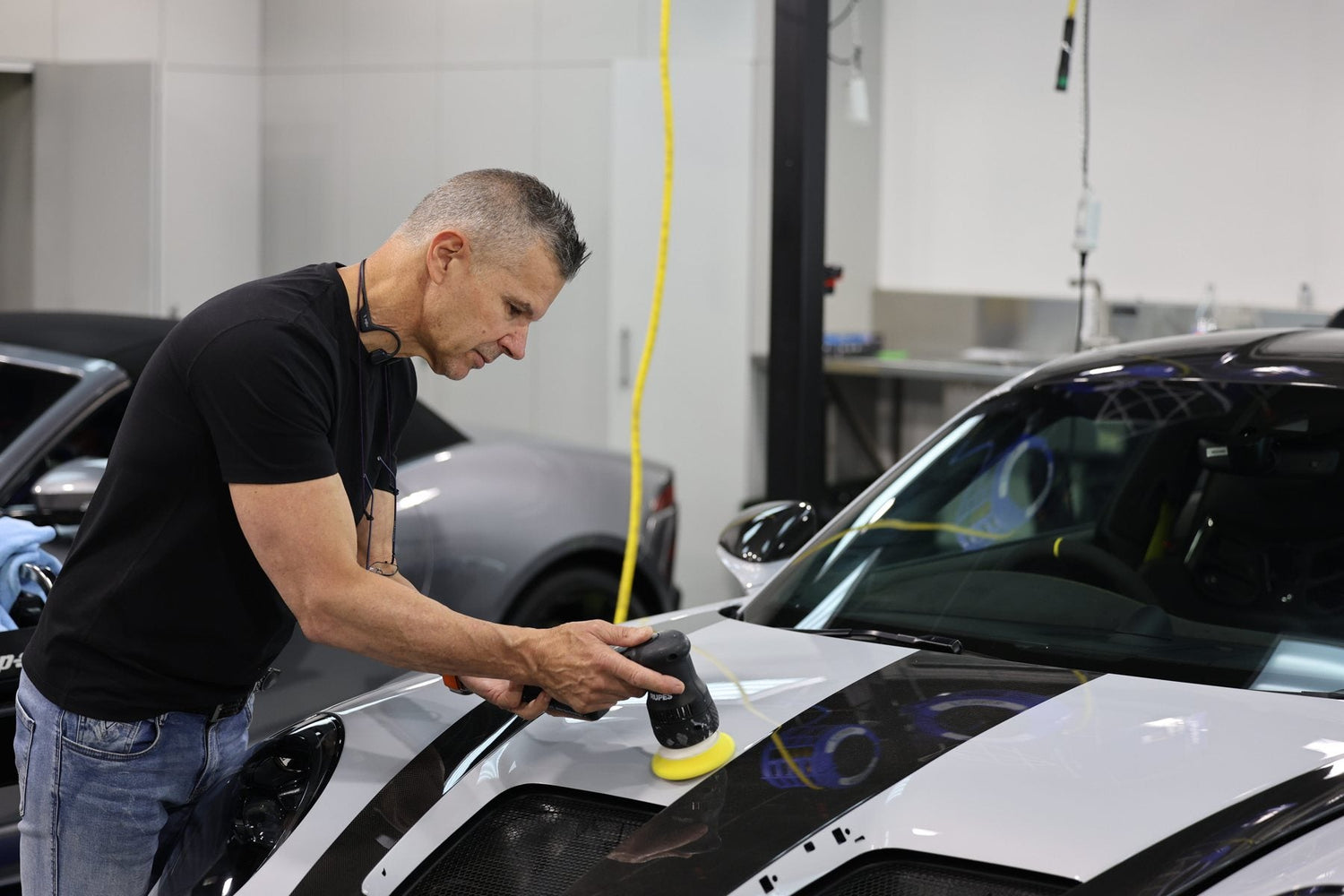
A polishing compound is a different kind of product to everything else in the cupboard. It is not lifting soil off a surface — it is abrading the surface itself. Once material is gone it is gone, and you have roughly eight microns of clearcoat to spend across the entire life of the car.
So the ingredient questions change. What is the abrasive, how does it behave as you work it, what is carrying it, and what does it leave behind. This chapter answers all four, ranks the options, and puts our own compounds on the same scale. It is part of our car care chemistry handbook.
Eight things worth knowing before the pad touches the paint.
Paint compounds are aluminium oxide. Glass compounds are cerium oxide. Not interchangeable, and ceria works on glass by chemistry rather than hardness.
"Diminishing abrasive" is aggregate breakdown, not crystal fracture. Porous clusters break into their smaller constituent particles as you work them.
Fillers are real and manufacturers say so. Some polishes list carnauba wax and non-volatile silicones in their own product copy.
Less than 0.001% silicone is enough to cause fisheye craters in refinish paint. That is the paint manufacturer's figure, not ours.
Most compounds are oil-carried, so the panel wipe before a coating is mandatory. This is the step most often skipped when a coating later "fails".
Clearcoat glass transition is around 80 °C. Push a panel toward it and the paint stops behaving predictably under the pad.
You have about 8 µm of clearcoat to remove — for the life of the car. That is the number that should govern how often you correct it.
There is no independent measurement of any consumer polish's cut rate. Every claim in this category, from every brand, is the manufacturer's own. We will say so.

What the abrasive actually is
Automotive paint compounds are built on aluminium oxide — alumina, Al₂O₃. 3M say so directly of their Perfect-It compounds ("the same mineral used in many of our top-performing abrasive discs"); Meguiar's list it at 10–30% on the M105 safety data sheet; Koch-Chemie describe "a unique aluminium oxide quality" and, in their own technical blog, "new types of aluminum oxides" and "the agglomerates of the aluminum oxides". Alumina sits at Mohs 9 with a Knoop hardness around 2100 — vastly harder than clearcoat, which is the point.
Glass is a different mineral entirely. Glass compounds use cerium oxide, and ceria is softer than alumina — nanoindentation puts it around 6.4 GPa. It works on glass not by being hard but by chemistry: ceria forms an actual chemical bond with the silica surface, Ce–OH + SiO⁻ → Ce–O–Si + OH⁻, and lifts silica away molecularly. That chemical tooth is why ceria polishes optical glass and windscreens and alumina does not. The full glass treatment is in the glass chapter.
Silicon carbide and diatomaceous earth get named regularly in detailing content as polish abrasives. We went looking for a manufacturer document or a safety data sheet putting either into a liquid automotive paint compound and found none. Silicon carbide's documented automotive use is in abrasive paper. If somebody tells you their polish is silicon carbide based, ask to see the data sheet.
Diminishing versus uniform abrasives
The "diminishing abrasive" idea — that particles break down as you work them, so cut falls away and the finish improves through one set — is real, and it is more specific than most people realise. It is not the individual crystal fracturing. It is porous aggregates breaking apart into their smaller constituent particles. Saint-Gobain's automotive finishing patent describes engineering exactly this: porosity "can allow the powder aggregates/particles to breakdown during use", with a deliberately multimodal particle distribution so the same product delivers cut early and refinement late.
Manufacturers instruct for it, too. Koch-Chemie's own directions for M3.02 say to work the polish "until a transparent film appears, indicating complete abrasive breakdown". If you stop early, you have not finished the product's job — and half the "this polish leaves haze" complaints are exactly that.
The widely repeated framing that "SMAT means non-diminishing and DAT means diminishing" lives almost entirely on forums. Meguiar's own technical bulletin says only "super-micro abrasive technology" and defines nothing further. Engineered uniform abrasives are a genuine formulation strategy — but we could not find a single independent, third-party measurement of particle size or cut rate over time for any consumer polish. Every claim in this category, from every brand including the ones we sell, is the manufacturer's own. Treat it accordingly.
Fillers, silicones, and when they cost you money
Fillers are the most-argued topic in polishing, and the argument is settled by reading manufacturers' own product copy. Some polishes contain waxes, oils, silicones, polymers and dyes that sit in the remaining defects and make a panel look better than it has been corrected. Koch-Chemie state outright that their P3.01 contains "carnauba wax and non-fugitive silicones" and P6.02 "carnauba wax and non-volatile silicones". Menzerna advertise the opposite: their polishes "do not contain any silicones or fillers", so scratches are "permanently removed... rather than temporarily covered".
Neither is dishonest. A wax-and-silicone one-step finishing polish is a perfectly reasonable product for a used-car yard or a quick enhancement. It is the wrong product in three situations, and this is where it costs real money:
Before a ceramic coating. The coating has to bond to the clearcoat, not to a layer of wax and silicone oil sitting in the scratches. Anything left behind is a weak boundary layer between the coating and the paint — and it is a common reason a coating looks fine on day one and stops behaving by month three.
Before refinish work. Documented by the paint manufacturers themselves. PPG describe fisheyes as craters "caused by variations in the surface tension of the paint", with "silicone in the environment or on the surface of the substrate; even minute traces are sufficient". Their supplier training puts the threshold at less than 0.001%. The American Coatings Association note that silicone oils "are so highly surface active and mobile that they must be kept away from paint, paint plants, and auto plants."
When you are assessing your own work. If you cannot see what you actually corrected, you cannot tell whether you are finished. A filler-free polish tells you the truth while you are still holding the machine.
One honesty note: the specific claim that filled swirls "come back after two or three washes" is a manufacturer assertion, widely repeated, that we could not find independently measured. The mechanism is not in doubt; the timeline is not published.

Oil-carried, water-carried, and why the panel wipe is not optional
Compounds are carried in either an oil and solvent base or a water base, and it is worth knowing which you have. Koch-Chemie's H9.02 safety data sheet lists white mineral oil at 10–25% and C10–C13 hydrocarbons at 10–25%, with no water in the composition — that is an oil-carried compound, and a very good one. Labocosmetica's FIERO is described by the maker as "an innovative and refined water-based primer without wax or silicones". Rupes describe their rotary fine compound as a "water-soluble abrasive formula".
Whichever it is, the residue has to come off before a coating goes on. Every coating manufacturer instructs a panel wipe as a mandatory step, and it is the step most often skipped when a coating later fails. A dedicated prep solvent such as VERITAS — an isopropanol and glycol-ether blend — or a proper IPA dilution is what removes polishing oils. Note the useful detail on FIERO specifically: Labocosmetica state it is "not affected by IPA", meaning the bonding layer it leaves survives the wipe that removes everything else.
The limitsHeat, and how much clearcoat you actually have
Two numbers are worth carrying in your head.
The first is glass transition temperature. An automotive OEM presentation hosted by NIST gives body clearcoat a Tg of around 80 °C — and only about 20 °C for the clearcoat over TPO trim, which is why bumpers behave differently to panels. Below Tg the clearcoat is glassy and abrades predictably. Push a panel toward Tg and it softens, behaves differently under the pad, and defects you thought you had removed can reappear as it cools. Modern polyurethane clearcoats also genuinely recover 80–90% of a scratch's shoulder height and trough depth over time, against 35–60% for older acrylic-melamine systems — but recovery is not repair, and nothing heals a crack once the coating has fractured.
The second is thickness.
Eight microns. That is the entire budget, spread across every correction the car will ever receive.
That number is why a paint depth gauge belongs in any serious correction, and why we correct a car once, properly, and then protect it rather than polishing it every year. We could not find an authoritative measured figure for how much a single polishing step removes — everything published on that is forum estimate — but the budget itself is real and it is small.

Where our compounds land on that scale
Koch Chemie H9.02 → F6.01 → M3.02
The cut/gloss numbering is the most useful thing in polishing retail. H9.02 is cut 9.0 gloss 6.0 and removes P1200 sanding traces; F6.01 is 6.0/7.0 to P2500; M3.02 is 3.2/9.0 to P3000. You can build a two- or three-step system without guessing. All three are silicone-oil-free per Koch's own technical data. These are oil-carried, so the panel wipe afterwards is mandatory.
A water-based finishing polish and coating primer that the maker states contains no resins, no fillers and no waxes or silicones — and, usefully, is "not affected by IPA", so the bonding layer survives the panel wipe that strips everything else. Labocosmetica describe the bonding mechanism as a self-assembled monolayer (SAM); that is the coating-adhesion claim, and their abrasive system is named separately. Worth getting right, because the two get conflated constantly.
Koch Chemie B9.01 Heavy Quick Cut · cut 9.0, gloss 5.5
The aggressive option when defect removal matters more than the finish left behind, because a refining step is coming anyway. Silicone-free like the rest of the H/F/M/B family.
Sonax Profiline Perfect Finish
Sonax state it silicone-free and rate it to remove sanding marks to P2000 in a single stage. A body-shop tool — it was developed for one-stage polishing of sanded paint in paint shops — that works well in a detailing context.
Labocosmetica VITREO · cerium oxide
The glass compound. Rotary, low speed, kept wet, minimal pressure, and never more than twice over the same area in succession. Do not try to do this job with a paint compound — different mineral, different mechanism, and glass is unforgiving of heat.
Koch Chemie P3.01 and P6.02
Both are perfectly good products and Koch are open about what is in them: carnauba wax and non-volatile silicones. That makes them the wrong tool for the work we do, which nearly always ends with a coating or a film going on. We keep the silicone-free H, F, B and M series instead. Products, not brands — the same reason we carry Koch in full range and still refuse one of their wheel cleaners.
The polyester-versus-polyether urethane distinction is real in the foam industry — polyether resists hydrolysis better, polyester resists solvents better, which maps neatly onto water-carried versus oil-carried compounds. But we could not find a single detailing pad manufacturer who states which chemistry they use. Lake Country publish reticulated versus non-reticulated structure, their CCS dimple pattern and wool composition, and nothing about the urethane itself. Treat the foam-chemistry argument as general polymer science, not as a claim about anyone's pads.
Paolo's separate point, and it is a commercial one rather than a chemical one: detailers routinely save a couple of hundred dollars on a polishing machine and then pay it back many times over in vibration through the arms and hours of extra labour. The cheaper first cost is often the more expensive decision.
Tell us the paint and the defect
Soft Japanese clear, hard German clear, a repaint of unknown age, or a new car that just needs the transit film off. The compound, the pad and the number of steps all change with it — and sometimes the honest answer is that it does not need correcting at all.
What abrasive is used in car polishing compounds?
Aluminium oxide, in essentially every automotive paint compound. 3M state it directly for their Perfect-It range, Meguiar's list it at 10–30% on the M105 safety data sheet, and Koch-Chemie describe their own aluminium oxide quality and its agglomerates. Alumina sits at Mohs 9 with a Knoop hardness around 2100, far harder than clearcoat. Cerium oxide is the glass abrasive and is not interchangeable — it is softer than alumina and works chemically rather than mechanically, forming Ce–O–Si bonds with the silica surface. Claims that car polishes are based on silicon carbide or diatomaceous earth could not be substantiated from any manufacturer document or safety data sheet.
What does "diminishing abrasive" actually mean?
It describes porous abrasive aggregates breaking apart into their smaller constituent particles as the polish is worked, so cut is high early and the finish refines late within a single set. It is aggregate breakdown, not individual crystals fracturing. Saint-Gobain's automotive finishing patent describes engineering exactly this, using porosity so that "the powder aggregates/particles" break down during use, with a deliberately multimodal particle size distribution. Manufacturers instruct for it too — Koch-Chemie's directions for M3.02 tell you to work the product until a transparent film appears, indicating complete abrasive breakdown. Stopping early is a common cause of haze blamed on the product.
What does "filler-free polish" mean and does it matter?
It means the compound contains no waxes, oils, silicones, polymers or dyes that temporarily fill remaining defects and make a panel look better corrected than it is. Fillers are real and manufacturers are open about them — Koch-Chemie state that P3.01 and P6.02 contain carnauba wax and non-volatile silicones, while Menzerna advertise that their polishes contain no silicones or fillers. A filled polish is a legitimate product for a quick enhancement, but the wrong choice before a ceramic coating, before refinish work, or when you are trying to judge your own correction honestly.
Why does silicone in a polish matter before painting?
Because it causes crater and fisheye defects in fresh paint, and the threshold is astonishingly low. PPG describe fisheyes as small crater-like holes "caused by variations in the surface tension of the paint", with silicone on the substrate being sufficient in "even minute traces", and their supplier training puts the figure at less than 0.001%. The American Coatings Association explain the mechanism as a surface tension gradient that causes wet paint to flow away from the contaminated spot, and note that silicone oils are so surface-active and mobile that they must be kept away from paint entirely. The same reasoning applies to ceramic coatings, which need to bond to clearcoat rather than to a silicone film.
How much clearcoat can you safely polish off a car?
Very little. A typical OEM paint system runs about 100–110 microns total, of which the clearcoat is roughly 45 microns; paint-gauge manufacturer DeFelsko put factory systems at 100–180 microns total with clear at 35–50 microns, and note that most vehicle manufacturers recommend removing no more than about 8 microns of clearcoat over the vehicle's entire life, to preserve the UV absorbers protecting the colour and primer beneath. That 8-micron figure is a lifetime budget across every correction the car will receive, which is why a paint depth gauge belongs in any serious correction and why annual polishing is a bad idea. How much a single step removes has no authoritative published figure.
Can polishing damage paint through heat?
Yes, and the mechanism is the glass transition temperature. An automotive OEM presentation hosted by NIST gives body clearcoat a Tg of around 80 °C, and only about 20 °C for clearcoat over TPO trim such as bumpers. Below Tg the clearcoat is glassy and abrades predictably; as a panel is driven toward Tg it softens, behaves differently under the pad, and defects that appeared removed can reappear as the panel cools. Modern polyurethane clearcoats also recover 80 to 90 per cent of a scratch's depth and shoulder height over time, against 35 to 60 per cent for older acrylic-melamine systems — but recovery is not repair, and no clearcoat heals a crack once it has fractured.
Do you have to wipe a panel down after polishing and before a coating?
Yes, and it is the step most often skipped when a coating later underperforms. Most compounds are oil-carried — Koch-Chemie's H9.02 safety data sheet lists white mineral oil at 10 to 25 per cent and C10 to C13 hydrocarbons at 10 to 25 per cent with no water at all — and that residue sits between the coating and the clearcoat if it is not removed. Every coating manufacturer instructs a panel wipe with a dedicated prep solvent or an isopropanol dilution before application. One useful exception to know: Labocosmetica state that FIERO is "not affected by IPA", meaning its bonding layer survives the wipe that removes everything else.
3M Perfect-It product documentation · Meguiar's M105 safety data sheet and technical bulletin · Koch-Chemie technical data sheets, safety data sheets and ExpertBlog · Saint-Gobain US Patent 11,130,682 on automotive finishing aluminas and aggregate breakdown · Buehler metallographic abrasive technical literature · Washington Mills and Dawson-MacDonald abrasive hardness data · published nanoindentation hardness data for cerium oxide and peer-reviewed ceria CMP literature · PPG Refinish fisheye documentation and PPG supplier crater-prevention training · American Coatings Association on automotive coating application defects · Menzerna technical FAQ · Nichols, automotive OEM paint materials and processes (hosted by NIST), for layer thicknesses and clearcoat glass transition temperature · Coatings 2012, 2, 221, on clearcoat scratch recovery · DeFelsko, paint thickness measurement in detailing · Labocosmetica, Sonax, Rupes and Lake Country official product documentation.

Leave a comment
This site is protected by hCaptcha and the hCaptcha Privacy Policy and Terms of Service apply.