Every cleaning product on your shelf is built around surfactants — and the electrical charge on one end of that molecule predicts most of what the product will do to your car. Learn four families and you can read a shampoo label better than most people selling them.
This chapter covers the four surfactant classes in detail, ranks the individual surfactants from what we want to see down to what we will not stock, and then explains the deposition trick behind "coating restorers" that bead brilliantly for a fortnight. It is part of our car care chemistry handbook. If you want the product-by-product comparison instead, we put four neutral shampoos through one car separately.
Seven things that explain what a shampoo will actually do.
Anionics clean, cationics cling, nonionics degrease and wet, amphoterics support. Four words that cover most of the category.
Anionics and cationics cancel each other out in solution. Which is why a strongly cationic product is rarely also a strong cleaner.
Past the critical micelle concentration, more shampoo does not mean more cleaning. It means more product down the drain.
"pH-neutral" does not mean chemically inactive. Cleaning strength comes from the surfactant package, the solvents and the chelation as much as from pH.
Lubrication matters more than foam. A shampoo's real job in a contact wash is keeping grit sliding rather than dragging.
Nonylphenol ethoxylates are the one surfactant we won't stock. Restricted at 0.1% under REACH, and Australia's own assessment flagged an unreasonable aquatic risk.
Instant beading from a "restorer" may be a deposited film, not a restored coating. Water beading cannot tell the two apart.

The four families, and why charge predicts behaviour
A surfactant molecule is amphiphilic: it has a water-compatible head and an oil-compatible tail. It works by parking itself at the boundary between the two, burying the tail in the oily road film and facing the head into the water, so the soil is lifted off the paint and held in suspension until you rinse.
They are classified by the charge on that water-loving head in water — which is a distinction worth holding onto, because it says nothing about whether the finished surface ends up hydrophobic.
The consequence people trip over: mix an anionic and a cationic in the same bottle and they neutralise each other and drop out of solution. That is why a strongly cationic product is rarely also a strong cleaner, and why a "wash and protect" shampoo is always a compromise between the two halves of its name.
CMC — critical micelle concentration. Below it, surfactant molecules float around individually. Above it they organise into micelles, the tiny spheres that actually carry oily soil. Past that threshold, adding more shampoo does not linearly increase cleaning — it increases what goes down the drain. Almost everyone over-doses their bucket.
HLB — hydrophilic-lipophilic balance. A number that predicts whether a nonionic will wet a surface, emulsify oil or solubilise it. It is why one nonionic ends up in a glass cleaner and a chemically similar one ends up in a degreaser.
Hydrotrope. The ingredient that keeps a concentrated mixed system in solution. It is why a hyper-concentrate does not separate in the bottle, and why some concentrates mix straight into cold hard water while others need agitating.
Which surfactants we like seeing, in order
Alkyl polyglucosides (APG)
Nonionic, made from plant sugar and fatty alcohol. Mild, excellent hard-water tolerance, readily biodegradable, and pleasant to work with all day. This is the modern premium-shampoo workhorse and one of the things that separates a properly formulated concentrate from a cheap one.
Alcohol ethoxylates (AEO)
The nonionic that does the real degreasing in a glass cleaner, an APC or a pre-wash. Strong wetting, strong oily-soil emulsification, and markedly better ultimate biodegradation than the nonylphenol chemistry it replaced.
Cocamidopropyl betaine (CAPB)
Amphoteric. Rarely the main cleaner — it is there to improve foam quality, soften the anionic package and keep the formula tolerant of hard water. Its presence is a sign somebody formulated rather than mixed.
SLES / AOS — sodium laureth sulfate, alpha olefin sulfonate
Anionic foamers and detergents. AOS is the more robust of the two across a wide pH range, which is why it survives in acidic and alkaline foams where other anionics would not. Nothing wrong with either.
LAS / SDBS — linear alkylbenzene sulfonate
The strong, cheap anionic detergent behind most heavy traffic-film cleaners. Effective and readily biodegradable, but harsher on skin and on protection layers than the nonionics above. A tool, not a default — and not what you want in a maintenance shampoo on a coated car.
Amine oxides
Behave amphoterically — nonionic at neutral pH, cationic when protonated in acid. Very good wetting and foam boosting, common in glass and hard-surface cleaners.
DOSS — dioctyl sodium sulfosuccinate
Anionic, and one of the fastest wetting agents available. Genuinely useful in touchless and rinse-aid chemistry. We would rather see it in a professional product used to a ratio than in a consumer bottle used by eye.
Quaternary ammonium compounds (quats)
Cationic. Legitimate in a drying aid or a rinse aid, where the whole point is deposition. Our issue is not the chemistry — it is when deposition is sold to a customer as chemical restoration. See below.
Nonylphenol ethoxylates (NPE / NPEO)
An old, cheap, effective nonionic. It degrades to nonylphenol, which is classified as an endocrine disruptor. The EU restricts NPEs at and above 0.1% in cleaning products under REACH Annex XVII, and Australia's own IMAP assessment concluded industrial use "may pose an unreasonable risk to the aquatic environment", with a riverine risk quotient over 14. Alcohol ethoxylates and APGs do the same job.
Cationic deposition and "false restoration"
This is the section that most often changes how somebody buys.
A cationic surfactant carries a positive charge. Most surfaces relevant here carry a net negative charge in water, so the cationic head adsorbs strongly and the hydrophobic tail is left pointing outward. Colloid chemistry has documented this for decades on silica, mica and mineral substrates: cationic surfactants "can induce strong hydrophobization of otherwise hydrophilic surfaces." Applying that finding to automotive clearcoat is an extrapolation on our part rather than a measured result, and we will say so — but the mechanism is real and the industry uses it deliberately in drying aids and rinse aids.
Here is the consequence. A customer whose coating has stopped beading buys an acidic "coating restorer" or "reviver". They use it. The water beads again, immediately and dramatically. Two things could have happened:
Mechanism one · genuine
The product removed mineral scale, alkaline residue and traffic film that were sitting on top of a perfectly healthy coating and masking it. The coating was always there. What you have done is uncover it. This is real, it is common, and it is the honest case for an acid maintenance step.
Mechanism two · deposited
The product laid down a hydrophobic film — cationic, silicone, siloxane or polymer — on top of whatever is underneath. The contact angle went up. Nothing was rebuilt. It will wash off, and the customer will conclude their coating "failed" a second time.
Water beading cannot distinguish between a coating that has been uncovered and a film that has been deposited. Both look identical, and both look like success.
This is not an argument against maintenance products — we sell them and use them weekly. It is an argument against reading beading as proof of anything. If you want the diagnostic protocol we actually use on a customer's car, including the decon-then-retest sequence and the residue-free panel wipe that makes the retest valid, it is in is your ceramic coating actually on your car.
Fabric softener is cationic surfactant chemistry doing exactly this on purpose — depositing a hydrophobic film onto fibres. Which is why a microfibre towel washed with softener stops absorbing water, smears glass, and cannot be rescued by washing it again in a hurry. Wash microfibre with a dedicated detergent, no softener, ever.
What a properly built pH-neutral shampoo contains
pH-neutral does not mean chemically inactive or automatically "safe". Cleaning strength depends on the surfactant package, the solvents, the chelation, the concentration, the dwell and the substrate — as much as on pH. A neutral shampoo with an aggressive anionic package and a high dose can strip a wax perfectly well. We wrote the longer version of this in why pH-neutral isn't the whole story.

Where our shampoos land
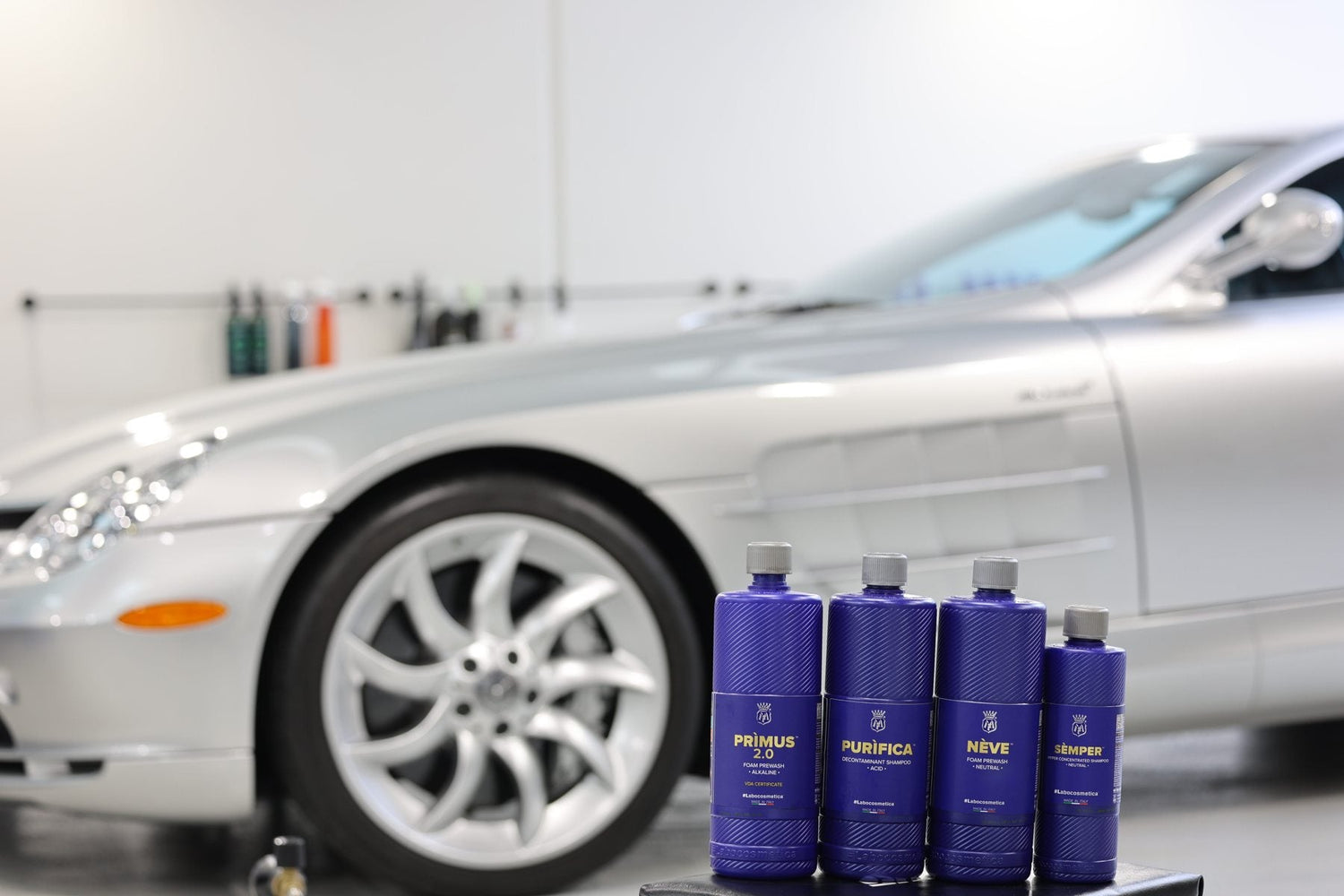
Labocosmetica SEMPER · 1:1500
Hyper-concentrated and pH neutral, and the dilution figure is the point — at 1:1500 the cost per bucket is trivial and the surfactant package is doing the work rather than the volume. This is the bucket product in the 3-pH system; NEVE is the foam. Getting those two the wrong way round is the single most common error we correct on kit builds.
A pH-neutral concentrate from the brand that publishes more usable technical detail than anyone else in this category. Straightforward, well-formulated, and priced without a certification premium attached.
Australian-made, pH neutral, and one of the very few products in this entire category whose maker publishes a foam cannon dilution rather than only a bucket ratio — 1:10, which works out around 90 cents a cannon fill on the 10 litre size. That transparency is rare enough to be worth rewarding.
Maniac Line Neutral Foam Shampoo · pH 7
Wax-safe, high foam, well lubricated, and cheap. When the job is a straightforward maintenance wash on a protected car, this is a perfectly honest answer and there is no need to spend more.
Labocosmetica SATINO and Maniac Line BLACK & WRAP
Matte, satin and wrapped finishes need a shampoo with no gloss enhancers, no waxes and nothing that will build a shine into a surface designed not to have one. This is a genuine formulation difference rather than a marketing variant.
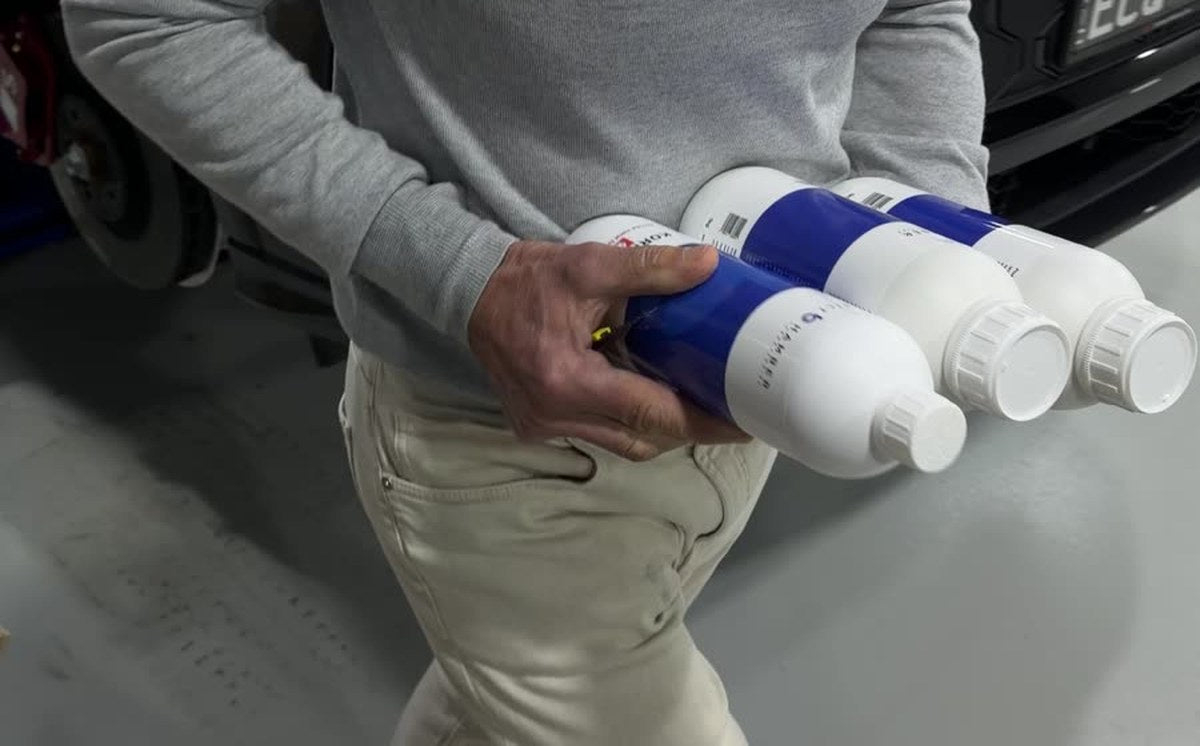
"Wash and seal" and ceramic shampoos — Maniac Ceramic, Koch NanoMagic, Bilt Hamber Touch-On
These are perfectly good products and we sell plenty of them. Just understand what they are: a shampoo that also deposits something. That is the anionic-versus-cationic compromise described above, and it means the beading you get afterwards is deposited, not evidence about the coating underneath. Excellent as maintenance on a protected car; not a diagnostic.
Tell us your water and your paint
Hard tank water, a coated daily, a wrapped car, or a black car that shows everything — the right shampoo changes with each, and the concentrate you already own may well be the answer at a different ratio.
What are the four types of surfactant in car shampoo?
Anionic, nonionic, amphoteric and cationic, classified by the electrical charge on the surfactant's water-loving head group. Anionics carry a negative charge and provide foam, detergency and soil suspension — sodium laureth sulfate and alpha olefin sulfonate are the common ones. Nonionics carry no formal charge and are the best wetters and degreasers, with alkyl polyglucosides and alcohol ethoxylates the modern choices. Amphoterics such as cocamidopropyl betaine change character with pH and improve foam quality, mildness and hard-water compatibility. Cationics carry a positive charge and are used for deposition rather than cleaning. Anionics and cationics neutralise each other in solution, which is why a strongly cationic product is rarely also a strong cleaner.
Does using more car shampoo clean better?
Only up to a point, and that point is called the critical micelle concentration. Below it, surfactant molecules are dispersed individually; above it they organise into micelles, the aggregates that actually carry oily soil away. Once you are past the CMC, adding more shampoo does not linearly increase cleaning — it mostly increases what goes down the drain and what you have to rinse off. Most people significantly over-dose their bucket. The manufacturer's stated ratio exists because somebody measured where that threshold sits for that particular formulation.
Does pH-neutral shampoo mean it is safe for a ceramic coating?
Not on its own. pH-neutral means the product sits near pH 7, which tells you nothing about the strength of the surfactant package, the solvents, the chelation or the dose you are using. A neutral shampoo built on an aggressive anionic detergent at a heavy dilution will strip a wax and degrade a sealant perfectly well. What actually protects a coating is a balanced surfactant package, a sensible ratio, no aggressive solvents and no strongly alkaline builders. pH is one variable among several, and it is the one printed on the bottle because it is the easiest to print.
Why does my "ceramic shampoo" make water bead so well?
Because it deposits something. Wash-and-seal or ceramic shampoos combine cleaning surfactants with a hydrophobic ingredient — often a siloxane, polymer or cationic component — that adsorbs onto the surface as you wash. That is a legitimate and useful product for maintaining a protected car. What it is not is a test of anything: the beading you see afterwards is the film the shampoo just laid down, not evidence about the condition of the coating underneath. If you are trying to work out whether a ceramic coating is still functioning, you have to decontaminate and panel-wipe first, and use nothing that deposits.
Can a "coating restorer" actually restore a ceramic coating?
It can genuinely uncover one, and it can also merely cover one. Two mechanisms produce identical-looking results. The honest one is that an acidic product removed mineral scale, alkaline residue and traffic film that were masking a perfectly healthy coating — the coating was always there and you have exposed it again. The other is that the product deposited a hydrophobic film on top of whatever remained, raising the water contact angle without rebuilding anything, in which case the effect washes off within weeks. Cationic surfactants are documented to hydrophobise negatively charged surfaces by adsorbing with their tails outward. Water beading cannot distinguish between the two outcomes.
Why should you never wash microfibre with fabric softener?
Because fabric softener is cationic surfactant chemistry doing deliberately what a "coating restorer" does accidentally — depositing a hydrophobic film onto the fibres. On microfibre that is a disaster: the towel stops absorbing water, it smears glass, and it drags rather than glides on paint. A single wash with softener can effectively ruin a set of drying towels, and it takes repeated washing with a proper detergent to strip the film back out, if it comes out at all. Use a dedicated microfibre detergent, no softener, no dryer sheets, and wash glass towels separately from anything used for dressings.
REACH Annex XVII entries 46 and 46a, nonylphenol and nonylphenol ethoxylates · AICIS/NICNAS IMAP Tier II environment assessment, nonylphenols · Shell technical presentation on alcohol ethoxylate versus NPE biodegradation · published colloid-science literature on cationic surfactant adsorption and surface hydrophobisation · surfactant manufacturer technical literature on APG, alcohol ethoxylate and betaine chemistry · manufacturer product documentation for the products named.

Leave a comment
This site is protected by hCaptcha and the hCaptcha Privacy Policy and Terms of Service apply.