Someone left a comment on our Instagram this week that was fair enough to sting a little. Paraphrasing: it would be great if your website had a list of what you use, what for, and when — because I could buy four different neutral car washes on your site and not know which one to pick.
They were being generous. We stock more than twenty shampoos that could honestly call themselves pH neutral. If you land on our store cold, that isn't a range, it's a wall.
So here is the guide that should already have existed. It is not a chemistry lecture about pH — nearly every maintenance shampoo on the shelf is neutral, so that tells you nothing. It is about the thing you actually have to choose between: brands. What separates them, what it costs to run each one, and which parts of the decision are real and which are just taste.
Sixty seconds. The detail is underneath.
Ignore the price on the bottle. Cost per wash across our neutral shampoos runs from about 13 cents to nearly two dollars — a fifteen-fold spread — and the shelf price predicts almost none of it.
Dilution is the whole story. A $207.90 bottle can be cheaper to run than a $19.95 one. Whether that's true depends entirely on the ratio printed on the back.
Only two brands publish a fixed dose. Labocosmetica and Bilt Hamber tell you exactly how much to use. Everyone else gives a range, which means their real cost is a band, sometimes twice as wide at the top as the bottom.
The cheapest wash on our shelf is Australian. MIRCH Dragon Tide in the 10 litre works out around 13 to 27 cents a wash. It beats the Italian hyper-concentrate.
Brands have philosophies, and they're genuinely different. Bilt Hamber sells you chemistry with the theatre stripped out. Labocosmetica treats scent as part of the product. Both positions are defensible.
Fragrance is not a tiebreaker we can settle for you. It is the most personal thing about a shampoo and nobody else's opinion should decide it.
Above a certain standard, "which cleans better" stops being measurable. We'll tell you where that line is and stop pretending past it.

What each brand actually costs per wash
This is the part nobody publishes, so we ran it. Every figure below uses a 10 litre bucket and the manufacturer's own stated dose — not ours, not a guess. Where a brand publishes a range, we've shown the range, because pretending otherwise would be inventing precision that doesn't exist.
The $16.95 bottle and the $207.90 bottle cost roughly the same per wash. One of them just makes you find out over three years.
Read that table twice, because it inverts almost everything the shelf tells you. Dragon Tide in the 10 litre is the cheapest wash we sell — an Australian shampoo at $89.95 beating an Italian hyper-concentrate that dilutes at 1:1500. Meanwhile SONAX Gloss at $19.95 looks like the budget option and lands near the bottom of the table on running cost, because you're pouring 50 to 60 mL a bucket instead of 5.
Bilt Hamber deserves a specific mention. Five millilitres — one teaspoon — in a 10 litre bucket. That is a dilution around 1:2000, which is how a 500 mL bottle delivers roughly a hundred washes and why a $54 bottle costs 54 cents a wash. The arithmetic is consistent and they publish it: 5 mL × 100 = 500 mL. Most shampoos calling themselves concentrated are asking for 30 to 50 mL a bucket.
Only Labocosmetica and Bilt Hamber publish a fixed dose. SÈMPER is 1:1500. Auto-Wash is 5 mL a bucket. Everyone else gives you a window — MIRCH say 15 to 30 mL, DIY Detail say half to one ounce, SONAX say "two caps" without defining a cap. That isn't sloppiness, it's a different philosophy about who makes the call. But it does mean their true cost per wash is a band, and at the wide end that band can be double the narrow end. If you're comparing on price, compare the top of each range, because that's where most people actually pour.
One honest wrinkle: SONAX quote caps, not millilitres, and retailer measurements of that cap vary between 25 and 30 mL. So their 1 litre sits somewhere between a dollar and $1.20 a wash and we can't tighten it further without measuring the cap ourselves. We'd rather say that than publish a number we can't stand behind.
The brandsFour philosophies, and why they produce different bottles
Cost is the objective axis. But brands are not interchangeable products at different price points — they're companies with genuinely different beliefs about what a car shampoo is for. Understanding those beliefs is usually what makes the choice obvious.

Bilt Hamber — Essex, England. Chemistry with the theatre removed.
Bilt-Hamber Laboratories is the closest thing our industry has to a company that would rather show you a data sheet than a photograph. Their stated position is that every product released for sale has been extensively compared and tested against market-leading and specialist competitor formulations before it goes anywhere near a shelf. Their roots are in marine and aeronautic corrosion work, which is a very different school from cosmetics.
You see the philosophy most clearly in what they leave out. Their glass cleaner is built around fully evaporating surfactants specifically to avoid the perfumes and dyes that cause streaking. Auto-Wash is the same instinct applied to a bucket: an amphoteric and anionic surfactant pairing, a declared SDS, pH approximately 7, no CLP hazard classification at all, and a dilution so extreme it's almost a statement of principle. It is a shampoo built around performance rather than fragrance or foam theatrics.
Buy Bilt Hamber if you want to know what's in the bottle, you find marketing language irritating, and you genuinely do not care what your wash bucket smells like.
Labocosmetica — Milan, Italy. Cosmetics for your car, meant literally.
The opposite temperament, the same rigour. Mafra began in 1965 when Gianfranco Mattioli took the principles of human cosmetics and applied them to cars — the slogan was "cosmetics for your car," and what he was describing then is what we call detailing now. The Labocosmetica line was created in 2016 out of that fifty-year foundation.
That heritage explains something people misread as frivolous. Scent is a stated feature, not an accident. Labocosmetica's own product page for SÈMPER lists a pleasant fragrance alongside its cleaning power, in the same breath. A cosmetics company thinks the sensory experience is part of the product, because for a cosmetics company it always was.
The rigour sits underneath it. Labocosmetica hold VDA Class A certification — the first in the world certified by a German body declaring their products safe and non-damaging to surfaces — along with TÜV 9001, 14001 and 18001, and REACH compliance carrying none of the 172 banned substances. They are also the only brand in our range with documented PFAS-free status. So the fragrance isn't covering anything up.


Koch-Chemie — Unna, Germany. A cabinetmaker's standard for a flawless surface.
Best origin story of the four, and the one closest to how we think. Hans Koch was a cabinetmaker. In 1968 he was unimpressed by the professional polishes available to him, and he had a craftsman's obsession with perfectly smooth, flawless surfaces — so he wrote his own formulas. The products were good enough that experts kept asking for them, and a company grew out of that.
The philosophy that follows is industrial rather than romantic. They are one of very few companies in the sector that researches, produces and sells its own products, which means nothing is outsourced to a contract blender. Their tagline is "Excellence for Experts," and they mean the second word — this is chemistry sold to people who wash cars for a living.
One detail we admire more than anything in their marketing: Koch-Chemie deliberately refuse to create their own test marks. They use independent, already-established certifications instead, on the reasoning that an external label with transparent guidelines carries credibility that a self-invented badge never can. In an industry full of invented seals, that's a real position. Their environmental management has been ISO 14001 certified since the Star range launched in 1989.
Worth knowing for accuracy: Koch-Chemie has been part of the international Novarc Group since June 2017, so the family-firm framing you'll see repeated online is out of date, even though production remains at Unna.
MIRCH — Keysborough, Victoria. The one you could drive to.
The local brand, and the only one on this list whose factory is a half-hour from our studio. MIRCH is made in Australia with Australian sourcing and operations, formulated by actual chemical engineers, and came up supplying trade before it ever went retail — which is why the products behave like workshop chemicals rather than shelf products.
Dragon Tide is their neutral maintenance wash, and their own description is unusually direct about the problem it's solving: plenty of brands offer something that looks great in the bucket, feels slick and smells good, but doesn't actually clean. It works in a bucket at 15 to 30 mL in 10 to 15 litres, or in a foam cannon at 1:10.
There's a straightforward reason to weigh this one heavily that has nothing to do with chemistry. Freight, supply and support are all local. A 10 litre drum of Australian shampoo doesn't cross an ocean, and it shows in that table.
Subjective, and we'll say soFragrance
Here is where we stop pretending to be objective, because there is no measurement to hide behind.
Fragrance in a car shampoo is the single most personal thing about it, and it is the reason a lot of people quietly stay loyal to a brand they'd struggle to defend on paper. You spend forty minutes with your hands in that bucket. If you love the smell, you wash the car more often. Washing the car more often is worth more to your paint than any difference in surfactant package we could describe.
Fragrance as a feature
Labocosmetica, Maniac Line, MIRCH and DIY Detail all build scent in deliberately. Labocosmetica are explicit about it — a cosmetics company treating the sensory experience as part of the product, which is exactly what their heritage would predict.
Fragrance as a contaminant
Bilt Hamber's instinct runs the other way: perfumes and dyes are things that get left behind on a surface, so the fewer of them the better. Their range is built around performance rather than scent, and that is a principled position, not an oversight.
We are not going to rank them. Anyone who tells you one shampoo smells better than another is telling you about themselves. What we will say is that if you're buying a 4.5 litre or a 10 litre, you're committing to that smell for a couple of years — so buy the small size first. That is the entire reason we stock SÈMPER in a 100 mL.
Subjective, with a caveatEffectiveness
This one is subjective too, but not entirely, and the distinction matters.
The part that is objective: cleaning power in a shampoo comes from the surfactant package, not from pH. A surfactant molecule is amphiphilic — the hydrophobic end buries itself in the oily road film, the hydrophilic end faces the water, and the soil is lifted off the paint and held in suspension until you rinse it. Get that chemistry right and a neutral shampoo will out-clean a poorly built alkaline one. Every brand here has that right.
Above a certain standard, "which one cleans better" stops being a question anyone can answer honestly. All of these clean a maintained car.
Which is the uncomfortable truth of the category. On a car that gets washed regularly, in a bucket, with a decent mitt, you will not reliably tell these apart on cleaning. The differences people report — slicker, foamier, rinses easier — are real perceptions but they are perceptions of lubricity and foam behaviour, not of dirt removal. Both matter to how the wash feels. Neither is the thing the marketing claims.
On a car that is actually dirty, the shampoo is not the variable — the pre-wash is. If you're reaching for a stronger neutral shampoo because the car isn't coming clean, you've diagnosed the wrong step. No neutral bucket soap is designed to shift bonded traffic film or mineral scale, and choosing a different one won't change that. Fix the pre-wash — that is what the 3pH system is for — and every shampoo in that table performs the same.

So which one should you buy?
Cheapest to run, no compromises. MIRCH Dragon Tide in the 10 litre. Around 13 to 27 cents a wash, Australian made, and nothing about it is a compromise for the price.
You want the chemistry and nothing else. Bilt Hamber Auto-Wash. A teaspoon a bucket, a published SDS, no fragrance to argue about.
You want the whole experience. Labocosmetica SÈMPER. VDA Class A, PFAS-free, 1:1500, and it smells like an Italian cosmetics company made it — because one did.
You wash cars for a living. Koch-Chemie. Industrial consistency, independent certification, and a range built so the products work as a system rather than as favourites.
You want the biggest foam. Maniac Line Neutral Foam or DIY Detail Incredible Suds. Neither is the cheapest to run and both know it. You're buying how the wash feels, which is a legitimate thing to buy.
You have no idea. Buy the smallest size of two of them and use each for a month. That costs less than thirty dollars and settles it permanently, which is more than this article can do.
One thing to get right before any of it matters
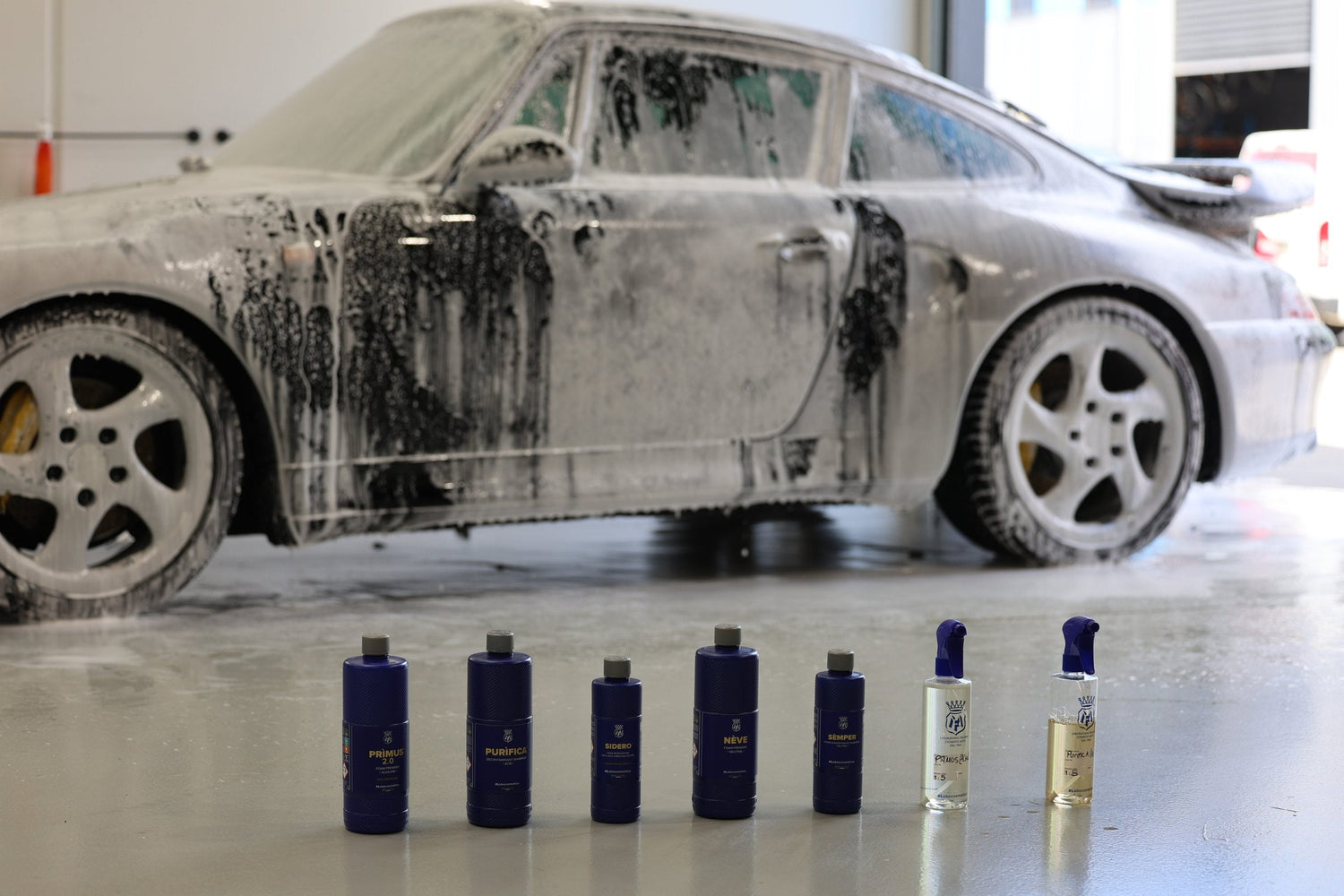
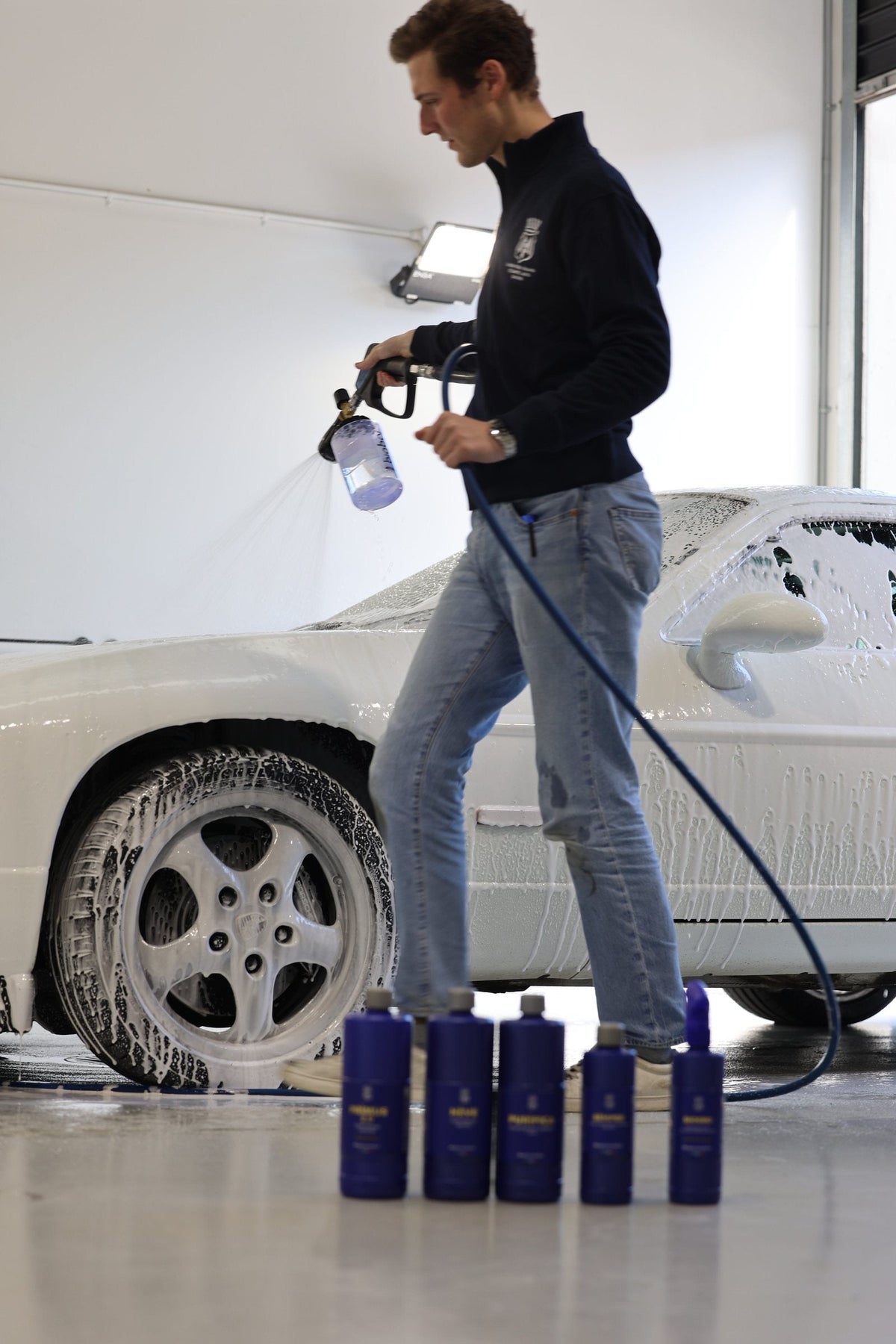
Whichever brand you land on, the bucket is not where most of the cleaning happens. Our studio wash is three buckets — wash, rinse, and a separate one for wheels, because wheel contamination is the harshest thing on the car and has no business anywhere near your paint. Before any of them, there's a pre-wash matched to how dirty the car actually is.
Get that sequence right and the shampoo becomes what it should be: a lubricated, safe contact wash that doesn't strip your protection. Get it wrong and no bottle in that table will save you.
Still can't choose? Ask us.
Call the studio or send us a message with what your car has on it and how often you wash it, and we'll tell you which one — including telling you the cheap one is fine, when the cheap one is fine. We'd rather sell you a $16 bottle that suits your car than a $57 one that doesn't.
The person who left that comment was right, and this page exists because of them. If there's something else on the store you can't choose between, tell us and we'll write that one next.
Which pH neutral car shampoo is cheapest to use?
On our shelf, MIRCH Dragon Tide in the 10 litre — roughly 13 to 27 cents per 10 litre bucket wash at the manufacturer's stated dose of 15 to 30 mL. Labocosmetica SÈMPER in the 4.5 litre is next at about 31 cents, and Bilt Hamber Auto-Wash at 54 cents. Shelf price is a poor guide, because cost per wash depends almost entirely on the dilution ratio.
Why is an expensive concentrated shampoo sometimes cheaper than a budget one?
Because you use dramatically less of it. Bilt Hamber Auto-Wash dilutes at roughly 1:2000 — five millilitres in a 10 litre bucket — so a 500 mL bottle delivers around 100 washes. A shampoo asking for 50 mL a bucket empties a one litre bottle in twenty washes. The ratio on the back matters far more than the price on the front.
What's the difference between Bilt Hamber and Labocosmetica?
Philosophy, mainly. Bilt Hamber is a British laboratory-led brand that tests every formulation against competitor products before release, publishes safety data, and deliberately avoids fragrance and dyes. Labocosmetica comes from Mafra, an Italian company founded in 1965 on the idea of applying human cosmetics principles to cars, so scent and sensory experience are treated as part of the product. Both are rigorous; they simply disagree about whether a shampoo should smell like anything.
Is Labocosmetica VDA certified?
Yes — VDA Class A. Labocosmetica state they were the first in the world to be certified by a German body declaring their products safe and non-damaging to surfaces. They also hold TÜV 9001, 14001 and 18001 certifications and comply with REACH, using none of the 172 banned hazardous substances, and are the only brand in our range with documented PFAS-free status.
Does a more expensive shampoo clean better?
Not reliably, above a certain quality threshold. Cleaning power comes from the surfactant package rather than price or pH, and every brand discussed here has a competent one. What varies more noticeably is lubricity and foam behaviour — how the mitt feels moving across the panel — which is real but is not the same thing as dirt removal. If a car isn't coming clean, the problem is almost always the pre-wash, not the shampoo.
Does fragrance affect how well a car shampoo works?
Not its cleaning ability. Fragrance is a formulation choice rather than a performance one. Bilt Hamber avoid perfumes and dyes on the reasoning that anything non-functional is something that can be left behind on a surface, which matters most in products like glass cleaners. For a shampoo that gets rinsed off, fragrance is essentially a preference — but a preference worth respecting, since people wash their cars more often when they enjoy doing it.
How much shampoo should I use per bucket?
Follow the manufacturer, because the range is enormous. Labocosmetica SÈMPER is 1:1500. Bilt Hamber Auto-Wash is 5 mL in 10 litres. MIRCH Dragon Tide is 15 to 30 mL in 10 to 15 litres. SONAX Gloss is two caps in 10 litres. DIY Detail Incredible Suds is half to one ounce in a 3 to 4 gallon bucket. Only Labocosmetica and Bilt Hamber publish a single fixed figure; the rest give a window and leave the judgement to you.
Where is each brand made?
Bilt Hamber is manufactured in England. Labocosmetica is made in Italy by Mafra, founded 1965. Koch-Chemie produces at Unna in Germany, where the company has operated since 1968 and has been part of the Novarc Group since 2017. MIRCH is Australian, manufactured in Keysborough in south-east Melbourne with local sourcing and operations.
Can I use a pH neutral shampoo on a ceramic coated car?
Yes — it is generally what the coating manufacturer requires. Highly alkaline detergents degrade coating topcoats over time, which is why professional coating warranties typically specify pH-neutral maintenance products and warn against automatic washes with abrasive brushes. Every shampoo discussed in this article is safe on coatings, wax and sealant.

Leave a comment
This site is protected by hCaptcha and the hCaptcha Privacy Policy and Terms of Service apply.