
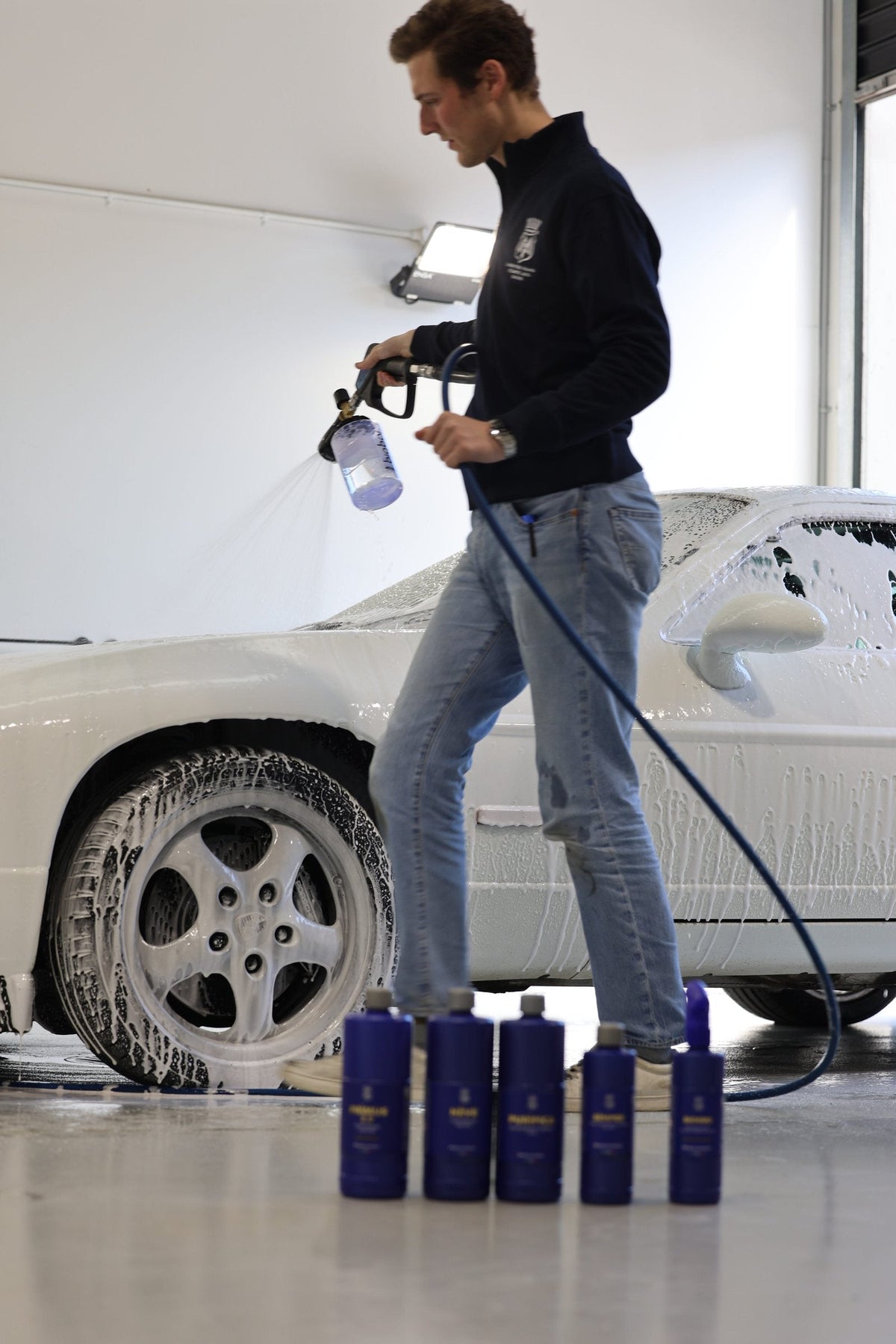
Almost every complaint we hear about foam cannons is actually a complaint about a pressure washer. The cannon arrives, it dribbles instead of foaming, and the blame lands on the cannon or the shampoo. Nine times out of ten neither is at fault — the machine behind it was never going to make foam, and nobody told the buyer what number to check.
So this guide starts with that number, then compares the three cannons we carry on their published specifications and on what they truly cost — including what the MTM kit works out to once you price the litre of Koch Chemie sitting inside it.
We have already written the chemistry side of pre-washing at length: six snow foams compared from pH 3 to 13, and whether alkaline foam is safe over a coating. This one is about the hardware.
Sixty seconds. The detail is underneath.
Check flow rate before you check anything else. The Rag Company publish a minimum of roughly 4.5–5.7 litres per minute and 1,100 psi for their cannon to foam properly. Under that, no cannon and no shampoo will save you.
A foam cannon is a venturi, not a mixer. The water stream does the shearing. Not enough energy in the stream, not enough foam — it is physics, not product quality.
The orifice is the fix nobody tries. A 1.1 suits a lower-flow machine, a 1.25 a higher-flow one. Mismatch it and you get a cannon that "doesn't work".
The MTM kit is the cheaper of the two premium cannons, once you do the arithmetic. It is $143.95 with a litre of Koch Chemie GSF in the box, and that GSF sells alone for $37.40 — so the hardware is effectively about $106.55.
The cheapest is the Bigboi. $129, and the most forgiving pressure floor on our shelf at 1,000 psi — which matters if your machine sits at the lower end. Currently on reorder.
The Ultra H2O is the one built to be kept. Detent clicks instead of friction dials, both orifices supplied, a weighted pick-up tube, and replaceable internals.
Thick foam is not the goal. Dwell is. Foam that clings for five minutes beats foam that photographs well and slides off in thirty seconds.
Almost nobody publishes a cannon dilution. Most brands give you a bucket ratio. We will show you the one figure we can actually stand behind rather than inventing five.

Your pressure washer decides this, not the cannon
A foam cannon has no motor and no mixing chamber. Solution is drawn up from the bottle through a venturi — a narrowing in the water path that speeds the flow and drops its pressure, pulling liquid in — and then sheared into air by the water stream itself. Every bit of energy that turns liquid into foam comes from your machine.
That is why there is a floor. Below a certain flow and pressure there simply is not enough energy in the stream to shear the solution into a stable foam, and you get a wet, runny curtain instead of something that clings. The Rag Company are unusually direct about this and publish their thresholds: at least about 4.5 to 5.7 litres per minute, and at least 1,100 psi. Bigboi publish a working range starting at 1,000 psi, the lowest floor of the three.
The cannon is not making the foam. Your pressure washer is. The cannon just decides where it goes.
Small garden-hose-style washers will not foam properly, and no shampoo fixes it. If your machine sits under that flow threshold you can put the most expensive concentrate in Australia into the bottle and still get a dribble. Most domestic and prosumer electric machines clear both minimums comfortably — but check yours before you spend anything, because it is the one number that decides the outcome. It is usually printed on the machine as litres per minute or gallons per minute.
The second lever, and the one almost nobody touches, is the orifice — the small nozzle inside the cannon that meters how much water passes through and therefore how hard the venturi pulls. A 1.1 suits a lower-flow machine, a 1.25 a higher-flow one. Fitting the wrong one is the single most common cause of a cannon that "doesn't work", and it is a thirty-second fix if you own both sizes.
The moneyWhat the three cannons on our shelf actually cost
Two of them sit within four dollars of each other on the shelf, which makes that comparison look like a coin toss. It isn't, because one of them comes with a litre of pre-wash in the box and the other doesn't — and that is worth backing out before you decide.
So on hardware alone the MTM is the cheaper of the two premium cannons by about thirty-three dollars, and you start with a litre of neutral pre-wash already in the box. That is a genuinely good buy and we would rather say so than pretend the newer product wins on every axis.
What you give up is choice of orifice — the MTM ships with the 1.25 fitted, so if your machine turns out to want a 1.1 you are sourcing one. The Ultra H2O includes both, which on a first cannon is worth more than it sounds.
Our own pick and the popular pick aren't the same cannon. Paolo's preference is the MTM PF22.3 — it is the one he reaches for. The Bigboi FOAMR PRO+ is the budget answer: cheapest of the three at $129, with the most forgiving pressure floor on our shelf at 1,000 psi, which matters if your machine sits at the lower end. It is a popular choice here for exactly those reasons. It is on reorder with the factory now — Bigboi build to order, so we never put a date on it.


All three, on published numbers
Every figure below is the manufacturer's own. Where a maker does not publish something, we have left it as not published rather than filling the gap with an assumption.
The pressure ceilings are the least interesting rows on that table, because almost nobody washing a car at home is anywhere near 3,200 psi. The floors are the rows that matter, and that is where the Bigboi is interesting — a published 1,000 psi minimum is the most accommodating of the three if your machine is modest.
Where the MTM wins
A proven Italian-built unit in brass, nylon and stainless, with a top-mounted dilution dial and a twist-adjust fan. It is the cheaper hardware of the two premium cannons once the GSF is priced out, it arrives with a coating-safe neutral pre-wash ready to go, and the wide-mouth bottle with its quick-release collar is genuinely fast to refill. It is also the one we reach for ourselves.
Where the Ultra H2O wins
Every adjuster runs on positive detents rather than friction, so the soap ratio and fan you settled on last wash are the ones you get this wash. Both orifices are in the box. The pick-up tube is weighted, so draw holds at steep angles and as the bottle empties. And the internals — O-rings, filters and wear parts — are replaceable rather than the cannon being landfill.
The detent thing sounds like marketing until you have owned a cannon with friction dials. Smooth dials drift under vibration and under wet hands, which is why so many people quietly re-dial their cannon every single wash and never quite land on the same foam twice. Clicks remove that variable. Whether it is worth the difference to you is a fair question, and the honest answer is that it depends on how often you wash.
The thing everyone gets backwardsThick foam is not the point
Shaving-cream foam photographs beautifully and is, on its own, close to meaningless. What removes traffic film is dwell — contact time between the surfactants and the soil.
The mechanism is the same one behind any wash chemistry. A surfactant molecule is amphiphilic: the hydrophobic end buries itself in the oily road film, the hydrophilic end faces the water, and the soil is lifted off the paint and held in suspension until you rinse. That takes minutes, not seconds. A dense foam that clings to a vertical panel for five minutes is doing real work. A spectacular foam that slides into the gutter in thirty seconds is doing almost none.
Which is why the adjustable dilution on all three of these cannons matters more than their maximum pressure rating. You are tuning for cling, on the particular shampoo you are running, in the particular weather you are standing in.
The pre-wash exists to remove as much grit as possible before anything touches the paint. Every particle the foam and rinse take away is a particle your mitt cannot drag across the clear coat. That is the entire argument for a cannon: not that it cleans better than a bucket, but that it means less of the car has to be cleaned by contact. If you want the chemistry behind which pre-wash to load into it, we compared six of them from pH 3 to 13.
What a tank of foam costs — and why we can only price one
We wanted to give you a cost-per-fill table the way we did for the shampoos. We can't, honestly, and the reason is worth knowing: almost no brand publishes a foam cannon dilution. They publish a bucket ratio, which is a completely different number, and converting one to the other is guesswork we are not willing to print.
MIRCH are one of the few who state it outright — 1:10 in a foam cannon for Dragon Tide. On a one litre cannon bottle that is roughly 100 mL of product per fill, and on the 10 litre size at $89.95 that works out around 90 cents a fill.
For everything else, load the bottle at the maker's stated cannon ratio where they give one, and where they don't, start weak and work up. The Bilt Hamber Touch-Less calculator we built is the one exception — a brand that publishes enough detail to compute it properly.
The decisionSo which one should you buy?
You want our honest favourite. The MTM PF22.3 Kit. It is Paolo's own pick, it is effectively $106.55 of hardware once the Koch Chemie is priced out, and you are foaming the same day because the pre-wash is in the box. We would rather tell you we have a favourite than pretend we don't.
Budget is the constraint. Bigboi FOAMR PRO+ at $129 — the cheapest cannon we sell and the most forgiving on pressure at a 1,000 psi floor. A popular choice here. Currently on reorder.
You wash weekly and want it to last. Ultra H2O. Repeatable detent settings, both orifices, and replaceable internals.
You don't know your machine's flow rate. Find that out first. It is on the machine, in litres or gallons per minute, and it decides whether any of these will work for you.
Your current cannon dribbles. Before replacing it, try the other orifice. That is the fix far more often than the cannon being faulty.
You have a ceramic coated car. Any of them is fine — the hardware is neutral. It is the chemistry you load that matters, and GSF at pH 7.5 is the safe default.
You have no pressure washer at all. Then no cannon will help. A hand-pumped or battery foam sprayer is the alternative — lighter foam, no machine needed. The one we stock is the Carton EP.02 cordless foam sprayer, which swaps the pumping for a motor and three foam filters.

Tell us your machine and we'll tell you which one
Send us the make and model of your pressure washer, or just its flow rate, and we'll tell you which cannon suits it and which orifice to run — including telling you when the cheaper one is the right answer.
What flow rate do I need for a foam cannon to work?
The Rag Company publish minimums for their Ultra H2O cannon of at least 1,100 psi and around 4.5 to 5.7 litres per minute for it to foam properly. That threshold exists because a foam cannon draws solution through a venturi and shears it into air using the energy of the water stream. Below the threshold there is not enough energy to do the shearing, which is why small garden-hose-style washers produce runny foam no matter how good the shampoo is. Most domestic and prosumer electric pressure washers clear both minimums comfortably.
What is the cheapest foam cannon that actually works?
On our shelf, the Bigboi FOAMR PRO+ at $129. It also carries the lowest published pressure floor of the three cannons we carry, a working range starting at 1,000 psi, which makes it the most accommodating option if your pressure washer is at the modest end. It ships with a second one litre bottle and a service kit, and is currently on reorder.
MTM PF22.3 or The Rag Company Ultra H2O — which foam cannon is better?
They are built to different priorities. The MTM PF22.3 is an Italian-built cannon in brass, nylon and stainless rated to 3,200 psi and 11.5 litres per minute, with a top-mounted dilution dial and a 1.25 orifice fitted. The Ultra H2O is rated from 1,100 to 5,000 psi and up to 5.3 gallons per minute, uses detent clicks rather than friction dials so settings repeat exactly, ships both 1.1 and 1.25 orifices, has a weighted pick-up tube, and has replaceable O-rings, filters and internals. Our own preference is the MTM; choose the Ultra H2O if you value repeatable settings and long-term serviceability.
Is the MTM PF22.3 kit good value compared with buying a cannon alone?
The kit is $143.95 and includes one litre of Koch Chemie GSF Gentle Snow Foam, which sells on its own for $37.40. Backing that out, the cannon and quick-connect adaptor come to about $106.55, which makes it the cheaper of the two premium cannons on our shelf on effective hardware cost — and you start with pre-wash already in the box.
Does thicker foam clean better?
No. Thick foam is a means, not the end. What actually removes traffic film is dwell time — foam that clings to the panel long enough for the surfactants to lift and suspend the soil before anything touches the paint. A shaving-cream foam that slides off in thirty seconds does less work than a thinner foam that stays put for five minutes. Judge a foam by how long it clings, not by how it looks in the first photograph.
What is an orifice on a foam cannon and which size should I use?
The orifice is the small nozzle inside the cannon that meters how much water passes through and therefore how much suction the venturi generates. A smaller orifice such as 1.1 suits a lower-flow machine, and a larger one such as 1.25 suits a higher-flow machine. Matching the orifice to your pressure washer is the single most common fix for a cannon that will not foam. The Ultra H2O ships with both sizes; the MTM PF22.3 comes with 1.25 fitted.
Can I use a foam cannon on a ceramic coated car?
Yes — the cannon is only hardware. What matters is the chemistry you put in it. A pH-neutral pre-wash such as Koch Chemie GSF, which sits at pH 7.5, lifts road film without attacking the waxes, sealants or ceramic coatings on the paint. Strongly alkaline pre-washes are a separate decision with their own trade-offs, which we cover in our snow foam comparison.
How much shampoo does a foam cannon use per car?
It depends entirely on the dilution the manufacturer publishes for cannon use, and most brands publish a bucket ratio rather than a cannon ratio. MIRCH are one of the few to state a cannon figure — 1:10 for Dragon Tide — which means roughly 100 millilitres of product in a one litre cannon bottle. On the 10 litre size at $89.95 that works out around 90 cents per fill. For brands that do not publish a cannon ratio, we would rather tell you that than invent a number.
Do I need a pressure washer for a foam cannon?
Yes. A foam cannon is powered entirely by the pressure and flow of the machine behind it and will not work on a garden hose. If you do not have a pressure washer, a hand-pumped or battery foam sprayer is the alternative — it produces lighter foam but needs no machine at all. Our Carton cordless sprayers are the battery option.

Leave a comment
This site is protected by hCaptcha and the hCaptcha Privacy Policy and Terms of Service apply.