
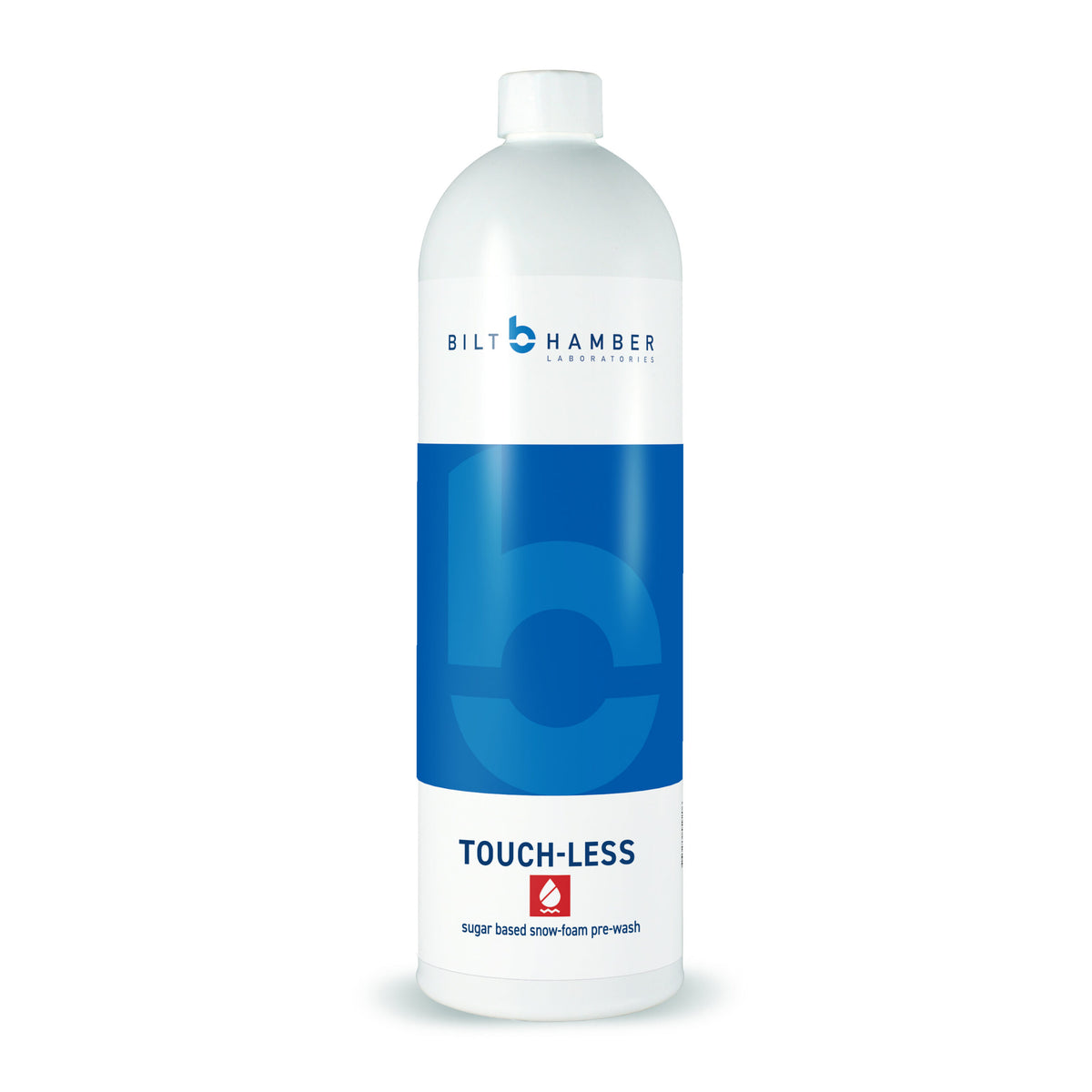
The most common question we get about Bilt Hamber Touch-Less is also the one with no single answer: how much goes in the foam cannon? Bilt Hamber don't publish a dilution ratio for it, and that's deliberate. They publish a Panel Impact Ratio — and once you understand why, you'll never trust a generic "1:10 in the bottle" recommendation again.

Bilt Hamber Touch-Less — an APG pre-wash at pH 10.5, dosed by Panel Impact Ratio.
Why "how much in the bottle" is the wrong question
A foam cannon doesn't spray what's in the bottle. It draws the bottle mix into a much larger stream of water coming from your pressure washer, and every washer delivers a different flow. Two detailers running the identical bottle mix through a 6 L/min machine and a 10 L/min machine are putting very different concentrations of surfactant on the paint — and it's the concentration at the panel that determines whether the product cleans as designed.
That's what PIR measures: the percentage of actual product in the liquid landing on your car, after all dilution — bottle and pressure washer combined. For Touch-Less, Bilt Hamber specify 0.5% PIR for maintenance washes up to 2% PIR for very dirty vehicles. The chemistry doing the work is a blend of sugar-derived alkyl polyglucoside surfactants — the SDS declares D-glucopyranose oligomers, decyl octyl glycosides at 10–30% — sitting at pH 10.5. Mild alkalinity, no caustic soda, no phosphates, no petrochemical solvents. But like any surfactant system, it has a concentration it's engineered to work at. Below it, cleaning falls away. Above it, you're pouring money down the driveway.
The chart — how much per 1-litre cannon
Nobody wants homework before a Saturday wash, so here are the numbers straight up for the machines we see most. Find your washer, pick how dirty the car is, add that much Touch-Less to a standard 1L cannon bottle and top up with water.
Flow figures are the manufacturers' published specifications (AR630 V2 shown at its independently tested ~2.35 GPM; rated 2.3 GPM max). Doses are Alpha Details estimates assuming a standard 1L foam cannon at full draw. If the clean is weak, step up one column. Never exceed 2% — the current formula doesn't need it.
Want it exact? The one-time bucket test
Honestly — most people will never do this, and the chart above gets you close enough to wash well. But if you want the precise figure for your machine and your cannon, it takes five minutes and you only ever do it once.
Fill. Fill your foam cannon bottle to the top with plain water and set the dilution dial to maximum draw (thickest foam).
Discharge. With the pressure washer running, spray the cannon into a large bucket or tub until the bottle is empty, then stop.
Measure. Measure the total volume collected — a jug works, or weigh it (1 kg of water is 1 litre). That figure is your setup's true throughput.
Calculate. Multiply the throughput by your target PIR. At 2% that's throughput (mL) × 0.02. The result is the volume of Touch-Less that goes into the bottle, topped up to the fill line with water.
Worked example: your cannon discharges 15 litres before the bottle runs dry. For a 2% PIR, 15,000 mL × 0.02 = 300 mL of Touch-Less in the bottle, topped up with water. For a 0.5% maintenance wash, the same setup needs just 75 mL. Using an IK-style pump sprayer instead? There's no downstream water at all, so it's simply bottle volume × PIR — 10 to 20 mL per litre covers the whole range.
Or use the calculator
Learn to read your foam
Here's the part almost everyone gets backwards: thick foam is not a sign your snow foam is working. Cleaning happens in the liquid phase — surfactants can only lift soil where solution is actually wetting the panel, and foam is mostly air. Bilt Hamber built Touch-Less around exactly this: it's the strength of the formulation doing the work, not the thickness of the foam, which is why it produces a deliberately thin, wet wall of foam that clings and keeps draining down the panel — and why it even works run through a non-foaming pump sprayer.
Too thick. If your foam sits on the car like meringue and then drops off in blocks, that's over-aerated product failing you, not impressing you. A dense, dry foam holds the surfactant solution up in the bubble walls instead of wetting the paint underneath — it insulates the dirt rather than attacking it. When that structure collapses, it sloughs off in clumps and takes the chemical with it before it's finished working. Common causes: over-dosing well past 2% PIR, or cutting a wash shampoo into the mix for looks. Back the dose off to the chart.
Too thin. If the mix hits the panel looking like plain water and sheets straight off within seconds, leaving the panel barely wetted, you're under-dosed for your machine's flow — step up one PIR column and re-check.
Right. An even, wet blanket that visibly clings, with the panel staying wet underneath and dirty run-off streaming from the sills for the full dwell. It won't win a foam-thickness contest on Instagram. It will win the swipe test after the rinse — and that's the only test that matters.
Check which formula you own — the numbers changed
Here's where a lot of online advice quietly goes wrong. The original Touch-Less was specified at 2% to 5% PIR, typically 4%. The current formula — often called V2 — is significantly more concentrated, and Bilt Hamber's guidance dropped to 0.5% to 2% PIR. Plenty of retail listings, including Australian ones, still carry the old numbers. Follow a 4–5% recommendation with the current bottle and you're dosing at two to four times the intended concentration: worse rinsing, wasted product, and no extra cleaning for it.
The pH figures floating around suffer the same copy-paste problem. You'll see pH 12 quoted for Touch-Less. The current safety data sheet says pH 10.5 — and since every pH unit is a tenfold change in hydroxide concentration, that's not a rounding error. If the listing you're reading says pH 12 and 4% PIR, it's describing a product that's no longer in the bottle.
Getting the wash itself right
Shake the bottle well before dosing — the concentrate should be homogeneous. Apply to cool panels, ideally in shade, let it dwell for one to five minutes, and never let it dry on the paint. Rinse thoroughly with the pressure washer, bottom to top first to use the run-off, then top to bottom. At the recommended PIR the mild APG chemistry is friendly to waxes, sealants and ceramic coatings, which is exactly why it exists — a maintained, protected car doesn't need the pH 13 of Auto-Foam; that one's for neglected, heavily filmed vehicles. And a mixed bottle doesn't have to be used in one go: a litre of diluted Touch-Less will typically cover four to five washes.
One safety note we won't skip, because the SDS doesn't: Touch-Less carries an Eye Dam. 1 (H318) classification. Mild pH and gentle-on-eyes are not the same thing. Wear eye protection when handling the concentrate.

The 5L trade size — at 0.5% PIR that's well over fifty cannon fills.
If you're chasing the full touchless routine, follow the pre-wash with Touch-On — Bilt Hamber designed the two to run as a system. And if your bucket test throws up a number that doesn't make sense, message us. Calibrating a cannon takes five minutes and we're happy to talk you through it.
Where that 10.5 actually sits among pre-wash foams is easier to judge with something to measure it against — we lined six of them up by their published pH in our snow foam pH comparison, and the spread from mild APG blends to the genuinely caustic end is wider than most listings let on.

Leave a comment
This site is protected by hCaptcha and the hCaptcha Privacy Policy and Terms of Service apply.