
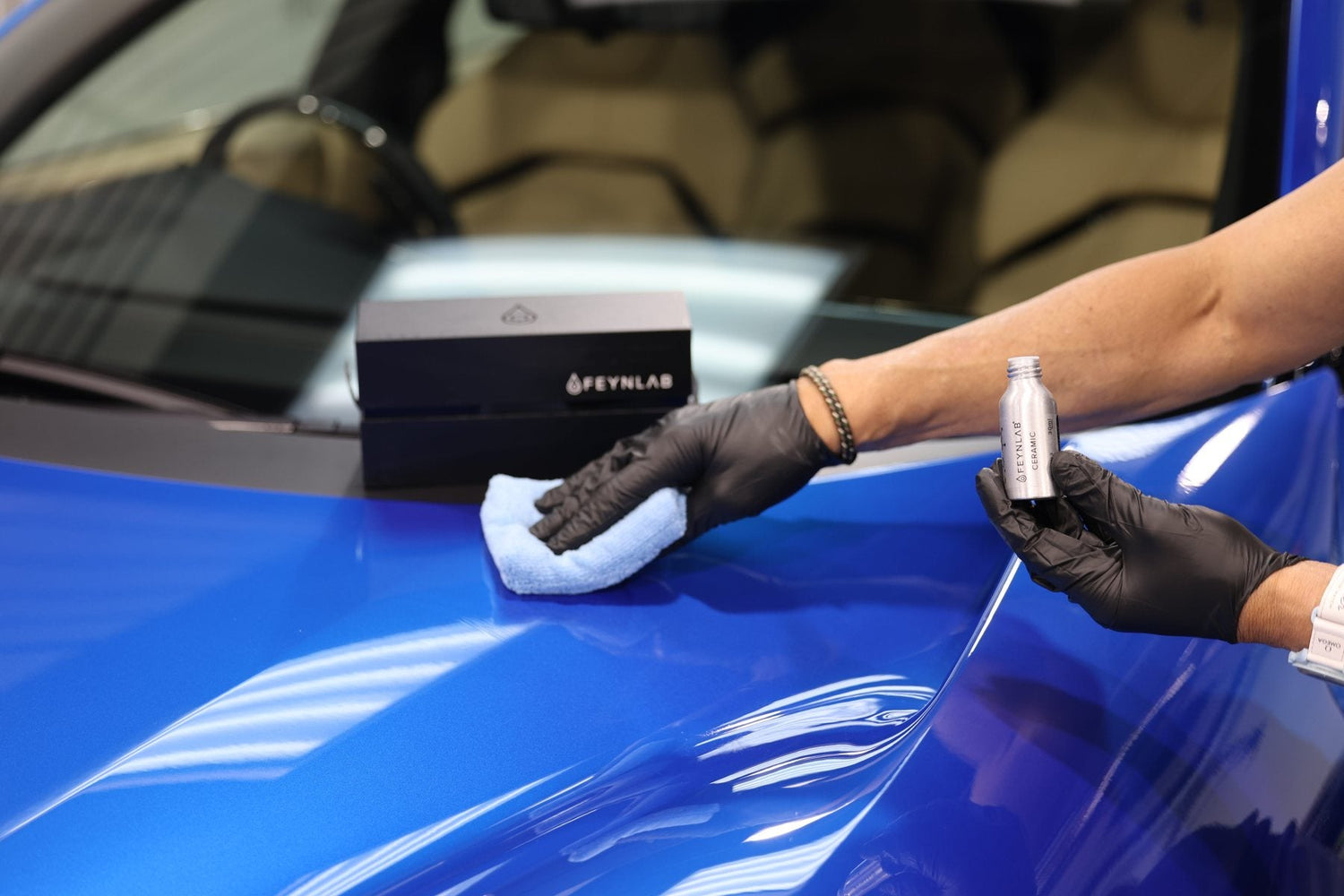
A Tesla came into the studio today, six months into a ceramic coating, with no water behaviour at all. The owner was certain he'd been ripped off. We didn't answer him straight away — we washed the car properly first, because that's the only way to give an answer worth anything. Then we told him what we'd found.
His coating was gone. Not fouled, not tired. Gone at six months.
He'd paid $700 and been told the car had a well-regarded coating on it. And here's the part that should bother you: we cannot tell him whether he got that product and it was applied badly, or whether he never got it at all. Neither can he. Six months on there is no way to reconstruct it — and that gap, between what you're sold and what actually went on the paint, is where the money in this industry quietly hides.
This article is about closing that gap. It covers what's really happening at the surface, how to check whether the coating you paid for is on your car, and what to ask before you book one so you're never in his position. Some of it is uncomfortable for our trade. Some of it is uncomfortable for us — including a piece of chemistry we published incorrectly ourselves and are correcting below.
The Tesla is one outcome. The other outcome is far more common: a perfectly healthy coating buried under road film and mineral scale, stops beading, owner concludes it failed. Both cars arrive looking identical. The whole point of what follows is that you cannot tell them apart by looking at water — you have to clean the car first and then test properly.
Sixty seconds. The detail is underneath.
No beading does not mean no coating — and it doesn't mean you're fine either. Water behaviour is set by the outermost one to two nanometres. A healthy coating buried under road film looks identical to one that has genuinely failed. You can't tell by looking.
Never judge a coating on a dirty car. Wash it, chemically decontaminate it, panel wipe it, then look. If the beading comes back, the coating was there the whole time.
pH-neutral shampoo can't do it. It lifts organic soil. It does not remove the inorganic contamination — iron, fallout, limescale — that actually kills water behaviour.
The paint thickness gauge test is nonsense. A coating is under 1.5 microns. The measurement error of a professional gauge on a car is 3 to 5 microns. You cannot measure it.
Check the panels nobody photographs. Compare the bonnet against door shuts, sills and the boot lip. Same product should behave the same way. This is the hardest test to fake.
Before you book, ask one question above all others: is paint correction included, and to what level? A coating cannot hide defects. It seals them in for years.
Get the paperwork on day one. Product, batch, applicator, registration against your VIN. Ask while the car is still in front of you. Six months later there is nothing left to prove.

What actually makes a ceramic coating hydrophobic?
A silane or siloxane-based coating does two completely different jobs in two different parts of the same molecule. Understanding that split explains almost everything that follows.
The network — the coating's body
The hydrolysable end reacts with water, forms silanol groups, and those condense into a crosslinked lattice: Si–OH + HO–Si → Si–O–Si + H₂O. This is what gives you chemical resistance and durability, and what anchors to the surface underneath.
The termination — the beading
Organic groups that never react sit on top — methyl, longer alkyl chains, PDMS segments. These give the low surface energy. They are the entire reason water balls up. And they are the first thing to go.
A peer-reviewed 2025 review of automotive coating materials puts it plainly: the methyl groups within PDMS impart the hydrophobicity, while the silane crosslinks provide the adhesion. Two functions, two parts of the molecule — and here is the consequence the beading test completely misses. They do not fail together.
The best evidence doesn't come from car detailing at all. It comes from high-voltage silicone insulator research, where siloxane surface degradation has been studied properly with surface analysis. Under oxidative attack the methyl groups are split off — and the network underneath doesn't disappear. It becomes more crosslinked and more silica-like. The hydrophobicity dies. The network is still there, still bonded, still doing its structural job.
When someone says "no beading means no coating," they're describing the loss of a molecular layer as though it were the loss of the whole film.

Nobody has taken a real car coating that stopped beading and run surface analysis to prove the network survived. That work doesn't exist. This is a strong inference from directly adjacent chemistry. And commercial coatings aren't pure alkylsiloxanes — they're blends, and some of what gives you the early beading genuinely is sacrificial and genuinely does wear away. "The network is still there" and "it's still performing" are two different statements.
Why we won't assess a coating on a dirty car
When someone asks us whether their coating is still active — the Tesla being today's example — we perform a full three-pH wash before we form any opinion at all. Alkaline pre-wash, acid stage, then a neutral contact wash. Only once the paint is genuinely clean do we look at how water behaves.
This isn't ceremony. Contact angle is a property of the outermost molecular layer of a surface. Surface scientists who measure this for a living will tell you a single molecular layer of the wrong material produces a measurable change. If there's a film of anything on the coating, you are no longer measuring the coating. You are measuring the film.

Why pH-neutral shampoo can't fix this
Most people maintain their car with a pH-neutral shampoo, and they should — it's the right thing for routine washing. But it's a surfactant system built to lift organic soil. It is not designed to remove inorganic contamination, and it doesn't.
What shampoo handles
Organic soil. Road film, oils, dust, general grime, the bulk of what a car picks up between washes. A neutral shampoo does this job well and does no harm to a coating.
What it leaves behind
Embedded ferrous particles from brake and rail dust. Industrial fallout. Mineral scale from hard water and sprinkler overspray. Exactly the contamination that bonds on top of a coating and kills its water behaviour.
This isn't a detailing-industry opinion. Vehicle manufacturers documented it themselves. Ford's technical service bulletins on iron particle contamination describe ferrous particles generated by manufacturing facilities and rail shipment bonding to paint, and specify a dedicated acid neutraliser, alkaline neutraliser and detail wash sequence to remove them. Washing is explicitly not the remedy. Mazda and Nissan issued parallel bulletins. These are brand new cars, contaminated before the customer ever sees them, with the fix covered under new vehicle warranty.


Removing it needs chemistry a surfactant can't do — acidic pre-wash chemistry for the mineral deposits and a dedicated iron remover for the ferrous particles. Limescale is straightforward: acid converts insoluble carbonate into a soluble salt, or a chelating agent grabs the calcium and magnesium ions and holds them in solution.
Thioglycolate iron removers change colour on ferrous contamination, and that purple is almost universally described across detailing content — including in an earlier article of ours — as a ferric complex. It isn't. Thioglycolate is a reducing agent as well as a chelator: it reduces Fe(III) to Fe(II), and the coloured species is ferrous thioglycolate. This has been understood since the 1920s and still underpins the pharmacopoeial limit test for iron. The complex is colourless in acid and develops its purple in alkaline conditions — which is why the active is typically an ammonium thioglycolate or mercaptoacetate salt. It changes nothing practical. We're correcting it because we'd rather be right than repeat what everyone else says.
So how do you actually check whether a coating is there?
Clean the surface properly, then look at two things — and only one of them is beading.
Alkaline pre-wash. Lift the organic road film off before anything touches the paint.
Acid stage. Attack the mineral and inorganic deposits a neutral shampoo cannot move.
Iron decontamination. Dissolve the embedded ferrous particles sitting proud of the surface.
Neutral contact wash. Bring the pH back and remove what the chemistry has released.
Residue-free panel wipe. The step nearly everyone skips — and the one that makes the result trustworthy.
Only now, assess. Water behaviour, sliding angle, and a panel-to-panel comparison across the car.
Water behaviour after decontamination. Clean, uncoated clear coat sits somewhere around 70 to 90 degrees of contact angle and does not bead tightly. A healthy SiO₂ coating runs above 105. So the decon is the discriminator: if the beading comes back, the surface underneath cannot have been bare clear coat — something with low surface energy was there the whole time, buried. If it doesn't come back, you're looking at clear coat.
The Tesla didn't come back. Full three-pH wash, iron decon, panel wipe, and the water still lay flat across every panel. That is what a genuinely failed coating looks like, and the only reason we could say so with any confidence is that we'd removed every other explanation first.
A lot of decon products, drying aids, clay lubricants and shampoos contain SiO₂ or silicone that deposits its own fresh hydrophobic film. Decon the car, watch the beading return, and you might just be admiring what you sprayed on. The test is only valid if you finish with a residue-free panel wipe before you judge anything. We have never seen this mentioned anywhere else in the trade.
Sliding angle, not just bead size. This is the one the industry ignores. Static contact angle tells you how a drop sits. Sliding angle tells you the tilt at which it actually moves — and that determines whether your car self-cleans in the rain. Surface science has been explicit: the key enabler for self-cleaning is surface slipperiness, not a large static contact angle. Surfaces with a static contact angle in the thirties, which barely bead at all, have been shown to shed water better than dramatically beading ones, because the drops don't pin.
This matters practically. A partly degraded or lightly fouled coating can still form respectable beads while pinning them in place. The water sits and evaporates where it lands, which is exactly how you get water spotting and mineral etching. A car that beads beautifully but holds every drop is in worse shape than one that sheets cleanly. You will not find sliding angle published by a single coating manufacturer — they all publish static contact angle, because it's the bigger-sounding number.
MythThe paint thickness gauge test does not work
A fair amount of online advice tells owners to buy a paint thickness gauge and check whether the coating shows up. The arithmetic kills this immediately.
What you're trying to detect
Manufacturers who publish figures put coating thickness at 0.2 to 1.5 microns — one catalogue gives 0.2 to 0.5 per layer, another states around one micron total.
What the instrument can resolve
On a panel reading 110 microns, a professional gauge specifies roughly ±3 microns. A prosumer unit is over ±5. Cheap gauges vary by far more between readings on the same spot.
The measurement error of the best professional instrument is two to five times larger than the entire coating you're trying to find.
And that's before panel curvature, alloy composition and surface temperature get involved. A gauge tells you the total non-conductive film over the metal. It cannot isolate, resolve or attribute a sub-micron layer within it. Anyone telling you otherwise is selling you a gauge.
The same arithmetic tells you something else worth knowing. A single machine polishing pass typically removes somewhere between one and five microns of clear coat. Your coating is under one and a half. One correction pass removes the entire coating. That's not an opinion, it's subtraction.
The masking problemWhy toppers make all of this harder
This is a position rather than a chemistry finding, and it's one of the reasons we choose the coatings we choose.
A topper, booster or ceramic maintenance spray deposits a fresh low-surface-energy layer on top of whatever is already there. Because water behaviour is set by the outermost molecular layer, that fresh layer governs how the car beads — regardless of the condition of the coating underneath. Look at how these products are marketed and the logic is right there in the copy: they restore and boost hydrophobic performance over any existing coating, and the recommended trigger for reapplication is "when water beading diminishes."
The instruction is to reapply the topper at exactly the moment you'd otherwise be able to assess the base coating.
Toppers are a legitimate tool and we sell them. Used deliberately, on a coating you already know is healthy, they're fine. What we avoid is building a customer onto a system that requires constant topping to look alive — because at that point you have no way of knowing whether you're seeing the four-figure coating you paid for or the eighty-dollar spray on top of it. The masking works both ways, and it works in the installer's favour. We'd rather sell a coating that can be honestly assessed six months later.
Before you bookWhat to ask before you book a ceramic coating
Everything above is about diagnosing a coating you already have. This is the part that prevents the problem.
Is paint correction included, and to what level? The single most important question, and the one most people never ask. A coating is a transparent film well under two microns thick. It cannot fill, hide or repair a swirl mark cut into 40-odd microns of clear coat. Whatever is in the paint when the coating goes on is what you're looking at for the life of the coating — and fixing it afterwards means removing the coating you just paid for.
Which coating, by name? Then go and research it. If the answer is vague, or it's an in-house product with no published technical data, that tells you something. A real coating has a manufacturer, a data sheet, stated layer counts, stated flash and cure times, and a process the installer can describe to you.
How many layers, and is it a system? Some coatings are specified as a single layer. Others require two or three with defined windows between them — one common professional coating specifies two coats inside a 45 to 60 minute window, or wait until the following day. Some are two-product systems with a base and a topcoat. These aren't interchangeable and they don't cost the same.
How does it bond? Some coatings are more film-forming and sit physically on the surface. Others are formulated to condense chemically with it. Some manufacturers describe their products as a deliberate blend of both. They behave differently, prepare differently and price differently — a competent installer should be matching one to your car, your storage and your budget rather than selling everyone the same thing.
How long will you have the car? Decontamination, correction across every panel, panel wipe, application, flash times and cure time where the car can't get wet. On a car needing genuine correction that's days, not hours. An hour and a half in a dealership bay is not a ceramic coating.
Why we polish new paint — and why the usual explanation is backwards
You'll hear it said around the trade that oxidation begins the moment paint is applied, that it attaches itself to the hydroxyl groups in the clear coat, and that it therefore has to be polished off before a coating will bond. The conclusion is right. The chemistry is inverted, and we'd rather correct it than repeat it.
What the trade says
Oxidation forms immediately and adheres to the hydroxyl groups in the clear coat, blocking the sites a coating needs to bond to. Polish it off to expose fresh, bondable paint.
What actually happens
Photo-oxidation doesn't consume hydroxyl groups or stick to them. It creates them. UV starts a radical chain, oxygen adds, hydroperoxides form and decompose, and the products are alcohols, ketones, aldehydes and carboxylic acids.
This isn't a fringe reading — it's how the industry measures the problem. Ford's own published work on clearcoat service life prediction quantifies photo-oxidation as the ratio of the hydroxyl and amine bands to C–H. Degradation is literally tracked by watching the hydroxyl band grow. Independent coatings research agrees: under accelerated UV the hydroxyl band at 3500 cm⁻¹ and the carbonyl band rise while C–H and the crosslink bands fall.
Which creates an obvious problem for the usual story. If oxidation adds hydroxyl groups, and a silane needs surface hydroxyls to condense with, oxidation should improve bonding. That's the entire principle behind plasma, corona and UV-ozone surface treatment — you deliberately oxidise a polymer surface to install polar groups, raise surface energy and get better adhesion.
The problem was never that oxidation destroys bonding sites. It's that advanced oxidation puts the bonding sites on loose material.
Past a certain point, those new hydroxyl and carboxyl groups are attached to chain-scission fragments no longer anchored to the bulk network. You end up with a friable layer of low-molecular-weight oxidised material sitting on intact coating. Bond to that and the adhesion can be excellent — to material that will come away with it. Adhesion science calls this a weak boundary layer. It's Bikerman's, from the 1960s, and it's why failures blamed on poor adhesion are so often cohesive failures inside a weak layer rather than true interface failures.
The cleanest demonstration comes from plasma-treated polypropylene: over-treatment generates low-molecular-weight oxidised material, joints fail cohesively within it, a thirty-second wash removes it and bond strength goes up several-fold. Same principle, different substrate.
Nobody has run that experiment on a car clearcoat with a consumer coating, and there is no published adhesion data comparing a coating on polished versus unpolished paint — not from a journal, not from a manufacturer. Every coating brand specifies polishing; none publish the numbers behind it. Anyone who tells you the data exists hasn't looked.

Now, the honest part about brand new cars
A properly stabilised OEM clearcoat is not meaningfully oxidised at delivery. It's baked around 125°C for half an hour on the line, loaded with UV absorbers and hindered amine light stabilisers, and the published work needs months of direct outdoor exposure before instrumental analysis picks up a degraded surface zone at all — years to drive real crosslink loss. Between the paint shop and your driveway that car has spent most of its life in enclosed transport, a compound and a showroom. So if someone tells you a new car needs polishing because of oxidation, they're borrowing an argument that belongs to a ten-year-old daily.
What a new car does have is three other things, and they matter more:
Transit protection. Manufacturers apply shipping wax or preservative film to protect paint in transit. That's a deliberate release layer — the most literal weak boundary layer a new car carries. It has to come off properly, and a wash alone doesn't guarantee it. This is where a panel wipe earns its keep.
Bonded contamination. The rail and industrial fallout the manufacturers themselves document. That's a job for chemical decontamination and clay before any polishing — polishing over embedded particles just drags them across the panel.
Wash marring. Dealer pre-delivery washing puts swirls into paint. This is what we see arriving in the studio rather than something anyone has published a study on, and we'll say so. But it's the real reason a new car gets polished — you're about to seal those defects under a film that lasts years.
Factory paint does not need a curing period before coating. It left the oven fully cured. The thirty-day wait people quote is real, but it belongs to refinish and repair work, where an ambient-cured 2K urethane is still releasing solvent and developing properties — sealing it too early traps that solvent. It has nothing to do with a car off the showroom floor.
Why "too cheap" is the first warning sign
We're aware how this reads coming from an installer, so here's the arithmetic instead of the assertion. This is what the coating alone costs at Australian retail — before anyone has touched the car.
So before a single hour of labour, the chemical is anywhere from under a hundred dollars to well over five hundred, depending entirely on what's being applied. Now add the part that actually costs money: decontamination, clay or chemical decon, machine correction across every panel, panel wipe, application, flash times, and cure time where the car occupies a bay and can't get wet.

Now run that against the Tesla. Seven hundred dollars, total. Take a professional coating off the top at retail and you're left with something in the region of five hundred for everything else. A genuine correction and coating on that car is a minimum of one full day and realistically two, plus the bay it sits in overnight while it cures. Five hundred dollars does not buy two days of a skilled operator's time anywhere in Melbourne. It doesn't buy one.
The number told him what he was getting. He just had no way to read it at the time.
So something was left out, and the arithmetic says it was almost certainly the preparation. Cars come to us all the time where the coating went straight onto unwashed, undecontaminated, uncorrected paint — bonded over contamination and polish oils rather than onto clear coat. That bond has nowhere solid to hold, and it does not last a year. Sometimes the coating itself is the thing left out, and what actually went on was a spray sealant that beads beautifully for three months and is gone by the time anyone thinks to check.
We are not going to tell you which of those happened to that Tesla, because we don't know and neither does he. That is the honest answer and it's also the point. The industry is full of these stories, and they almost never resolve — the customer can't prove what went on the car, the shop has moved on, and the coating brand cops the blame for a job it had nothing to do with. Cheap doesn't always mean rubbish. But in this trade it very often does, and when it does you usually find out six months later with no way to prove anything.
The test they can't fakeHow to check the installer actually coated the whole car
Here's a test we've never seen written down anywhere, and it's the hardest one to fake.
A rushed application always favours the panels people look at. Bonnet, roof, boot lid, doors. The areas that get skipped when someone's working to a clock are the ones nobody photographs.
The hero panels
Bonnet, roof, boot lid, upper doors. These always get done. They're what goes in the photos and what the customer looks at first.
The skipped panels
Door shuts and jambs, sills below the swage line, the boot lip and lower rear bumper, the fuel filler surround, trailing edges of panels.

So don't test one panel. Wash the car properly, decontaminate it, panel wipe it, then compare water behaviour on a hero panel against those neglected areas. On a properly coated car they behave the same, because the same product went on both. If the bonnet beads tightly and the sills and shuts wet out completely, you're not looking at a worn coating — you're looking at an application that stopped where the camera did.
Then check the paperwork — and do it on day one, not in six months. Professional coatings from real manufacturers carry an installer-side registration: product, batch, applicator, date, and usually the vehicle. Many brands also run approved or certified installer networks you can search yourself. If you were sold a named coating with a warranty, the manufacturer either has a record against your car or they don't. Ring them and ask. It costs you a phone call and it is the closest thing to a definitive answer an owner can get.
Being told a brand name is not the same as being given that brand. Most well-known coatings are sold at retail — anyone can buy a bottle. So "we used X" tells you nothing on its own about who applied it, which product in the range went on, or whether the paint was prepared first. Ask for the registration, the batch and the applicator's certification while the car is still in front of you. A real installer produces it without blinking. Six months later, when the water stops beading, there is nothing left to check.
Why we give the first maintenance wash away
Every customer who has a coating applied here gets shown what to look for — how the paint should behave, what normal degradation looks like versus a real failure, and why a car looking flat after a month of Melbourne road film is a wash problem rather than a coating problem.
And we give the first maintenance wash away. Not as a giveaway. It's so we can stand next to you at the car and show you how to wash it, what chemistry to use, what to avoid, and what your specific coating should be doing. A coating maintained with the wrong chemistry will look dead within months, and the customer will blame the coating, and they'll be wrong. We'd rather spend an hour teaching than lose a year of performance.

Not sure what's actually on your car?
Bring it in. We'll run the full three-pH decontamination wash and give you a straight assessment — whether it came from us, another studio or a dealership. Sometimes the coating is fine and it just needed a proper wash. Sometimes there was never much there. Either way you'll know, and you'll know why.
If you want to run the assessment yourself, the three products behind it are our alkaline pre-wash, the acid stage and the neutral foam — plus a residue-free panel wipe to make the result honest.
Does no water beading mean my ceramic coating is gone?
No. Water beading is determined by the outermost one to two nanometres of a surface. Road film, mineral scale and embedded iron sitting on top of an intact coating will stop it beading. Wash and decontaminate the paint properly, finish with a residue-free panel wipe, and reassess before concluding anything.
Can a paint thickness gauge tell me if my car has a ceramic coating?
No. Coatings are roughly 0.2 to 1.5 microns thick. The measurement uncertainty of a professional gauge on a typical car is around three to five microns — several times the thickness of the coating itself. The gauge measures total film over the metal and cannot isolate a coating layer.
How can I tell if the installer coated the whole car?
Wash, decontaminate and panel wipe, then compare water behaviour on a hero panel like the bonnet against areas a rushed application skips — door shuts, sills, the boot lip, panel trailing edges. Consistent behaviour indicates a complete application. Also ask the coating manufacturer whether a registration exists against your vehicle.
Does a brand new car need paint correction before coating?
Usually some level, yes — but not because of oxidation. A factory clearcoat is baked and stabilised, and published research shows it takes months of real outdoor exposure before surface degradation is instrumentally detectable. What a new car actually carries is transit wax or preservative film, bonded rail and industrial fallout, and swirl marks from dealer pre-delivery washing. A coating is a transparent film under two microns thick and cannot hide defects in a 40-micron clear coat, so whatever is in the paint gets sealed in for years.
Does paint oxidation stop a ceramic coating from bonding?
Not in the way it's usually described. Photo-oxidation of a clearcoat generates hydroxyl and carboxyl groups rather than consuming them — the automotive durability literature measures degradation by watching the hydroxyl band grow. The real problem on genuinely weathered paint is that those groups sit on low-molecular-weight chain-scission fragments no longer anchored to the bulk network. A coating bonds well to that friable layer, and the layer comes away. Abrasion removes it. Note that no published study compares coating adhesion on polished versus unpolished automotive clear coat.
Does new factory paint need to cure before a coating is applied?
No. OEM paint is baked at around 125°C on the production line and leaves fully cured. The 30-day waiting rule applies to refinish and repair work, where an ambient-cured 2K urethane is still releasing solvent — sealing it early traps that solvent. It does not apply to a factory-painted car.
Why doesn't pH-neutral shampoo restore my coating's performance?
pH-neutral shampoos are surfactant systems built to lift organic soil. They do not remove inorganic contamination — embedded ferrous particles, industrial fallout and mineral scale — which is exactly what bonds on top of a coating and suppresses its water behaviour. That requires acidic or chelating chemistry and a dedicated iron remover.
Why is a very cheap ceramic coating a warning sign?
The coating chemical alone costs an installer roughly A$60 to over A$530 per vehicle at Australian retail depending on the product, before any labour. Proper preparation and correction is days of work, not hours. A price that cannot cover both means something was omitted — usually the paint correction, sometimes the coating itself in favour of a short-lived spray sealant. A A$700 coating on a car needing correction has roughly A$500 left after product, which does not buy the two days of skilled labour the job requires.
My coating failed after six months — can I prove what was actually applied?
Usually not, and that is the core problem. Once the coating has degraded there is no field test that identifies which product was used or whether the paint was prepared first. The only reliable record is the installer-side registration held by the coating manufacturer — product, batch, applicator and vehicle. Request it on the day the work is done. Being quoted a brand name is not evidence you received that product, since most coatings are available at retail to anyone.
Should I choose a coating that needs regular toppers?
A topper deposits a fresh hydrophobic layer that governs water behaviour regardless of the coating beneath it, and manufacturers typically instruct reapplication "when beading diminishes" — the exact moment you would otherwise be able to assess the base coating. Toppers used deliberately on a known-healthy coating are fine. A system that requires constant topping to appear functional cannot be honestly assessed by the owner.

Leave a comment
This site is protected by hCaptcha and the hCaptcha Privacy Policy and Terms of Service apply.