
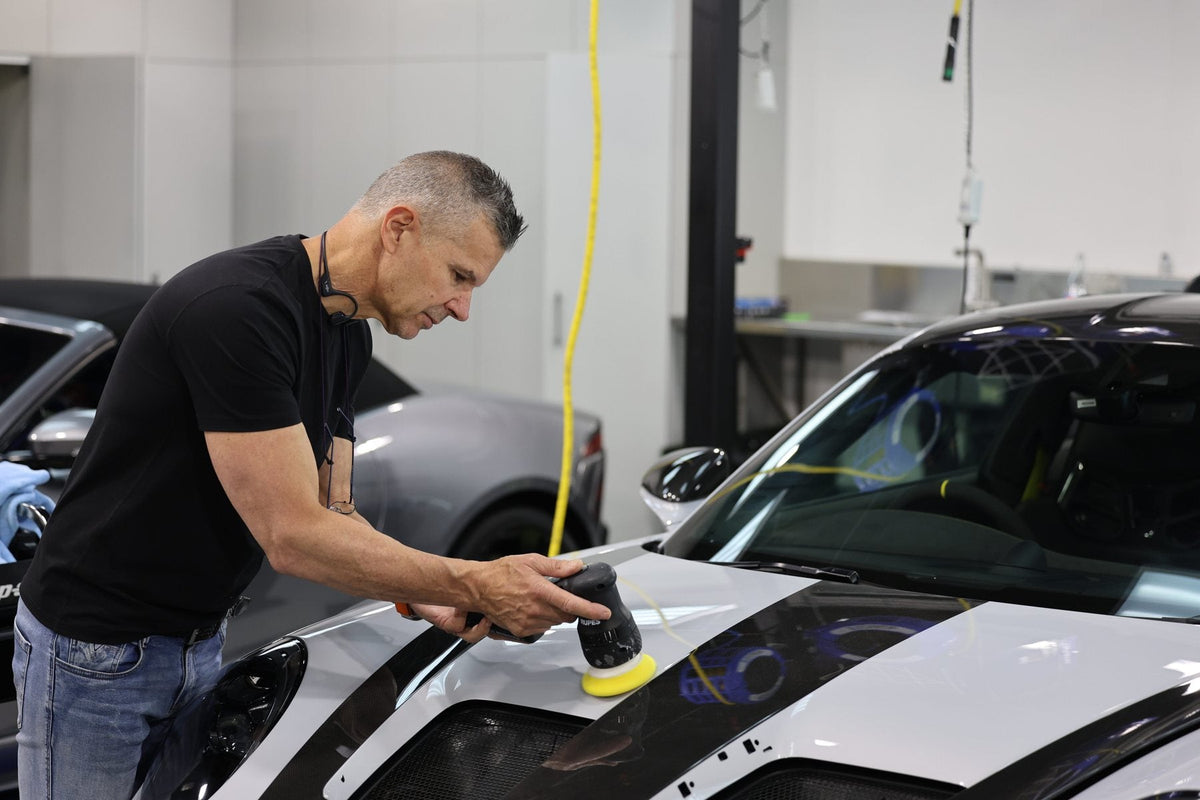
What a detail actually costs you — chemicals, and the machine in your hand
We run a detailing studio and a PPF bay in Heidelberg West, and we sell the chemistry we use. So we can do something most suppliers can't: show you what a job actually costs per car, across four brands, using published dilution ratios and current Australian prices. Some of the results do not favour the expensive option — and we have left those in.
The short version
A full three-pH decontamination wash costs about A$8.24 in chemistry. Pre-wash, acid decon foam and a contact wash, at the manufacturer's stated ratios and current retail.
Cheapest bottle and cheapest per car are different questions, and the answer flips depending on the product. On all-purpose cleaner, Bilt Hamber Surfex-HD works out three times cheaper per litre of working solution than the premium alternative. On iron removal it goes the other way and Labocosmetica Sidero comes in nearly five times cheaper than a ready-to-use rival.
But price is the floor, not the decision. Odour in a closed bay, how long a product stays wet on a hot day, whether it is approved for Alcantara, whether it reports limescale as well as iron — none of that divides neatly, and all of it changes what we reach for. We stock nothing we would not use, and we will tell you which one we prefer and why.
Chemistry is almost never your cost problem. On a A$150 wash it is around five per cent of the ticket.
The same arithmetic destroys the case for a cheap polisher — but not for the reason it is usually given. The honest version is in the second half, and it involves an occupational health standard rather than a marketing claim.
Buying in trade sizes saves between 17% and 67% per litre across the range we stock.

Why nobody publishes this number
Search for what it costs to detail a car and you will find hundreds of pages telling you what to charge. You will find almost nothing telling you what it costs. The reason is structural rather than sinister. Manufacturers publish dilution ratios but not prices. Retailers publish prices but have never used the product on a customer's car. Detailers know what they spend but have no reason to publish their margins.
We sit in all three positions at once. We detail cars and install film for a living, we hold a chemistry degree, and we stock the products. That combination is the only reason this can be written honestly — and it is also why we are going to show you results that cost us money, because a cost table that always recommends the dearest product is not a cost table, it is an advertisement.
How do you work out cost per car?
Cost per car is not the price on the bottle. It is the price of the concentrate you actually consume, and consumption is decided by the dilution ratio — which is why buying on shelf price gets this wrong so consistently.
The formula is simple enough to do in your head. Take the price per litre of concentrate, divide by the dilution ratio plus one, and you have the price per litre of working solution. Multiply by how much working solution the job uses.
A worked example, because the abstraction hides how dramatic this gets. Semper is a hyper-concentrated pH-neutral shampoo that dilutes at 1:1500. A 4.5-litre container at A$207.90 is A$46.20 per litre of concentrate. At 1:1500 that makes roughly 6,754 litres of ready-to-use shampoo — just over three cents a litre.
What a ten-litre wash bucket of pH-neutral shampoo costs you, at the manufacturer's stated ratio
Six and a half millilitres in a ten-litre bucket. About a teaspoon. If you have been mentally budgeting a few dollars a car for shampoo, you have been out by a factor of ten.
What does a three-pH wash actually cost in chemicals?

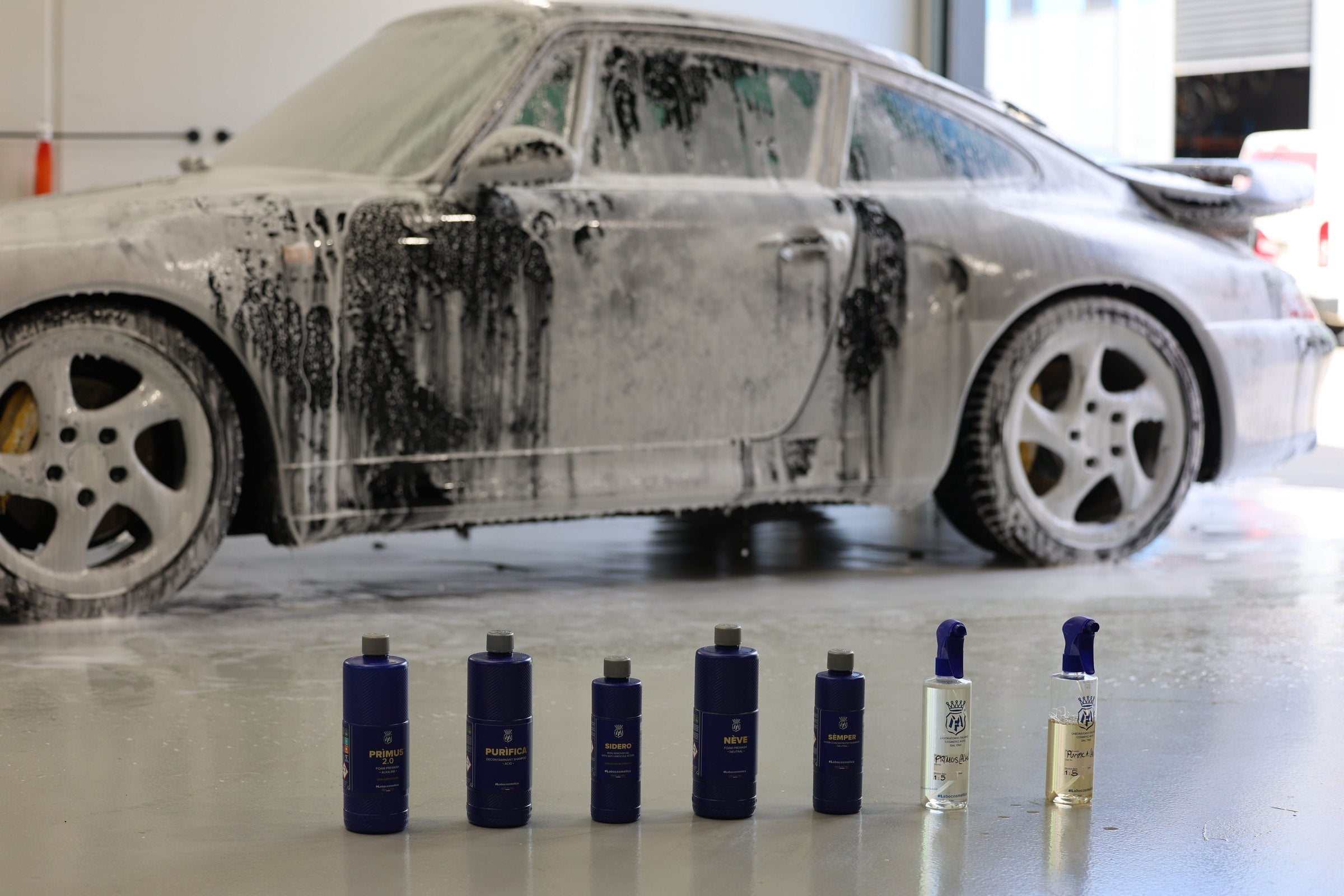
Here is a full decontamination wash costed line by line — alkaline pre-wash through a foam cannon, acid decon foam through the same cannon, then a neutral contact wash. Prices are per use on trade-size pricing.
| Stage | Product & ratio | Concentrate | Cost |
|---|---|---|---|
| Alkaline pre-wash | Prìmus 2.0 at 1:10, one-litre cannon | 91 ml | A$3.19 |
| Acid decon foam | Purìfica at 1:10, one-litre cannon | 91 ml | A$4.75 |
| Contact wash | Sèmper at 1:1500, ten-litre bucket | 6.7 ml | A$0.31 |
| Three-pH wash — chemistry only | A$8.24 | ||
Drop the pre-wash to 1:20 on a lightly soiled car and the total falls to A$6.72. The ratio is a lever you control, and on a maintenance customer it is the right one to pull — over-concentrating an alkaline pre-wash buys nothing but a faster-emptying drum.
Which brand is actually cheapest per car?

That first table uses one brand because a three-pH system is a matched set. But most of your consumption is not a matched set — it is an all-purpose cleaner, an iron remover, a shampoo. So we ran the same arithmetic across the four ranges we stock, and the results are not consistent.
All-purpose cleaner, per litre of working solution, at a comparable general-cleaning dilution:
| All-purpose cleaner | Trade size | Per litre concentrate | At 1:20 |
|---|---|---|---|
| Bilt Hamber Surfex-HD · pH 13.25 | 5L A$60.00 | A$12.00 | A$0.57 |
| MIRCH Odin Edge | 10L A$149.95 | A$14.99 | A$0.71 |
| Koch Chemie Green Star · pH 12.5 | 5L A$85.55 | A$17.11 | A$0.82 |
| Labocosmetica Dùctile | 4.5L A$165.90 | A$36.87 | A$1.76 |
Surfex-HD is roughly three times cheaper per litre of working solution than Dùctile — and at its light-duty 1:100 ratio it drops to about twelve cents a litre. We stock both. We are telling you the cheaper one wins this comparison.
Iron removal goes the other way, and the reason is dilution. Three of these four are ready to use. One is a concentrate.
| Iron / fallout remover | Trade size | Use strength | Per litre on the panel |
|---|---|---|---|
| Labocosmetica Sidero | 4.5L A$261.90 | Dilute 1:3 on paint | A$14.55 |
| MIRCH Gaia Purge | 10L A$239.95 | Ready to use | A$23.99 |
| Bilt Hamber Korrosol | 5L A$190.00 | Ready to use, no dilution | A$38.00 |
| Koch Chemie RRR · pH 7–8 | 500ml A$34.20 | Ready to use, do not dilute | A$68.40 |
The most expensive bottle on the shelf is the cheapest product on the panel, by a factor of nearly five. That is the entire thesis of this article in one row.
So the lesson is not "buy the premium brand" and it is not "buy the cheap one". It is that the answer changes product by product, and the only way to know is to divide.
Price is the floor, not the decision
Everything above gives you a cost floor. It does not give you an answer, and we would be doing you a disservice if we stopped here — because in our own studio we do not always reach for the cheapest option per litre, and we can tell you exactly why.
We only stock brands we use. There is nothing on our shelves we would talk a customer out of, because we would not have bought it in the first place. But we do have preferences, and they are not secret — ask us and you will get a straight answer about which one we would put on our own car and what would have to be true for us to choose the other.
When we advise, we are weighing three things, and the honest answer changes with all three. What the job actually requires — a neglected work ute and a coated weekend car are not the same brief. What the budget will carry, because there is no point specifying a product someone cannot restock next month. And the individual case in front of us: the substrate, the water hardness, whether the bay is enclosed, how much time the operator has. Change any one of those and the recommendation legitimately changes. Anyone who gives you the same answer regardless is selling, not advising.
Take those four iron removers. All of them work by chelation — a thiol active binds ferrous particles into a water-soluble complex, which is the purple bleed running down the panel. On price per litre they finish in a clear order. On suitability they do not finish in that order at all, and here is what actually separates them, from each manufacturer's own published data:
| Product | What genuinely distinguishes it | When we would reach for it |
|---|---|---|
| Labocosmetica Sidero | Gel format. Shifts purple for iron and to a dark green-bronze where calcium and limescale are present — so it reports two contaminants, not one. Inert on bodywork, bumpers and plastics. | Hard-water areas and cars carrying both fallout and mineral staining. The dual colour signal saves a separate diagnosis. Keep it off bare untreated metal. |
| Bilt Hamber Korrosol | Sodium mercaptoacetate at 15–25%, pH 5.5–7.0. Formulated to spread across paint — its sibling Auto-Wheel uses the same active but is built to cling to a vertical wheel. | Paint before claying. Stripping the iron chemically first means the clay is not dragging sharp ferrous particles across the finish, and the bar lasts far longer. |
| Koch Chemie RRR | Ammonium mercaptoacetate 15–40%, pH 7–8 on the manufacturer's own SDS. Balanced deliberately to stay wet through a full three-to-six-minute reaction rather than flashing off. | When you need a long, controlled dwell and a genuinely neutral pH on mixed substrates — paint, glass and rims in one pass. |
| MIRCH Gaia Purge | Hydrotropes hold it wetter for longer in heat, it degreases while it reacts, and the mercaptan odour is substantially reduced. | Enclosed bays, hot days, and any workshop where the smell of a conventional fallout remover is a genuine problem for you or the person next to you. This one matters more in practice than any table suggests. |
Not one of those differences shows up in a price-per-litre column. A product that stays wet on a 35-degree day is worth more than one that saves you four dollars and flashes off before it has finished reacting. A low-odour formulation is worth real money if you work in a closed shed. That is the sort of thing you only learn by using them.
◈ And one caveat on our own APC table
We compared those four all-purpose cleaners at a flat 1:20 so the arithmetic was like for like. In practice they are not always doing the same job at the same ratio. Surfex-HD is still working at 1:100–1:200 for light duty, which is where its real economy sits. Dùctile is Alcantara-approved and carries cationic softeners for interior fabric — which is precisely why we reach for it on a trimmed interior and not for a wheel arch.
So Dùctile finishing last on cost per litre is not a verdict on Dùctile. It is a reminder that a fixed-ratio comparison flattens the differences between products built for different substrates. Read the table as a floor, then choose on the job in front of you.
The other factors that never make it into a spreadsheet are certification and behaviour. VDA testing on the Labocosmetica pre-washes is independent material-compatibility work against paint, alloys, trim, PPF and rubber — that is a liability argument, not a cleaning one, and on a customer's car liability is worth paying for. Rheology decides whether a product sits where you sprayed it or runs off a vertical panel. Colour indication tells you when the reaction has finished, which stops you rinsing early or letting it dry. None of it divides neatly.
And a lot of what we know did not come from a data sheet. We are lucky enough to have customers and trade contacts who tell us what is working and what is not — the tips, the failures, the "try it at half that ratio" corrections that come back from people using this gear every day. That feedback loop is genuinely the most valuable thing we have, and it keeps changing what we recommend. If you find something that contradicts what is on this page, we want to hear it.
◈ Why these ratios work — the chemistry, not the marketing
Concentrates dilute far because they are formulated with high-purity actives and minimal filler. Each molecule does more work, so you need fewer per litre. Sèmper's 1:1500 comes from an essentially single-active non-ionic surfactant system — there is very little in the bottle that is not cleaning.
It is also why over-concentrating does not improve results. Above the concentration the chemistry needs, the extra active has nothing left to react with. You are pouring product down the drain and, with acid or alkaline chemistry, raising the surface risk for no cleaning benefit.
And it is why the iron table inverts. Sidero, Korrosol, Gaia Purge and RRR all work by chelation rather than acid attack — a thiol group binds ferrous particles into a water-soluble complex, which is the purple bleed you watch run down the panel. Same mechanism, but only one of the four is sold as a concentrate you dilute yourself.
One honest complication: not everyone measures the same way
Comparing pre-washes is harder than comparing APCs, and it is worth knowing why before you try.
Bilt Hamber quote a Panel Impact Ratio — the concentration actually landing on the paint, typically 0.5–2% for Touch-Less and 1–5% for Auto-Foam. Most other brands quote a reservoir ratio, which is what you mix in the foam cannon bottle before the pressure washer dilutes it again on the way out.
Those two numbers are not interchangeable, and converting between them requires knowing your machine's actual draw. Anyone who converts one to the other without measuring their own setup is guessing. If you want the real figure for your pressure washer, we built a dilution chart and calculator for exactly that — it walks through the bucket test that measures your throughput in about five minutes.
What percentage of a detailing job is product cost?
Set the chemistry number against a real ticket. A decontamination wash at A$150 carries about A$8 of chemistry — a shade over five per cent.
So chemistry is not the lever on your margin, and this is the most useful sentence in this article. If a job is not making money, buying cheaper product will not fix it, because you are optimising five per cent of the ticket. The variables that matter are how long the car is on the bay, how much of that time is rework, and whether the price reflects the hours.
It also reframes what "expensive product" means. The gap between a premium pre-wash and a budget one, per car, is often two or three dollars. If the premium product saves fifteen minutes of agitation, or removes the risk of marking a customer's trim, it has repaid itself several times on one vehicle. Chemistry is cheap. Your time and your liability are not.
Is an expensive polishing machine worth it?

Here is where detailers lose the most money, and it is the mirror image of the shampoo mistake. We watch people save two hundred dollars on a polisher and pay for it every week for five years.
There are two separate reasons a better machine costs less to own, and they are usually blurred together into one vague claim. They deserve separating, because only one of them is about speed.
The first is throughput. A larger throw covers more panel per pass, and a machine with genuine torque does not bog down and stall when you lean into a stubborn area — which is the moment cheap DAs stop cutting and start polishing air. That is where the time actually goes. It is a function of throw, power delivery and balance, not of vibration.
The second is vibration, and it is not a comfort feature. It is an occupational health exposure. Prolonged hand-transmitted vibration causes hand-arm vibration syndrome — the early signs are tingling and numbness in the fingers after using vibrating tools. Australia does not currently have a legally binding workplace exposure standard for hand-arm vibration; Safe Work Australia's guidance says so explicitly and instead points to the widely used reference values of 2.5 m/s² A(8) as an action value and 5.0 m/s² A(8) as a limit value, with measurement under AS ISO 5349.1 and 5349.2. Your general duty to manage the risk under work health and safety law applies regardless.
We are not going to tell you that a better polisher saves you hours because it vibrates less. That is two claims welded into one and the join is weak. What lower vibration buys you is endurance and consistency — the fourth and fifth cars of the day finishing to the same standard as the first — and it buys you not developing a permanent injury in your thirties. What buys you the actual hours is throw and torque. Both arguments point at the same machine. They are just different arguments, and a supplier who runs them together is hoping you do not look closely.
⚠ How to actually judge a polisher, in two questions
Ask for the declared vibration figure in m/s². Industrial tool manufacturers publish it because their customers are audited on it. If a seller cannot produce a number for a machine they want A$300 for, that silence is the answer. Compare it against the 2.5 and 5.0 reference values above for a realistic daily trigger time.
Ask what happens under load. Free-spinning specifications are marketing. The question is whether the machine holds its speed with pressure on a curved panel, because a DA that stalls is one that turns a two-hour correction into a three-hour one.
Then do the payback sum, which takes ten seconds. Divide the price difference by your hourly rate multiplied by the hours saved per car. At A$120 an hour, a machine that saves ten minutes a car repays a A$200 premium in ten cars, and a A$700 premium in thirty-five. For anyone detailing full time, both are inside a couple of months — and everything after that is margin, on top of arms that still work at fifty.
We stock the Dynabrade forced-rotation DA, the DIY Detail Correction Pro cordless in 15mm and 21mm, and the Mirka cordless 77mm for tight work. We are not going to pretend those are the only good machines made. What we will say is that we chose them by using them on customers' cars, and we will give you the honest comparison against whatever you are considering, including when the answer is that your current machine is fine.
Is it worth buying the trade size?
The last thing that falls out of this arithmetic is container size. Below is the real difference between our small and trade sizes, per litre of concentrate, at current retail.
| Product | Small size | Trade size | Saving per litre |
|---|---|---|---|
| Nìtido glass cleaner | A$67.80/L | A$22.20/L | 67% |
| Dùctile APC | A$75.80/L | A$36.87/L | 51% |
| Sèmper shampoo | A$87.80/L | A$46.20/L | 47% |
| Omnìa 2.0 interior cleaner | A$75.80/L | A$43.76/L | 42% |
| Dèrma 2.0 leather cleaner | A$85.80/L | A$49.76/L | 42% |
| Sidero iron remover | A$89.80/L | A$58.20/L | 35% |
| Verìtas panel wipe | A$59.90/L | A$43.53/L | 27% |
| Prìmus 2.0 pre-wash | A$45.90/L | A$35.09/L | 24% |
| Purìfica acid shampoo | A$64.90/L | A$52.20/L | 20% |
| Nève neutral snow foam | A$38.90/L | A$32.20/L | 17% |
The honest caveat is shelf life and cash flow. A ten-litre drum of something you use twice a year is not a saving, it is money on a shelf. Take the size step on what you genuinely go through — for most detailers the pre-wash, the shampoo, the APC and the interior cleaner, which is conveniently where four of the five largest savings sit.
⚠ The assumptions, stated plainly
Every cost above depends on one number we cannot know for you: how much working solution your process consumes per car. We have assumed a one-litre foam cannon reservoir and a ten-litre wash bucket, which is what we run on a typical sedan. Run a two-litre cannon and the pre-wash figures double. Foam a large SUV twice and they double again.
Ratios follow the convention that 1:10 means one part product to ten parts water — so about 91ml makes a litre of working solution, not 100ml. Manufacturers write this differently, so check before converting anyone's chart, and see the Panel Impact Ratio section above.
Prices are our published retail as at August 2026 and will move. Trade pricing is lower, which shifts every figure down and changes none of the conclusions. Vibration reference values are Safe Work Australia guidance figures, not an Australian legal exposure standard — that distinction matters and we are not going to blur it to sell a polisher.
How to redo this for your own studio
Measure once, properly, on one car. Fill your cannon and buckets with a measuring jug rather than by eye and write the volumes down. Almost everyone we have done this with is surprised, usually because the cannon holds more than they thought.
Work out price per litre of concentrate, not per bottle. That is the only number that compares a 500ml bottle against a ten-litre drum honestly.
Divide by the ratio plus one, multiply by your measured volume. That is your cost per car for that product. Do it for the five products in your core process and you will have a cost floor for every service you sell, in about twenty minutes.
Then leave it alone. Recheck when prices move or your process changes. It is not a number that needs monthly attention — it is a number you need once, so every pricing decision after it is made with your eyes open.
We are detailers who happen to sell chemistry
Alpha Details runs a detailing studio and a paint protection film bay in Heidelberg West, Melbourne. Everything we stock is something we use on customers' cars, which is why we can publish dilution ratios, cost workings and a table where our dearest APC finishes last, without checking with a marketing department first.
We are comfortable selling anything in this store, and we still have favourites. Those two things are not in tension — we only carry brands we have proven on real cars, and within that set there are products we would put on our own vehicle first, and circumstances where we would tell you the other one is the better buy. Ask, and you will get the reasoning rather than the sales line.
If you work in the trade, a trade account gets you trade pricing across the range, and you are welcome to call us about a process problem whether or not you bought the product from us that week. The information here is free and stays free. We learn as much from the detailers we supply as they learn from us — so if your experience contradicts something on this page, tell us and we will update it. Ask us the awkward questions. That is the part we enjoy.

Leave a comment
This site is protected by hCaptcha and the hCaptcha Privacy Policy and Terms of Service apply.