
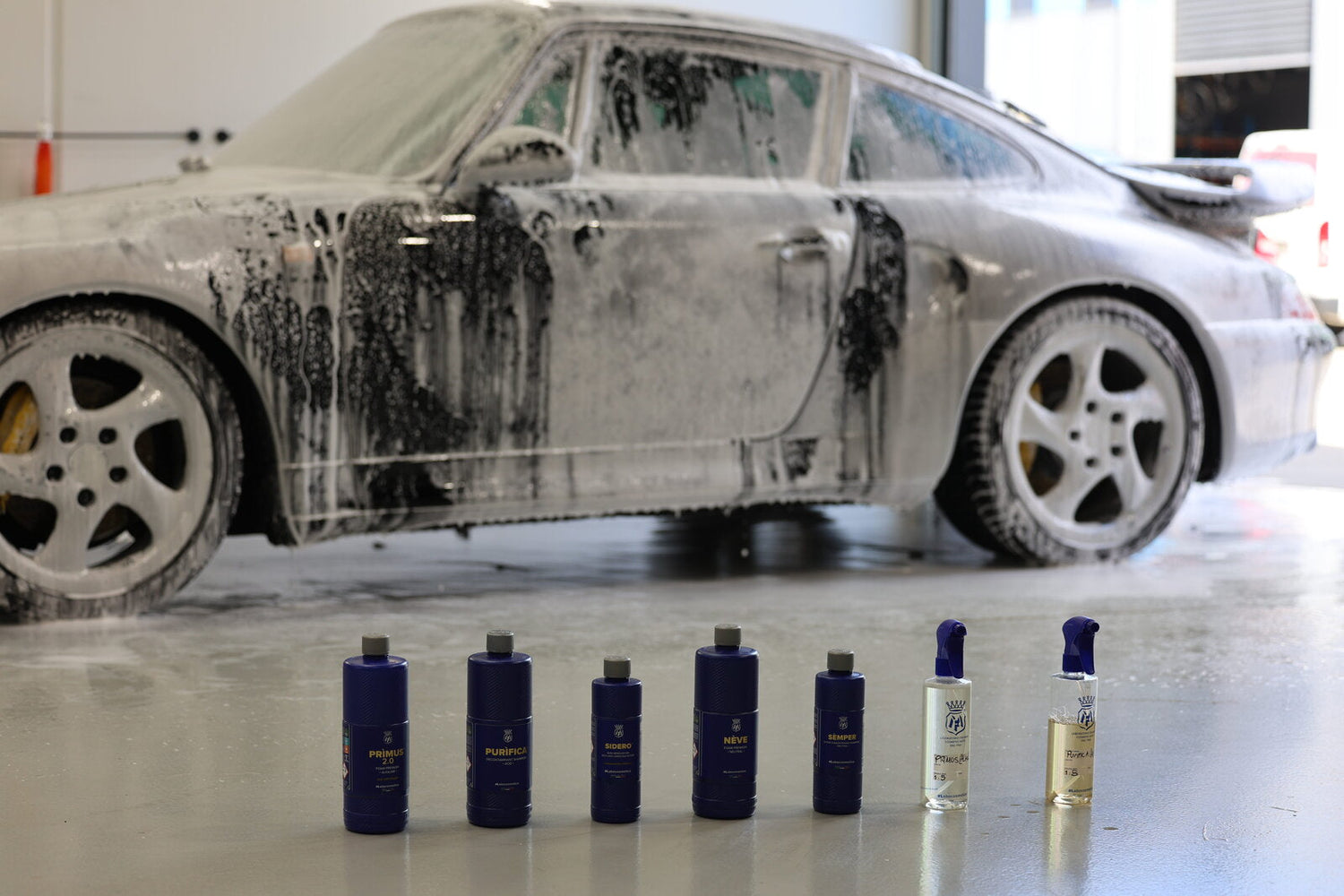
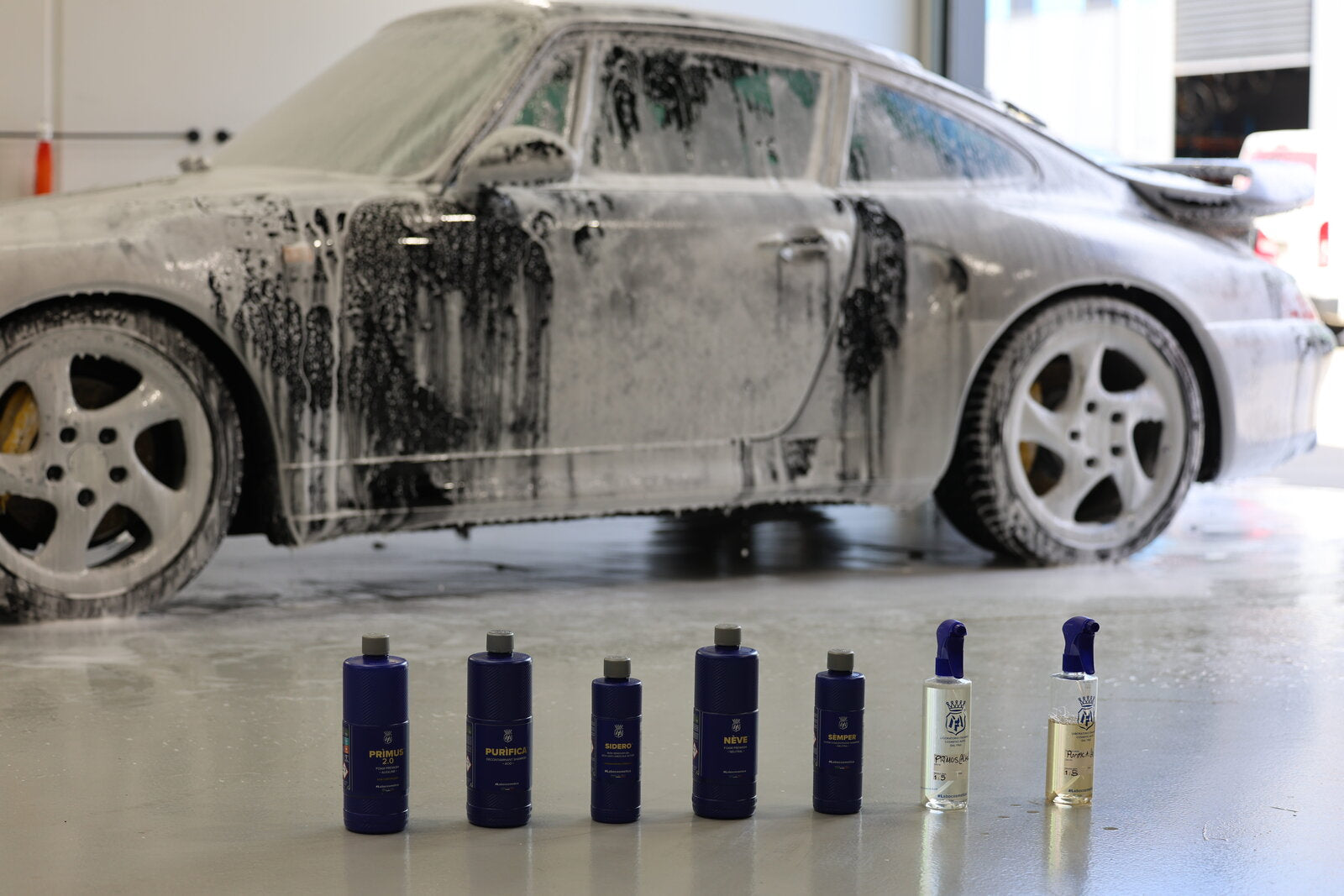
Every coated-car owner eventually asks the same question at the wash bay: that thick blanket of snow foam is alkaline, so is it quietly eating my ceramic coating? It's a fair worry, and most of the answers online are vague hand-waving. Here's the actual chemistry.

The short answer
Alkaline snow foam can be perfectly safe on a ceramic-coated car, but only when the alkalinity comes from the right chemistry. A pH-neutral foam is always coating-safe. An alkaline foam is safe too, provided it is built on surfactant chemistry rather than free caustic soda, and provided you never let it dry on the panel. The pH number printed on the bottle tells you far less than the ingredient producing it.
Why the pH number isn't the thing to panic about
First, a quick reset on what pH actually measures. The pH scale is logarithmic, so each single step is a tenfold change in hydrogen ion concentration. A pH 11 product isn't "a bit stronger" than pH 9, it is a hundred times more alkaline. That sounds alarming, and it's why people fixate on the number.
But here's the part the label won't tell you: pH alone does not tell you how damaging a product is. Corrosivity depends on the active chemical ingredient, not the pH reading. Two pre-washes sitting at exactly the same pH can behave completely differently on your paint, trim and coating depending on what chemistry is generating that alkalinity. So the real question was never "how high is the pH", it's "what's making it alkaline".
What actually attacks a ceramic coating
The genuine villain is free caustic soda. Sodium hydroxide (NaOH) is cheap, it's a brutally effective degreaser, and it turns up in a lot of budget snow foams and all-purpose cleaners. It also strips protective coatings, attacks bare aluminium, and degrades rubber and plastic trim.
On an alloy or a bare metal edge, the reaction is not subtle:
2 Al + 2 NaOH + 2 H2O -> 2 NaAlO2 + 3 H2 (hydrogen gas)
That's aluminium being converted to sodium aluminate with hydrogen gas fizzing off: the chemistry behind the pitting, etching and irreversible whitening you see on trim and wheels that have met caustic chemistry. The same aggressive hydroxide that does that is what shortens the life of a sacrificial coating. When a snow foam genuinely harms a coated car, free caustic soda is almost always the reason, not the abstract fact that the foam was "alkaline".
So is alkaline snow foam safe on a coated car? It depends on the chemistry
This is exactly why a product like Labocosmetica Primus 2.0 exists. It sits at pH 11, properly alkaline with real cleaning power for heavy grime, but it contains no free caustic salts. The alkalinity is built from safer alkaline surfactant chemistry instead of NaOH, which is what lets it lift dirt without the collateral damage.
You don't have to take that on faith, either. Primus 2.0 is the world's first VDA-certified pre-wash. VDA stands for the Verband der Automobilindustrie, the German Automotive Industry Association, and the certification means the product has passed independent material-compatibility testing against delicate automotive surfaces: paint, alloys, trim, PPF, rubber and coatings. Very few car care products hold it, because passing usually means reformulating the chemistry from the ground up. It's the closest thing the industry has to proof that a product won't damage what it touches.
"But neutral foam is weak" - usually true, with one exception
Here's the trade-off the marketing rarely admits: most pH-neutral snow foams buy their safety by giving up cleaning power. They throw a thick, photogenic blanket of foam on the car, but chemically they're doing very little. It's closer to decoration than decontamination. That's the legitimate reason a lot of detailers reach for an alkaline pre-wash in the first place. If neutral always meant feeble, the choice really would be safety versus performance.
This is where the surfactant chemistry matters more than the pH. Labocosmetica NEVE is the exception that breaks the trade-off. It's pH-neutral, yet it's built from a concentrated blend of highly biodegradable, phosphate-free surfactants engineered to cling to the panel and keep working, delivering cleaning power comparable to an alkaline detergent without the alkalinity. It also carries calcium-carbonate chelating agents, so it holds its performance in hard water and leaves less residue as it dries, and it's stable enough to use in direct sunlight.
The practical upshot is that NEVE does two jobs at once: it's a serious touchless pre-wash and a neutral wash shampoo, all while staying completely safe on coatings, waxes, sealants and delicate trim. For a coated daily driver that means real cleaning out of your pre-wash step without ever stepping outside coating-safe pH. Save a well-formulated alkaline like Primus 2.0 for the genuinely filthy days, and let NEVE carry the routine washes.

How to pre-wash a coated car without stripping it
Technique matters as much as chemistry. Work on a cool panel out of direct sun. Let the foam dwell so it can break down dirt, but never let it dry on the surface. Then rinse thoroughly before your contact wash. Almost every "the snow foam wrecked my coating" story traces back to one of two things: caustic chemistry, or letting product bake dry on hot paint. Avoid both, and a quality alkaline pre-wash and your ceramic coating will get along just fine.
The hardware matters less than the chemistry, but it is not nothing: a cannon that cannot generate foam dense enough to cling gives you no dwell at all, and dwell is the whole point of the step. We compared the three foam cannons we carry on published specs and real cost, including the pressure and flow minimums your machine has to clear before any of them will foam properly.
If you want to keep the whole wash inside coating-safe pH chemistry, the Labocosmetica 3pH Maintenance Wash System pairs the right products across the pre-wash, wash and decontamination steps so you're never guessing.
Have a question about the chemistry on your own coated car? That's exactly the kind of thing we're happy to talk through. It's the reason we test and stock what we do.

Leave a comment
This site is protected by hCaptcha and the hCaptcha Privacy Policy and Terms of Service apply.