
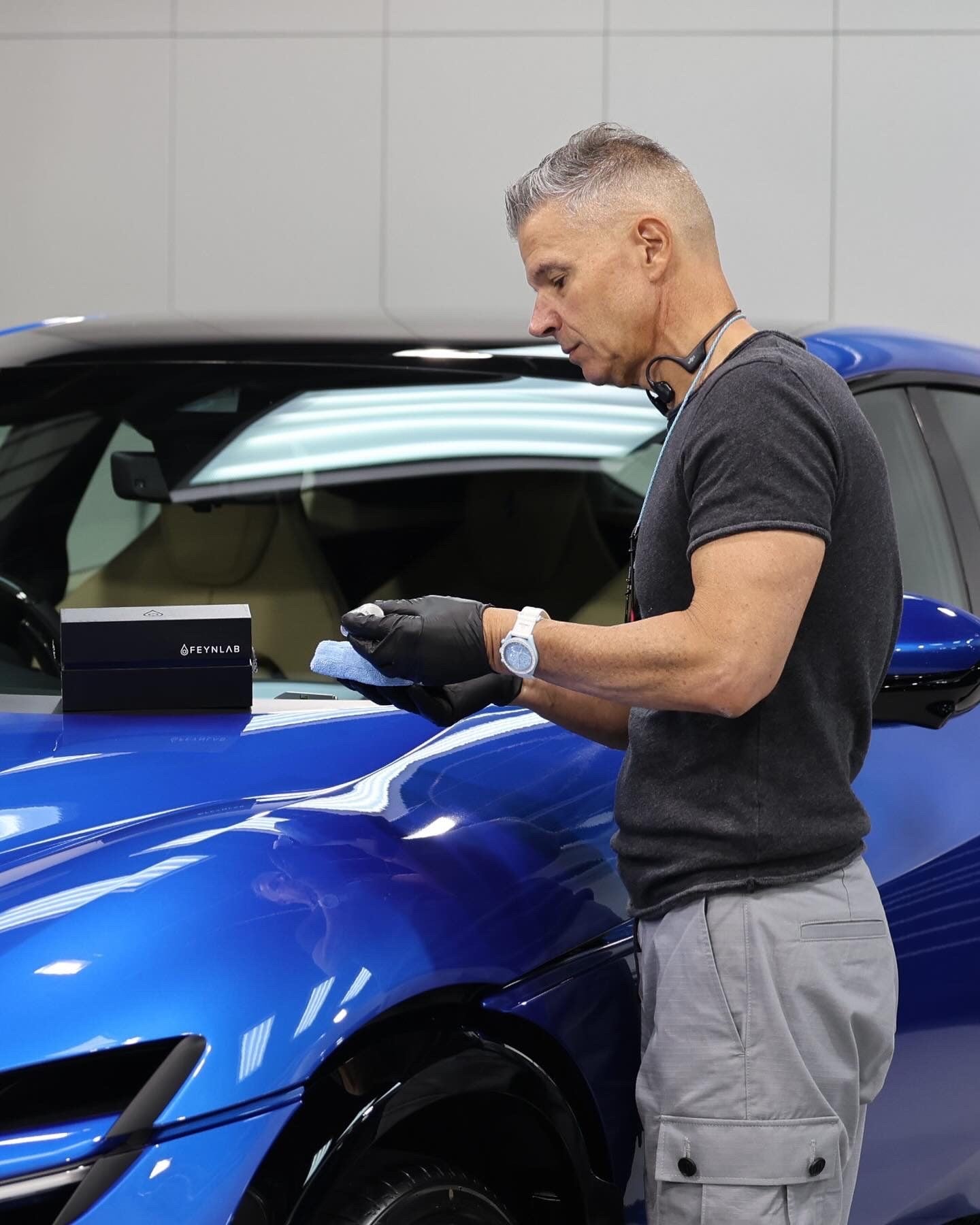
A little while ago I had a public disagreement with a well-known PPF installer about something that sounds boring but matters enormously: whether you should correct paint before wrapping a car in protection film. His position was simple — the film hides most defects anyway, so why bother removing clear coat to polish first? It's a popular argument. It's also wrong, and the chemistry explains why. Here's the full case, because if you're about to spend thousands protecting your paint, you deserve to know what's actually happening underneath that film.
The argument: "the film covers it, so why polish?"
On the surface it sounds reasonable. Quality paint protection film is optically clear and sits over light imperfections, so a swirled, slightly hazy panel can look transformed the moment the film goes down. If the film visually masks the defects, the reasoning goes, polishing first is just removing clear coat for no reason — and clear coat is finite, so why waste it?
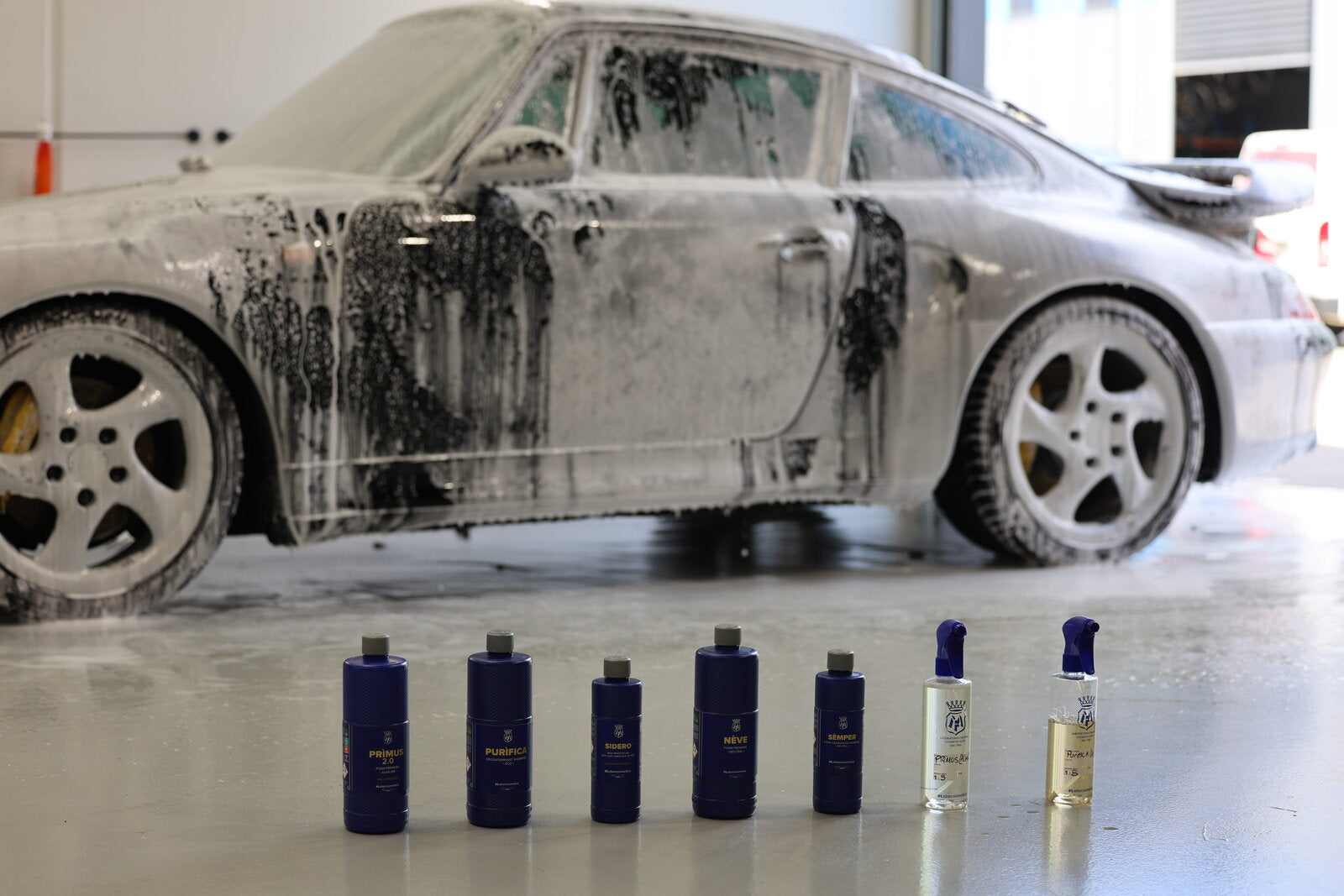
We actually agree on plenty of the prep. We both start with a proper three-stage pH-balanced wash and chemical iron-fallout removal before anything touches the paint. Where we part ways is everything that happens next.
What you're really doing when you skip correction
Here's the part the "film hides it" crowd skips over. Paint protection film isn't a temporary cosmetic — it's a five-to-ten-year commitment bonded to your clear coat. Whatever is on that paint the moment the film goes down gets sealed under it. Every swirl, every water spot, every patch of oxidation is now entombed beneath an expensive layer that you cannot polish through. To fix any of it later, you have to peel the entire film off and start again.
And here's the bit people get backwards. Quality film blocks 90–99% of UV, which means once it's on, it actually slows oxidation of the paint underneath. That's a genuine benefit — but it cuts the other way too. The film doesn't reverse anything; it preserves the surface in whatever state you hand it. Wrap pristine, corrected paint and you've locked in showroom condition. Wrap tired, swirled paint and you've locked in tired, swirled paint — for the life of the film. The decision to skip correction isn't "saving clear coat." It's choosing to freeze flaws in place for a decade.
The clay bar contradiction
In the same conversation, the installer insisted on clay-barring the paint as part of his prep. This is where the logic collapses on itself. A clay bar removes bonded contamination by shearing it off the surface — and in doing so it almost always induces some degree of fine marring, what detailers call clay haze. It happens on most clear coats, varying with paint hardness, clay grade and how much lubricant you use, but it happens.
So you cannot, in good faith, argue "there's no need to polish" and "you must clay bar" in the same breath. If you clay, you've just created marring that needs correcting. We don't clay unless we're machine-polishing afterwards, full stop — otherwise you're introducing defects and then sealing them under the film. The two positions can't both be true.
Adhesion — the part even the skeptics admit
I asked him a trick question: do you notice a difference applying film over freshly corrected paint? He said yes — it tacks harder. And that, right there, concedes the whole argument.
Why it tacks harder. Film bonds through a pressure-sensitive acrylic adhesive, and adhesion is about contact area. A surgically clean, levelled, defect-free surface lets that adhesive make full, uniform contact with the clear coat. A rough, contaminated or marred surface leaves microscopic air pockets and high points where the bond is compromised — and those are exactly the spots where film lifts at the edges, bubbles, or peels prematurely. Better surface, better bond, longer-lasting installation. The "harder tack" he noticed isn't a curiosity; it's the measurable proof that correction makes the film perform better.
"But doesn't polishing remove paint?"
It does — but far less than people assume, and the detail matters. A typical clear coat is around 35–50 microns thick. A light, single refining step — a finishing polish like Fiero or Perfect Finish, not a heavy compound — removes so little that it's almost impossible to put a number on. Paint depth gauges disagree with each other by a few microns, and the clear coat itself is never perfectly uniform across a panel, so the natural variation in the paint is larger than the sliver a fine polish takes off. You'd have to step up to an aggressive cutting stage to approach the 2–5 microns people throw around.
That's the honest answer I give clients: a light single step removes a fraction you can barely measure, in exchange for clearing oxidation, light swirling and water spots and leaving a flawless surface for the film to grip. We still run a paint depth gauge as we work — not because the removal is dramatic, but because it tells us what the car started with and keeps us comfortably clear of any limit. On a healthy modern car, you have margin to spare.
A useful analogy: you shower before you put on a suit, even though no one looking at you would know either way. The prep isn't for the version of the car people see on day one — it's for the surface you're committing to for the next ten years.
"But it's a brand-new car"
This is the objection I hear most: the car's new, so the paint is perfect, so why correct it? The chemistry says otherwise. A modern clear coat is a two-component polyurethane that's still crosslinking after it leaves the paint booth — and from the moment that surface meets oxygen and sunlight, photo-oxidation begins. UV energy breaks C–H bonds in the resin and drives the formation of carbonyl and hydroxyl groups, with the urethane linkages the most light-sensitive of all. That's not a process that politely waits a few years to start; it begins as soon as the paint sees daylight. It's the same degradation chemistry that, left to run, eventually reads as a dull, flat, faintly yellow finish.
Now add the real world. By the time a "new" car reaches you it's been transported, pre-delivery washed, and parked on a lot for weeks — so it's already carrying wash marring and light swirls on top of paint that has, chemically, already begun to age. The flawless factory finish is mostly a trick of the showroom lighting. A single, conservative corrective step resets that surface to genuinely defect-free, and only then does sealing it under film for a decade actually make sense.
The film itself matters as much as the prep
Prep is half the equation; the film is the other half, and not all film is equal. The chemistry that separates a great film from a cheap one comes down to the polymer in the top layer. Premium films use aliphatic thermoplastic polyurethane (TPU) — a linear polymer with no benzene rings, which makes it weakly UV-absorbing and genuinely stable in sunlight. Cheaper films use aromatic TPU, whose benzene rings oxidise under UV: the methylene bridges between rings convert into conjugated quinoid structures, which is the irreversible yellowing you see on a budget wrap after one hot summer. Worse, that same reaction embrittles the film, so it loses the impact resistance and self-healing you paid for.
This is why we won't touch the no-name film flooding in from overseas, no matter how good the margin looks. We fit reputable, warranty-backed film from manufacturers who stand behind their claims — because a warranty is only worth anything if the company issuing it will still be there, and testing their product, in eight years' time.
Why we do all of this under one roof

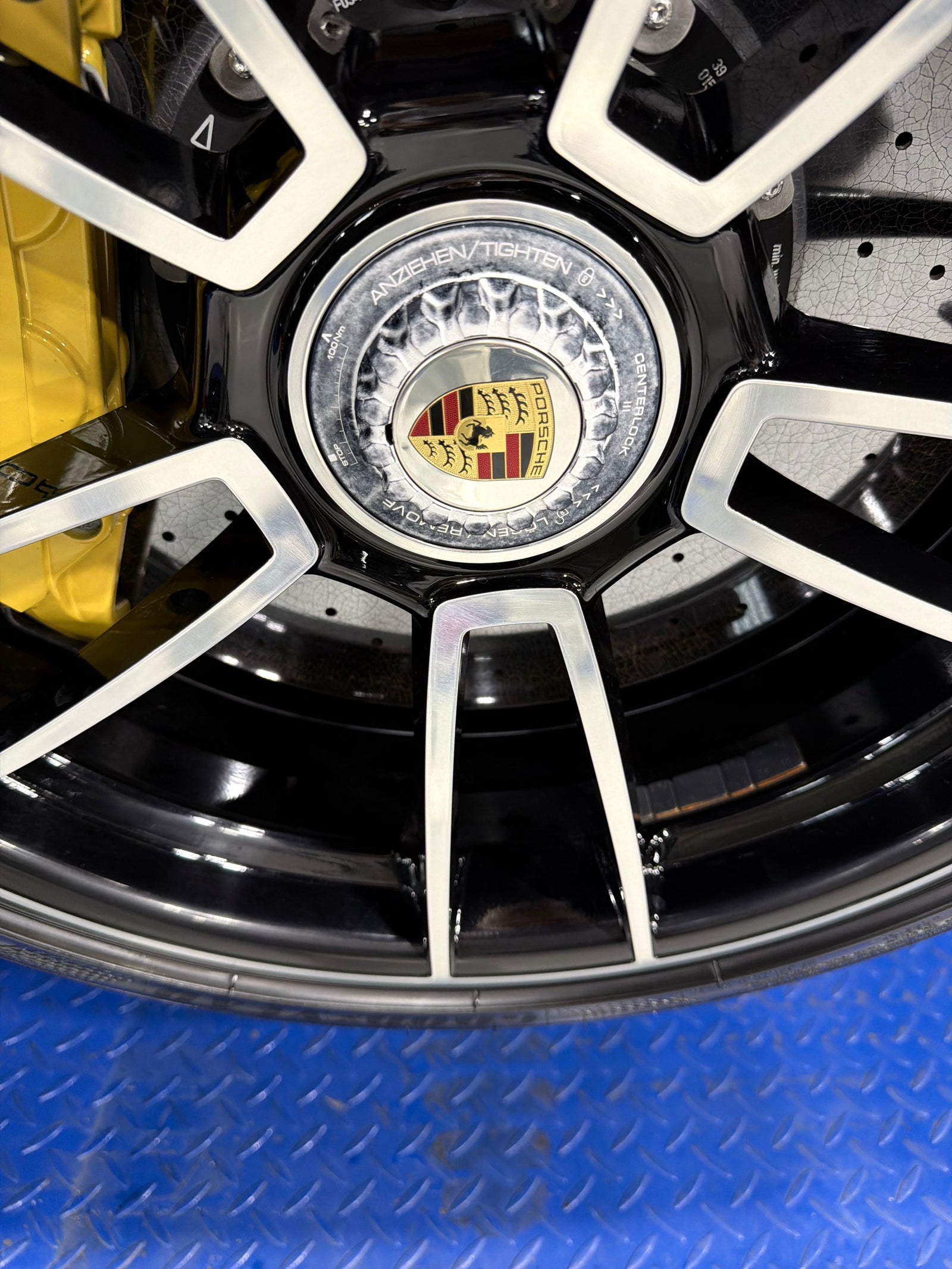
Wheels off, the whole car addressed — correction, film and coatings handled in the one bay.
Here's where it comes together. Alpha Details specialises in paint correction as well as PPF, so the prep and the install are done by the same people, in-house, with no hand-off and no compromise. And because we live in coating chemistry, we don't stop at the painted panels — we can coat wheels, the undercarriage, interior plastics and glass in the same visit, so the whole car is protected, not just the bits the film covers.
Aftercare is part of it too. After an install we book you in for a complimentary first wash with us, where we walk you through exactly how to maintain the film and the coatings so they last the distance. Protection that gets washed wrong doesn't stay protection for long, and we'd rather show you once than have you guess.
The bottom line
"The film hides it" is true for about a week. After that, you've simply made every existing flaw permanent and bonded your expensive film to a compromised surface. Correct the paint first — minimally and safely — fit a properly engineered aliphatic film, protect everything around it, and look after it afterwards. That's not over-servicing. That's the difference between paint protection that's done, and paint protection that's done right.
If you're weighing up film for your car and want it done by people who understand both the chemistry and the craft, take a look at our PPF and ceramic coating work, or get in touch and we'll talk through the right approach for your paint.

Leave a comment
This site is protected by hCaptcha and the hCaptcha Privacy Policy and Terms of Service apply.