
The bottle that "really works" might be the problem
Look up "best wheel cleaner" and the loudest reviews all say the same thing. It foams, it turns purple, it eats brake dust on contact. That visual hit — yellow goop turning red, then rinsing away — is the chemistry doing its job. Iron particles from your brake rotors react with the cleaner and produce the colour change. That part is real, and properly formulated wheel cleaners are some of the most effective chemical tools in detailing.
The problem is everything else in the bottle. The same cleaners that nuke brake dust can also nuke the finish underneath if the chemistry isn't carefully chosen. And once that damage starts, you usually won't see it for months.
The two extremes wheel cleaners sit at
Wheel cleaners live at the chemical extremes of the pH scale, and there's a reason for that. The short version: pH runs from 0 (strongest acid) to 14 (strongest base), with 7 being neutral. Each step on the scale is ten times more reactive than the one before it.
|
100×
more aggressive at pH 2 vs pH 4
|
0
cleaners required to disclose corrosivity
|
Both extremes exist for a reason. Strong alkaline cleaners lift baked-on grease, road grime, and silicone fallout. Strong acid cleaners dissolve iron particles and mineral deposits. The trouble is what they do to everything that isn't grime or iron.
The alkaline side. Strong wheel cleaners often use sodium hydroxide — caustic soda, the same chemistry as drain cleaner. Sodium hydroxide reacts with aluminium directly. The reaction is 2Al + 2NaOH + 2H2O yields 2NaAlO2 + 3H2, with hydrogen gas evolved. In plain English: the wheel surface dissolves into the cleaner. On bare or polished alloy, you'll see it as pitting and a "frosted" look over time. On powder coat, it eats the polymer layer before it ever reaches the metal underneath.
The acid side. Bright-finish wheel cleaners historically used hydrofluoric acid (HF) because it strips iron and tarnish quickly and dramatically. HF is also one of the most dangerous chemicals you can buy. It penetrates skin and attacks the calcium in bone. Modern "safer" formulations use ammonium bifluoride, which releases HF when it hits water on the wheel. Same chemistry, slightly less direct, still aggressive to wheels and still dangerous to handle.
Why pH alone is a useless number
This is where most "pH neutral, safe for all wheels" marketing falls apart. A cleaner can be pH 7 and still strip your finish if the surfactant package is wrong. And a cleaner can be pH 11 and be completely safe on every wheel if the alkalinity is buffered properly.
What matters is the active ingredient, not the pH number on the bottle. A buffered alkaline cleaner with mild surfactants and chelating agents can be more aggressive on grime than a sodium-hydroxide cleaner, while being safer on every finish. On the acid side, "noble acids" like citric or phosphoric do useful work — water spot removal, iron staining — without destroying the substrate.
What we wish was on every label: corrosivity
Here's the bigger problem. Companies are required to declare pH, but they aren't required to declare corrosivity — and corrosivity is the number that actually tells you what the cleaner will do to your wheels.
Two cleaners can have the same pH and behave completely differently on aluminium, powder coat, or chrome. A weakly-buffered pH 12 cleaner with the right surfactant package might be safer than a strongly-acting pH 10 cleaner full of sodium hydroxide. The pH number alone tells you almost nothing.
Until corrosivity becomes a labelled value, the only way to know is to read the ingredients list and look at who the brand sells to. Brands like Labocosmetica with VDA certification publish full safety data and disclose what's in the bottle. Brands that won't tell you the active ingredients are telling you something else.
|
VDA
certified safe for premium finishes
|
90%
of wheel cleaning handled by buffered alkaline + iron remover
|
Categorising your wheels before you choose a cleaner
Not every wheel needs the same chemistry. The way we approach it in the workshop is to categorise the wheel first and the cleaner second.
Carbon ceramic brake cars. Porsche Turbo S and GT cars with PCCB, McLaren, Ferrari, top-spec AMG. These cars are virtually dustless — the ceramic discs don't shed iron the way cast iron rotors do. You should almost never need an aggressive cleaner on rims fitted to a carbon ceramic setup. A pH neutral wash or a VDA-certified product is plenty. Save the alkaline cleaner for the tyres if you need to clear browning, but keep it well away from the rim.
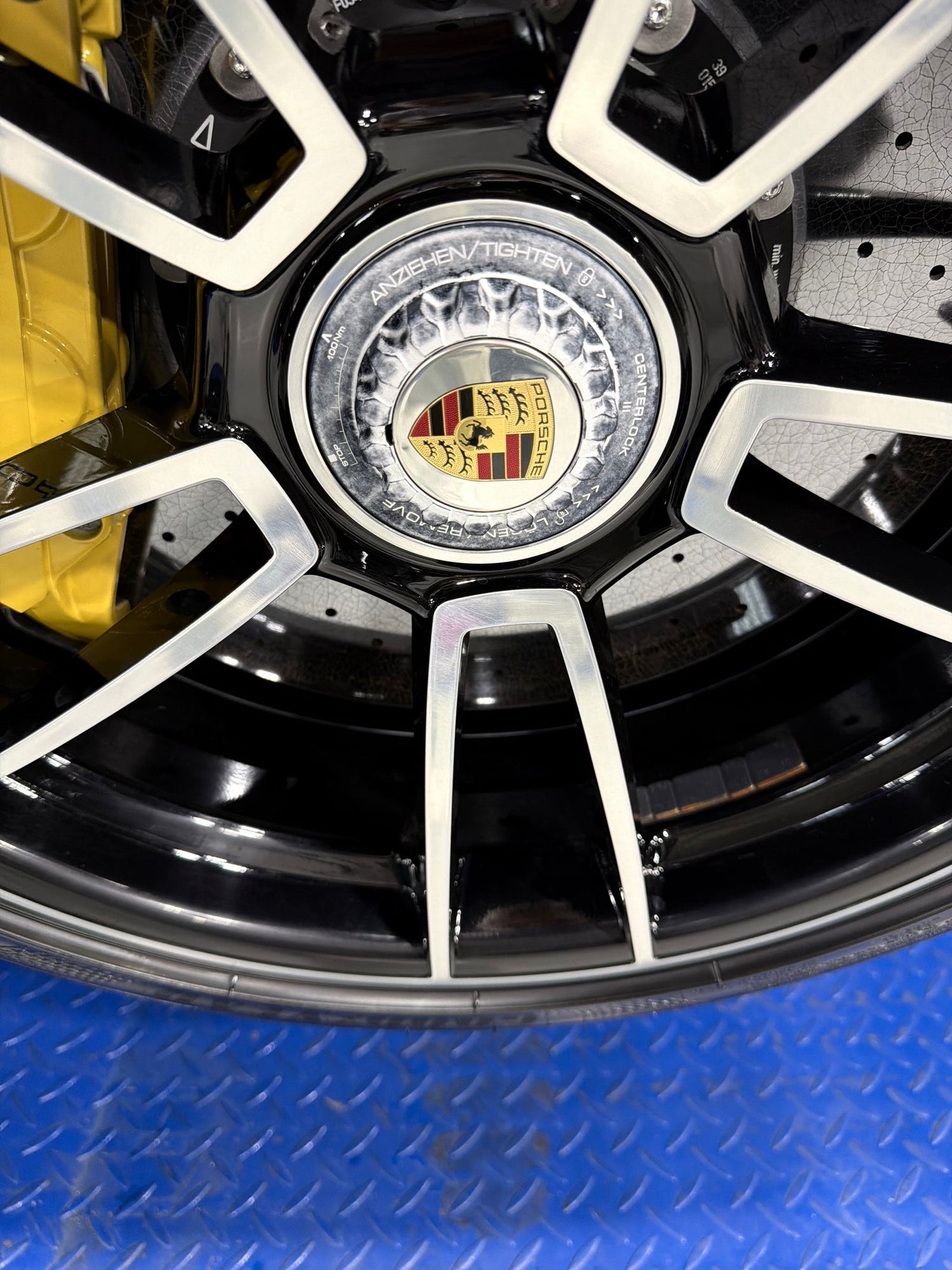
Porsche centre-lock wheels. These are some of the most expensive wheels to refinish on the road. A recent example from our workshop: a 911 Turbo S with centre-lock rims and PCCB calipers behind, pictured above. One wash with a sodium-hydroxide-based wheel cleaner is enough to mark the polished face of these wheels permanently. The hub centre, where cleaner pools, is where the damage shows up first. With this kind of car, pH neutral is the only safe answer.
Audi wheels (and most modern European cars). These have their own quirk. Look at any older Audi and you'll usually see rust forming around the hub section, where the wheel meets the hub face. The protective coating in that area is thin and gets thinner every time an aggressive cleaner is allowed to dwell. Once the hub starts rusting, the wheel develops a halo of orange that no amount of polishing fixes.
Standard alloy and painted wheels. Assess on the day. If brake dust is light and the wheel is regularly washed, you don't need anything stronger than a properly diluted shampoo and a wheel mitt. If you're recovering a neglected wheel, a controlled application of a stronger cleaner is fine — but spray, agitate, and rinse before it dwells longer than the bottle says.
Powder-coated wheels. The most common modern wheel finish and the most chemically sensitive. Powder coat is a baked-on polymer (usually polyester or epoxy), not a paint. Strong acid attacks the polymer matrix; strong alkaline softens it. A customer recently brought in a set of black powder-coated rims that had been etched by the wrong cleaner — visible as a hazy, foggy patina that wouldn't polish out. The cleaner did its job on the brake dust. It also took the surface profile of the polymer with it.
The signs you've already done damage
The frustrating part of wheel cleaner damage is the delay. A single wrong wash won't usually show visible damage on day one. The change shows up over weeks and months as cumulative exposure adds up.
A black wheel looking grey or hazy. The polymer or paint film is thinning. The pigment hasn't faded — the surface texture has roughened, which scatters light differently and dulls the colour.
Loss of shine after washing. Wheels that used to look glassy now look matte even when clean. The micro-texture of the finish has been changed.
Pitting around the spokes and lug holes. Areas where cleaner pools and dwells the longest. Visible as a sandpaper texture, usually first noticeable when light hits at a low angle.
White or chalky residue that keeps coming back. Aluminium oxide forming as the bare metal underneath the coating starts to oxidise. The protective layer is breached and the wheel is now slowly degrading between washes.
What we'd actually buy
The honest answer is that you don't need an aggressive cleaner for a regularly washed car. Brake dust, when it's fresh, comes off with a properly diluted shampoo and a wheel mitt. The aggressive products exist for problem cases — heavy iron staining, baked-on contamination, wheels neglected for months.
When you do need something heavier, the questions to ask are simple. Is it labelled safe for the finish you actually have? What's the active ingredient? Does the brand publish a Safety Data Sheet? Premium European brands like the ones in our wheels collection all publish full SDS and tell you what's in the bottle. If a brand won't tell you, that's the answer.
Buffered alkaline plus a dedicated iron remover, used sparingly, handles ninety percent of real-world wheel cleaning safely. Not as satisfying as watching purple goo eat brake dust, but it's the chemistry that won't quietly destroy your wheels while you sleep.
If you're not sure what you've got, drop into the shop or message us — happy to look at your wheels and tell you what cleaner pairs with the finish you've got. Better five minutes asking than two thousand dollars on a refinish.

Leave a comment
This site is protected by hCaptcha and the hCaptcha Privacy Policy and Terms of Service apply.