
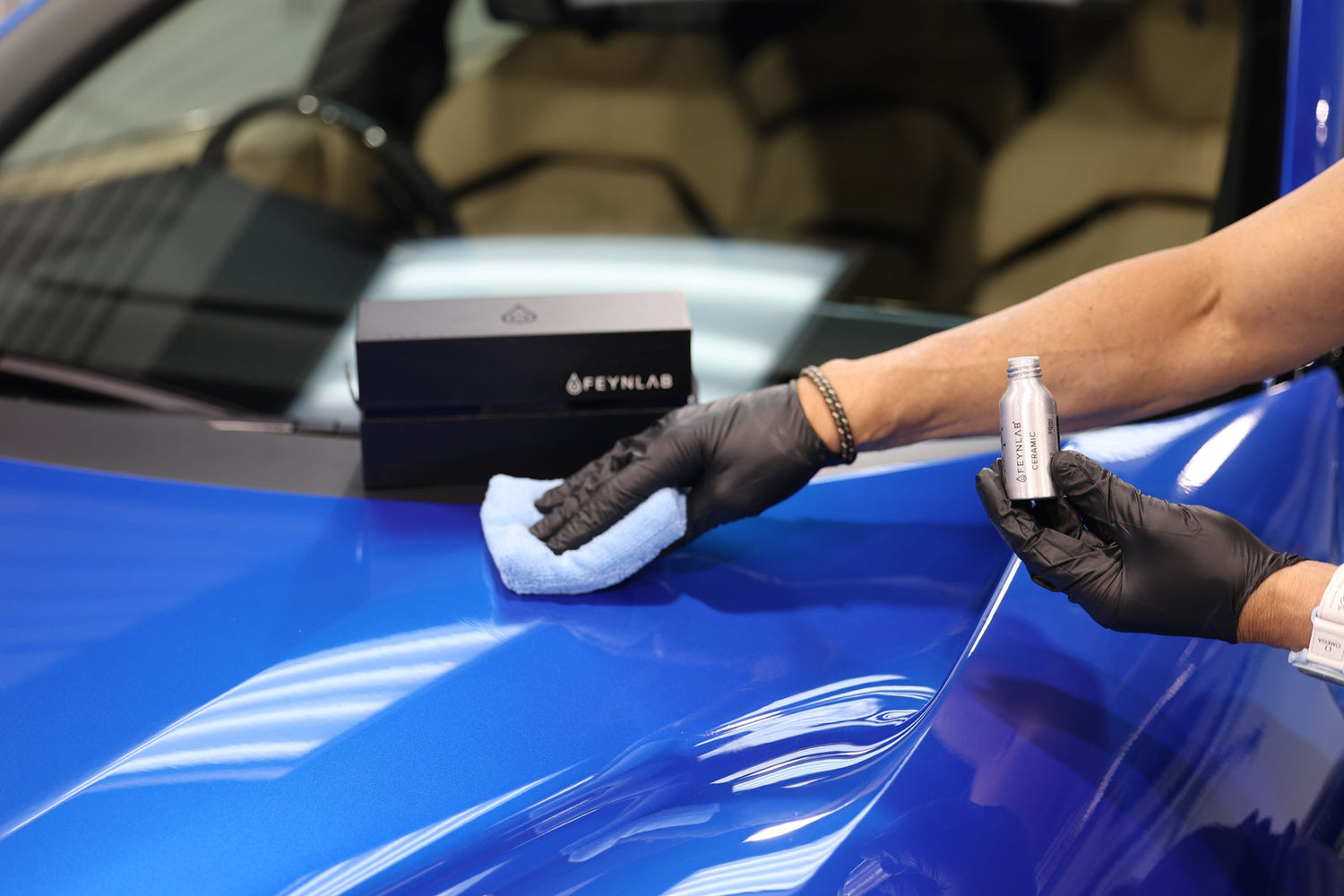

If you've shopped for ceramic coatings in the last five years, you've seen "9H hardness" stamped on roughly every product page. It's the headline number every brand reaches for, and it's marketing nonsense. The number doesn't mean what they want you to think it means, the test doesn't measure what they want you to think it measures, and on a 1-micron coating film it's barely measuring the coating at all.
I'm going to call that out, then talk about what coatings actually do — which is much more interesting and much more useful when you're deciding what to put on a car.
The 9H Number Is Mostly Hype
"9H" comes from the Wolff-Wilborn pencil hardness test (ASTM D3363). You drag pencils of increasing hardness across a coating until one of them gouges it. 9H is the hardest standard graphite pencil on the scale. That's it. That's the whole test.
Now look at the actual coating film thickness. A typical consumer ceramic coating is between 1 and 2 microns thick. A factory clear coat is around 40 microns. To get a genuine 9H reading on the coating alone — independent of what's underneath — you'd need a film roughly 150 microns thick. We're 100 times short of that. What the pencil is actually testing is mostly the clear coat sitting underneath, and a healthy factory clear coat already sits in the 9H neighbourhood before any coating ever goes on top.
The verdict
When a brand stamps "9H" on a 1-micron film, they're measuring the paint underneath and selling it back to you as a coating spec.
The test also doesn't measure the things that actually matter on a car. It tells you nothing about scratch resistance from a grit-loaded microfibre, nothing about chemical resistance to bird droppings, road salt, iron fallout, or alkaline shampoos, and nothing about UV stability. A "10H" coating and a "9H" coating could behave completely differently in any of those real-world conditions, and neither number tells you which one will hold up. So let's talk about what does.
The Real Job of a Ceramic Coating

Two things kill car paint over time, and a good coating is genuinely good at blocking both.
UV oxidation. Every clear coat begins to oxidise from the day it leaves the spray booth. UV radiation breaks the polymer bonds in the clear coat, and over time the surface goes hazy, chalky, and dull. This is the slow, invisible damage that turns a five-year-old car into one that looks ten.
50%
Gloss lost in 2–3 yrs without protection
90%
UV blocked by a quality coating
A ceramic coating builds a continuous silicon-oxygen-silicon (Si–O–Si) network on the paint surface — the same family of bonds holding quartz, glass, and most rocks together. That network absorbs UV photons before they reach the clear coat, converting the energy to harmless heat. Around 60% of all paint fading is directly attributable to UV exposure. Block the UV, you stop the fade.
Chemical attack. Bird droppings sit at pH 3–4 (acidic enough to etch unprotected clear coat in hours on a hot day). Tree sap is acidic. Bug remains are acidic and enzymatic. Iron fallout from brake dust and rail lines is reactive. Most strip soaps and degreasers are aggressively alkaline. Untreated clear coat is genuinely vulnerable to all of this — it etches, stains, and erodes. The Si–O–Si network in a cured ceramic coating is chemically inert across most of the pH range. It buys you time to wash the contamination off before it reaches the paint underneath.
Those two things — UV protection and chemical resistance — are what you're actually buying. Not a pencil number.
Two Families of Coatings, Two Different Jobs
The silicon-based polymers used in ceramic coatings split into two main families. Both build a Si–O–Si network in the end. What's different is how they get there, and what the resulting network looks like.
Polysiloxane — the Soft, Slick One

A polysiloxane is a chain of alternating silicon and oxygen atoms with organic groups on the side. The generic formula is [R₂SiO]ₙ. It's the chemistry behind every silicone you've ever touched — bakeware, sealants, even hair products.
When a polysiloxane ceramic coating cures, the Si–O–Si backbone is already there in the bottle. The polymer chains pack onto the surface and crosslink with their neighbours as the solvent flashes off. You end up with a flexible, hydrophobic film that bonds to itself and, more weakly, to the paint underneath.
This is the chemistry behind most DIY-friendly coatings — including Labocosmetica HPC 2.0. Long open time, forgiving in moderate humidity, decent gloss, proper hydrophobicity. The trade-off, and this is where I think the industry's been quietly dishonest, is that the cured film is genuinely soft. The polymer network is flexible by design. That means it sacrifices itself slowly through normal wash cycles — every microfibre with grit on it, every alkaline shampoo, takes a microscopic amount of coating with it. That's why most hybrid polysiloxane coatings have a real-world life of 12 to 24 months on a daily driver. They don't fail dramatically. They wear off in the wash bucket.
Reframe
Polysiloxane coatings aren't "bad" because they wear off — they're useful because they wear off. A sacrificial top layer is doing its job when it takes the abuse instead of the paint.
Polysilazane — the Hard, Network-Building One
Polysilazane swaps oxygen for nitrogen in the backbone. The generic formula is [R₂Si–NH]ₙ — silicon and nitrogen atoms alternating, with hydrogen on the nitrogens. In the bottle, there's no Si–O–Si network yet. What you're applying is the precursor.
The network builds during cure. When polysilazane meets the moisture in the air, the Si–N bonds hydrolyse:
–Si–NH–Si– + H₂O → –Si–OH + H₂N–Si–
Those silanol (Si–OH) groups then condense with each other, forming Si–O–Si bonds and releasing water:
–Si–OH + HO–Si– → –Si–O–Si– + H₂O
The Si–N–H groups keep hydrolysing and release small amounts of ammonia (NH₃) — which is why freshly applied polysilazane coatings have that sharp smell during cure. Ventilation matters.
The thing that makes polysilazane different isn't the final composition. It's that the network builds in real time, directly against the paint surface, instead of being pre-formed in the bottle. The Si–N groups can react not just with airborne water but with hydroxyl groups on the paint itself, forming covalent bonds to the substrate. The crosslink density is higher because the network forms in situ. There are fewer chain ends, fewer voids, fewer weak spots. The cured film is dramatically harder, more abrasion-resistant, and more chemically stable than a polysiloxane — and lasts measurably longer. Labocosmetica HPC PRO is the polysilazane in our professional range.
The Other Chemistry Worth Knowing About

There's a third family worth mentioning because it's what sits underneath every Labocosmetica professional layered coating: a siloxane resin built around a polyhedral cage structure. This is the chemistry behind BLINDO PLUS and STC. Instead of long flexible chains, the resin is built around rigid 3D silicon-oxygen cages — closer to glass than to silicone.
That cage structure is what makes BLINDO almost mechanically impossible to remove. You don't polish it off; you sand it. BLINDO and STC are the armour layer. The crosslinked cage network is exceptionally hard, exceptionally durable, and chemically resistant on its own. What it doesn't give you is the silky, hydrophobic, mirror-gloss surface that owners expect from a finished coating. That's why the professional protocol layers HPC PRO over the top.
Why a Layered System Wins

On a Labocosmetica professional install, what's actually on the paint is two distinct films doing two distinct jobs.
BLINDO PLUS (or STC) goes down first as the hardness layer. It bonds aggressively to the clear coat, builds a rigid cage network, and provides the mechanical and chemical barrier underneath. This is the layer that has to outlast the next several years.
HPC PRO goes over the top as the polysilazane finishing layer. It adds the hydrophobicity, the slickness, the gloss, and — critically — it acts as a sacrificial top layer. The wash-cycle wear that would slowly erode an unprotected coating instead erodes HPC PRO, which can be topped up or refreshed without disturbing the BLINDO underneath. The armour stays intact for years. The visible surface stays slick and bright because it's being maintained.
The architecture
Hard, durable base under a slick, replaceable top.
That's the difference between a 12-month hybrid coating you apply yourself and a 5-year professional system. Not the pencil number. Not even just the chemistry of any single layer. It's the architecture.
Which One Belongs on Your Paint
If you're applying a coating yourself in a home garage, polysiloxane is the right call. HPC 2.0 is forgiving, tolerates moderate humidity, has long open time, and gives you 12–24 months of real protection on properly prepped paint. The fact that it eventually wears off is the trade-off you make for being able to apply it in your driveway.
If you want a coating that protects the paint for the next five years — and you want the gloss and slickness to still be there in year three — the layered professional system is what actually delivers that. BLINDO PLUS as the armour, HPC PRO as the sacrificial top. Application is restricted to trained Labocosmetica detailers because the cure windows are tight, the humidity has to be controlled, and the layer-on-layer protocol is unforgiving of mistakes. If you're a workshop looking for trade access, the trade enquiry page is where to start. If you want us to apply it for you in our Heidelberg West studio, our ceramic coating service page is where to start.
The Actually Useful Takeaway
Forget the pencil number. The questions worth asking when you're comparing coatings are simpler and more honest:
Does it block UV well enough to stop oxidation? A real Si–O–Si network does — that's the chemistry doing real work.
Is it chemically inert across the pH range you'll encounter in normal wash and contamination cycles? Polysiloxanes and polysilazanes both are, once cured. Cheap acrylic "ceramic" sprays often aren't.
Is the architecture matched to how long you want it to last? A single-layer DIY coating for 1–2 years. A layered professional system for 5.
That's the conversation that actually changes the outcome on your panel. The 9H sticker is, mostly, somebody trying to win the conversation before it starts.
Ready to talk chemistry?
Explore the full Labocosmetica Australia range, or book a professional install at our Heidelberg West studio.

Leave a comment
This site is protected by hCaptcha and the hCaptcha Privacy Policy and Terms of Service apply.