When we train detailers and run classes, we always start in the same place: not with a product, but with a principle. Almost everything on a car care shelf falls into one of three buckets - acid, neutral, or alkaline. Once that clicks, the mystery of "what's actually in this bottle" disappears, and you stop buying on marketing and start choosing on chemistry. This is the single most useful thing you can learn as a detailer, and it takes about five minutes.

Earth or metal → acid.
Almost every product is one of three
The pH scale runs from 0 to 14. Below 7 is acidic, 7 is neutral, above 7 is alkaline. It's also logarithmic, so every single step is a tenfold jump in strength - pH 5 is ten times more acidic than pH 6, and a hundred times more than pH 7. That's worth knowing, but the number itself is only half the story (more on that below).
A quick honesty note before we go further: this framework is deliberately simple. It's written for detailers and enthusiasts who want to make better choices, not as a chemistry lecture. If you have a chemistry background you'll spot places where we've smoothed over the detail on purpose - that's the point. Master the three buckets first; the nuance comes after.
The rule that takes the mystery away
Here's the part that changes how you shop. The two ends of the scale clean opposite kinds of dirt.
And neutral sits in the middle for everyday use. A pH-neutral shampoo isn't trying to chemically attack anything - it lifts loose dirt safely during a normal wash and is gentle on waxes, sealants and ceramic coatings. It's your maintenance tool, not your problem-solver.
Decode any label in seconds
Once you know the rule, the marketing name on the bottle stops mattering - the job tells you the chemistry. See "water spot remover"? That's an acid. "Bug and grime remover" or an all-purpose cleaner? Alkaline. Match the bucket to the contaminant and you'll never stand in the aisle guessing again.
Bird droppings
Tree sap and resin
Tar and bitumen
Engine grease
General road film
Brake and rail dust
Water spots
Limescale
Rust bleed
Cement splatter
Still not sure which bucket something falls in? Use the burn-or-rot test. If it would burn or rot, it's organic - it came from life or oil, so reach for alkaline. If it wouldn't burn, it's a mineral or metal, so reach for acid. Water spots and rust don't burn; they're what's left when everything organic is already gone.

The twist that separates pros from amateurs
The pH number alone does not tell you what a product does. The best example sits in every serious detailer's kit: the iron remover. Products like Labocosmetica Sidero are pH-neutral in the bottle, yet they dissolve bonded iron fallout and turn an alarming shade of purple while they do it. That colour change is the active ingredient chemically bonding to embedded iron particles - a reaction that has nothing to do with the bottle's pH. It's the perfect proof of the real rule: what matters is the active ingredient and what it reacts with, not just the number on the scale.
The safety rule: not all alkalines (or acids) are equal
Two products at the same pH can behave completely differently. On the alkaline side, a cheap pre-wash built on caustic soda (sodium hydroxide) will strip coatings and pit bare aluminium, while a well-formulated alkaline at the very same pH cleans just as hard without the damage. On the acid side, the difference between a cheap wheel cleaner using hydrofluoric acid or ammonium bifluoride and a properly buffered acid is the difference between a ruined finish and a safe one.
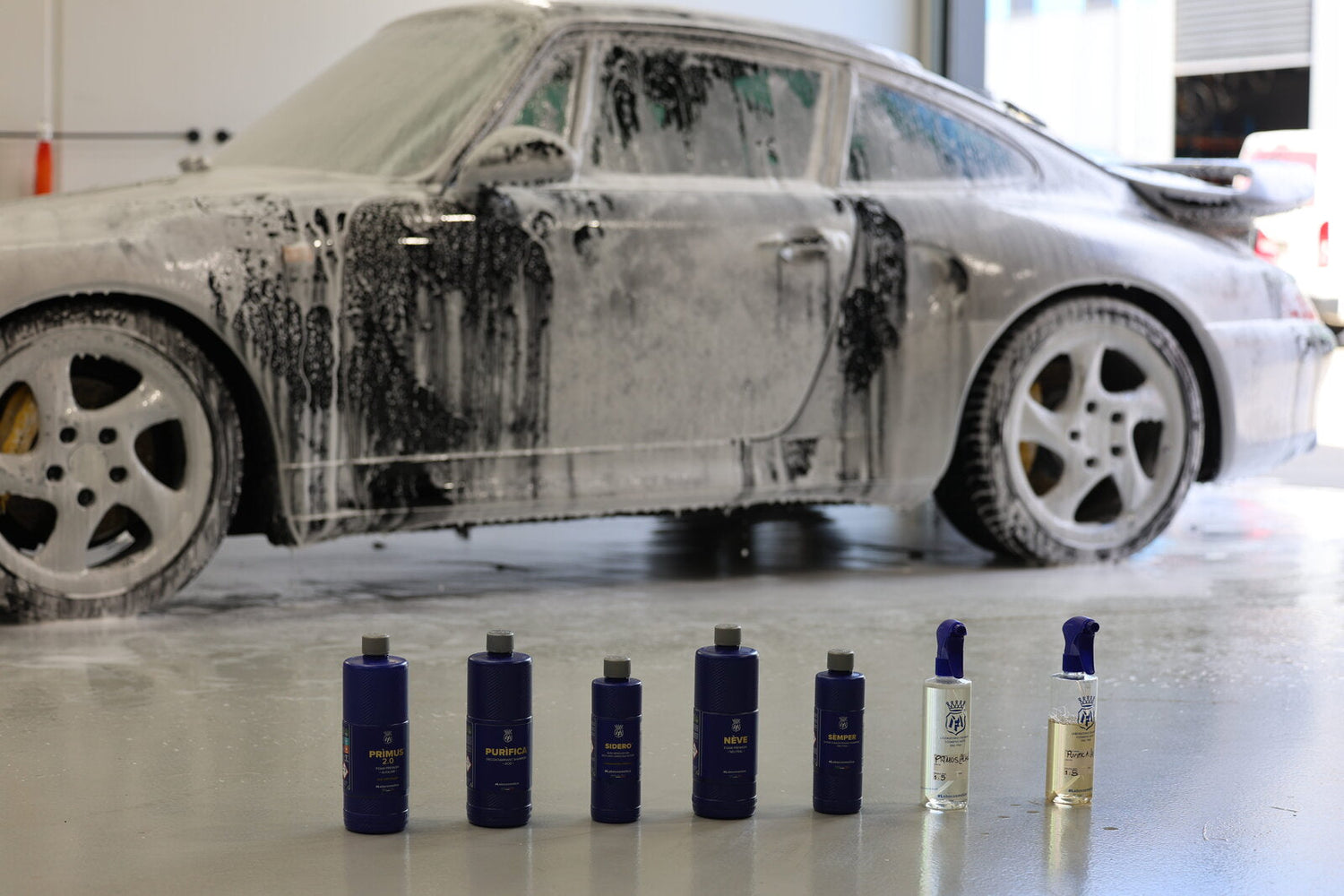
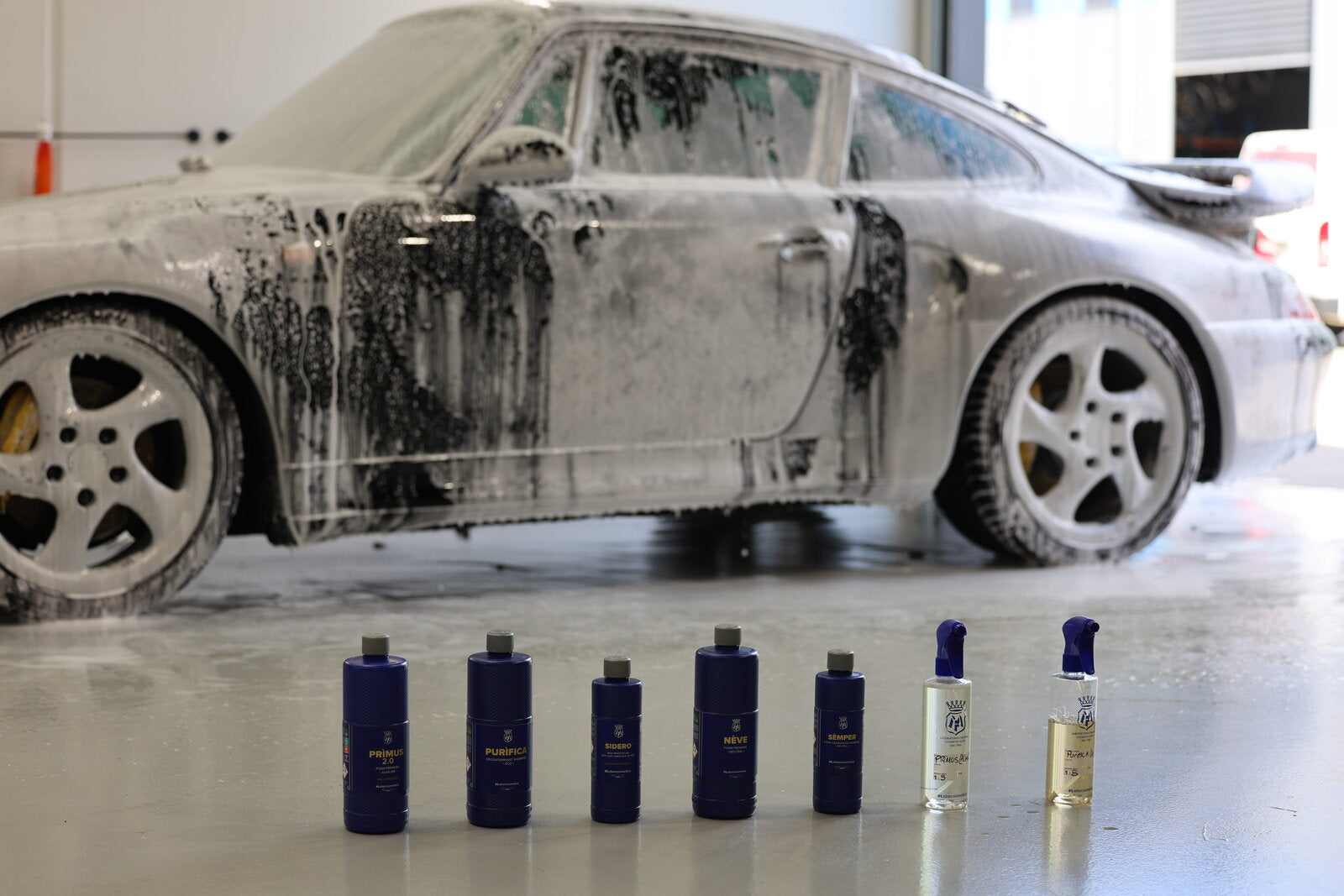
This is exactly why we lean on VDA-certified chemistry: Primus 2.0 is a pH 11 alkaline pre-wash with no free caustic salts, and Purifica is an acid pre-wash that uses buffered noble acids instead of HF or ABF. Same strong pH values, completely different - and proven - safety profiles. We go deeper on the alkaline side of this in our guide to whether alkaline snow foam is safe on a ceramic coating, and on the acid side in why your wheel cleaner may be etching your wheels.
Putting the framework to work
Here's the whole thing mapped to a wash, so you can see how the three buckets cover every job:
Alkaline, for organic grime. Start a dirty car with an alkaline pre-wash like Primus 2.0 to lift grease, bugs and road film before you touch the paint.
Acid, for minerals and metal. When there's iron fallout, water spotting or limescale, that's an acid job - an acid pre-wash like Purifica, or a dedicated iron remover like Sidero.
Neutral, for the everyday wash. Your routine maintenance wash should be pH-neutral and coating-safe - Neve as a neutral foam, Semper as a neutral shampoo.
If you want the whole framework in one box, the 3pH Maintenance Wash System pairs an acid, a neutral and an alkaline step so the chemistry is already matched to the job for you.
Understand these three buckets and you stop being mystified by labels - you become the person who actually knows what's in the bottle, and why. That's what makes a better detailer. Got a contaminant you're not sure how to tackle? That's exactly the kind of thing we love talking through.

Leave a comment
This site is protected by hCaptcha and the hCaptcha Privacy Policy and Terms of Service apply.