
Almost everyone asks the same question first: how long does a ceramic coating last? They want a number. But the honest answer is that the number on the bottle is the smallest part of the story. I've watched a quality coating fail in a few months, and I've watched the exact same coating sail well past its rating — on two different cars, with two different owners. The coating didn't change. The prep and the upkeep did.
I come at this from an industrial chemistry background, so I'll give you the real version: what actually decides how long a coating lasts, and the routine that protects the money you spent on it. Half of this you can do in your driveway. The other half is why people bring their cars to us.
How long does a ceramic coating actually last?
Honest ranges, not marketing ones. Spray and "consumer" ceramics generally give you six to twelve months. Professional liquid coatings realistically run two to five years, with the best chemistry, properly installed and looked after, reaching the top of that range. Anything advertised as "lifetime" is leaning on a warranty that's effectively impossible to claim against — polymer networks degrade under UV, heat cycling, road salt and contaminant impact, and no chemistry made today is immune to that.
This is why the better manufacturers rate by exposure, not just time. Labocosmetica's professional HPC PRO, for example, is rated up to 48 months or 60,000 km — whichever comes first. That dual figure is the most honest spec in the industry, because it admits the truth: a garage-kept weekend car and a daily highway commuter live completely different lives, and a single "5 years" number can't describe both.
It starts before the coating: prep is everything
A ceramic coating works by bonding to your clear coat and effectively becoming part of the paint surface. That bond is the whole game — and it can only form on a surface that's genuinely clean and genuinely refined. Whatever is on the paint when the coating goes down gets locked underneath it, permanently.
Fillers are the silent killer here. Many finishing polishes hide swirls with oils and glazes. They look perfect on the day, but those residues sit exactly where you need a clean chemical bond — and when they wash out later, the marring reappears under your coating where you can't fix it. That's why our final step before any coating is a true, filler-free primer polish like Labocosmetica Fiero: it removes light defects instead of masking them, and Labocosmetica designs it to leave a self-assembled monolayer that the coating can bond to.
If the prep is wrong, nothing downstream saves it. The single biggest reason a coating underperforms its rating isn't the product — it's a surface that was contaminated, filled, or rushed before application. If you're booking a coating rather than doing it yourself, read what to ask an installer before you hand over the car — the prep question is the one almost nobody thinks to ask.
Respect the cure — the first days matter most
A coating isn't fully cross-linked the moment it's buffed off; it keeps hardening into its final glass-like network for days. How long it must stay dry and chemical-free depends on the coating, so follow the manufacturer's cure window for yours. Feynlab, for example, asks for no water exposure for the first 24 hours and no chemicals or car washes for 7 days, and if it rains during that week, dry the car once the rain stops. Washing too early disturbs the curing layer and compromises it before it's done its job.
Wash it right — the single biggest lever you control
If prep is the foundation, washing is the day-to-day discipline that decides where in the range you land. Most coatings that "die early" were simply washed badly.
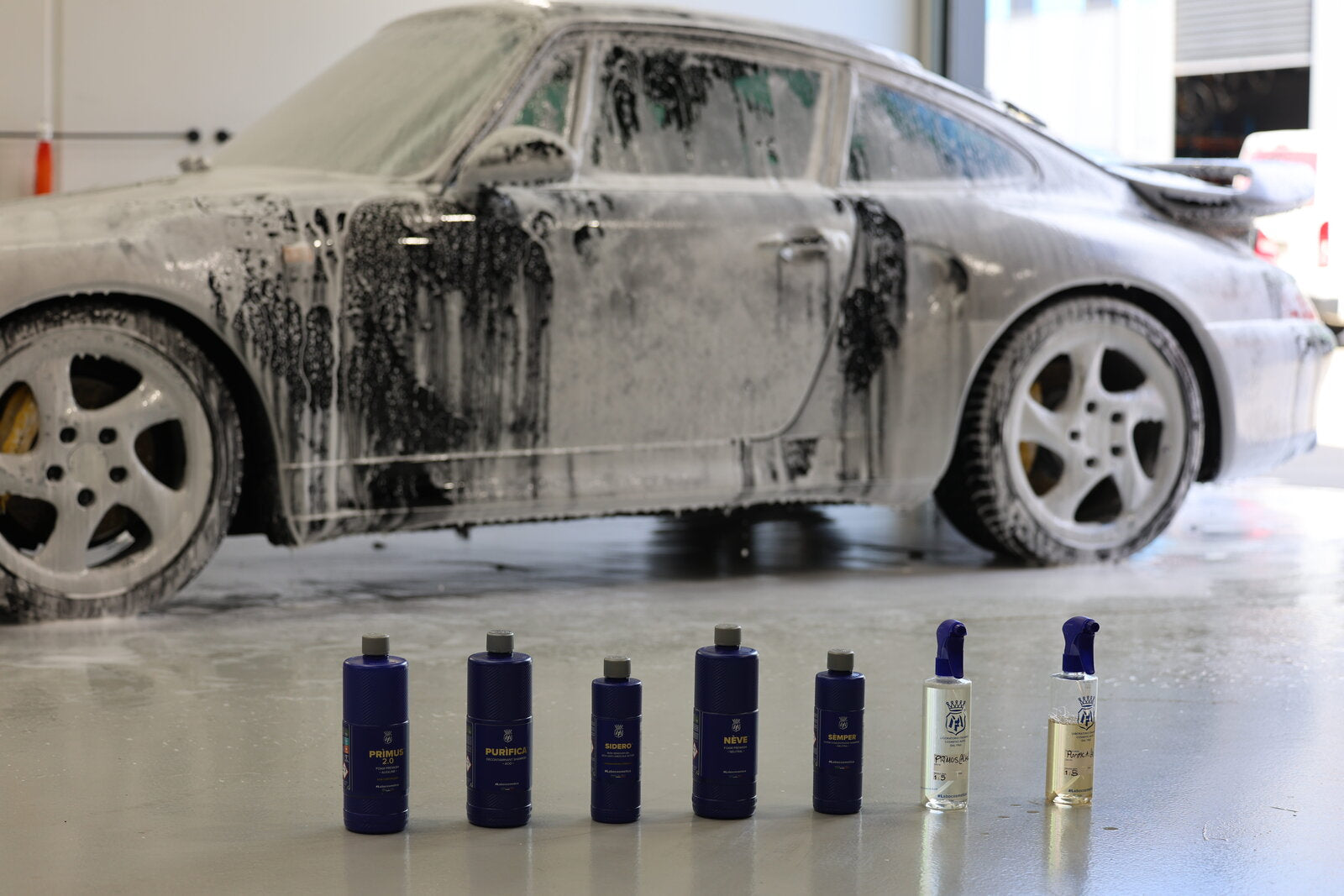
Use a pH-neutral shampoo with no wax or gloss additives. Those additives leave a film that smothers the coating's hydrophobics — the opposite of what you want. A clean, neutral car shampoo made for coated surfaces resets the beading every wash instead of dulling it.
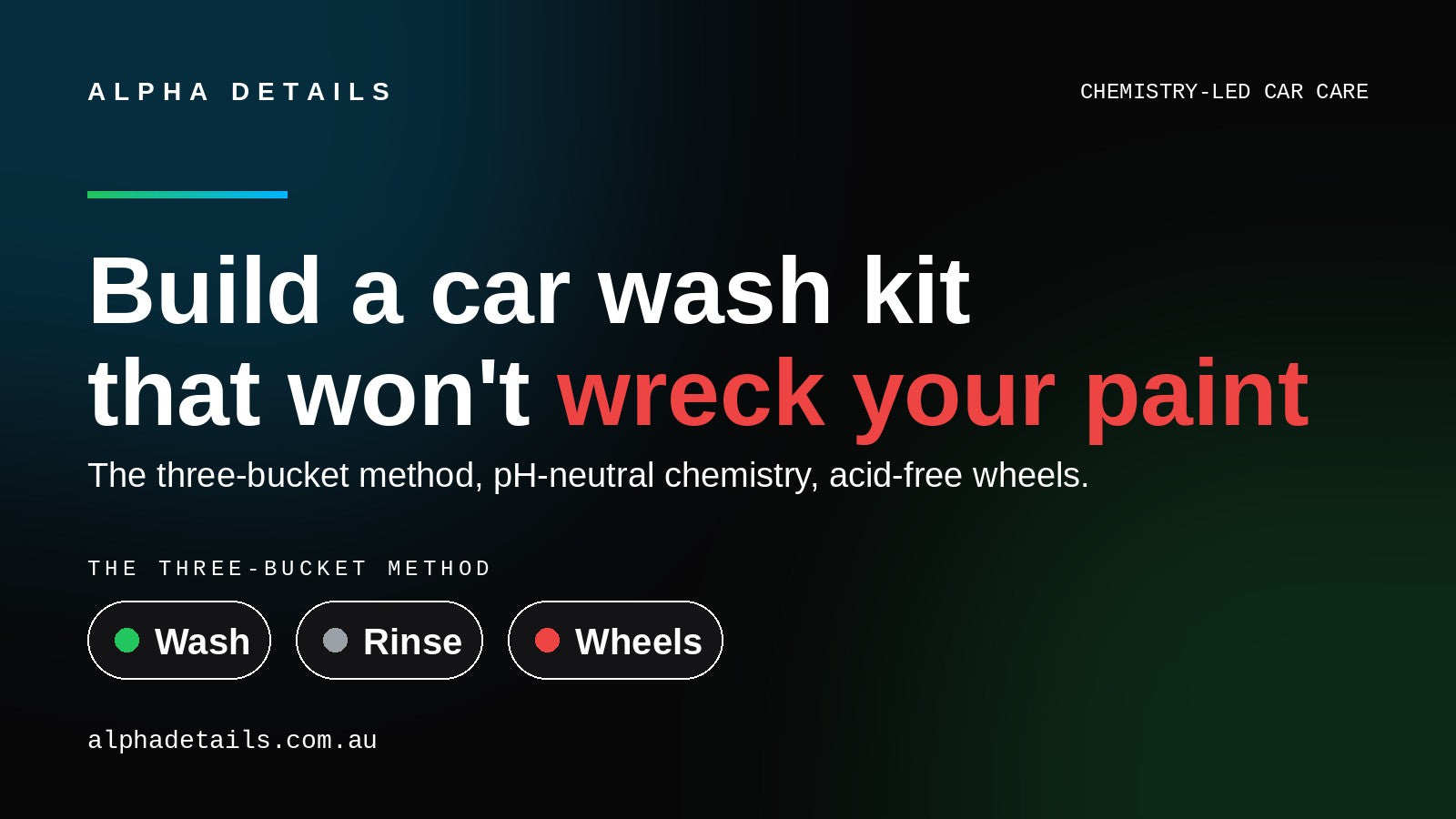
Wash by hand, three buckets, soft mitt. One bucket of soapy water, one to rinse the mitt, and one kept for the wheels, with grit guards in each, so you're not dragging grit or brake dust back across the paint and grinding micro-scratches into the coating. And wash regularly — every one to two weeks — so contaminants never get the chance to sit and etch.
Dry without putting the swirls back in
More coatings are scratched during drying than during washing. Never reach for a random rag. Use a clean, dedicated drying towel or, better, a car dryer/blower so nothing touches the surface at all. Keep your microfibre coated-car-only and washed separately — one gritty towel undoes a careful wash.
Kill the things that actually kill coatings
A coating is sacrificial protection, not a force field. Bird droppings, bug guts, tree sap, road salt and industrial fallout are acidic or abrasive and will etch the coating if left to sit. The coating buys you time to remove them safely — so use it. A quick spot-clean with a quick detailer or waterless wash between full washes handles the worst offenders.
Stay out of automatic and brush car washes. Spinning brushes drag grit across your paint, and many "touchless" tunnels use aggressive high-alkaline pre-soaks that strip hydrophobics over time. The convenience isn't worth the lifespan you trade away.
Decontaminate a few times a year
Even with good washing, microscopic iron fallout from brake dust and rail/road sources bonds to the surface and won't shampoo off. A periodic iron remover dissolves it chemically without abrasion — a gentle, effective reset for a coated surface. Reach for an iron remover two or three times a year; coated paint rarely needs claying, which is the point.
When your coating looks "dead" but isn't
A coating that's stopped beading often isn't finished — it's buried. Inorganic contaminants like mineral deposits, hard-water spots and alkaline road film build up on the surface and smother the hydrophobics, and a pH-neutral shampoo simply isn't designed to break them down. The coating is still there underneath; it just can't breathe.
This is where a multi-pH wash system earns its keep. Labocosmetica's 3pH wash system pairs your regular neutral wash with periodic alkaline and acidic steps to lift what neutral soap leaves behind. The acidic step — Purìfica, an HF-free acid pre-wash — dissolves those inorganic deposits and brings the beading and slickness straight back, so a coating that looked dead suddenly behaves like new again. Run it a few times a year before you ever write a coating off as failed.
And if you want to know for certain whether it's buried or genuinely gone, we've written the full diagnostic protocol: Is Your Ceramic Coating Actually On Your Car? A Chemist's Guide to Checking. It covers why water beading is the wrong test, the decontaminate-then-retest method (including the residue-free panel wipe step almost everyone skips), why a paint thickness gauge can't detect a coating, and how to check whether the installer coated the whole car or just the panels that get photographed.
Top it up — restore the hydrophobics
The water-repelling behaviour fades before the coating itself does. A ceramic booster or SiO₂ topper every three to six months refreshes the beading and slickness and adds a thin sacrificial layer over your base coating, taking the wear so the real coating doesn't. It's the cheapest insurance there is for coating longevity — browse our spray sealants and toppers. One caveat worth knowing: because a fresh topper governs how the car beads regardless of what's underneath it, topping up also masks the condition of the base coating. Assess the coating first, then top it.
Get it inspected once a year
Once a year, the coating is worth a proper look. An annual inspection and maintenance service — a decontamination wash, an honest assessment of where the coating is at, and a fresh top-up — is what separates a coating that limps to the end of its rating from one that comfortably beats it. This is the part we handle in the studio, and it's the cheapest way to protect a serious coating investment. You can book a maintenance detail or coating with us here.
The realistic maintenance schedule
Every 1–2 weeks: a gentle three-bucket hand wash with pH-neutral shampoo, dried with clean microfibre or a blower.
Every 3–6 months: a ceramic booster/topper to restore beading and add sacrificial protection.
Every 6–12 months: a full decontamination — an iron remover for metallic fallout and an acidic wash like Purìfica for inorganic build-up — plus, ideally, a professional inspection.
Always: remove bird droppings, sap and fallout as soon as you see them.
What "lasts" really comes down to
The best ceramic coating in the world, prepped on a filler-hidden surface and washed in a brush tunnel, will lose to a mid-tier coating prepped properly and maintained with discipline. Longevity is mostly chemistry you control after the install: a clean bond to start with, neutral wash chemistry, prompt contaminant removal, a regular top-up, and an annual check. Get those right and the number on the bottle stops being a ceiling and starts being a floor.
Set your coating up to last
Everything above starts with the right chemistry. Browse our ceramic coatings and the prep that makes them bond — Labocosmetica Fiero and the full Labocosmetica and Feynlab ranges. Or let us handle it end to end: book a coating or maintenance detail at the Alpha Details studio.
Reading next: Is Your Ceramic Coating Actually On Your Car? · Best Ceramic Coating in Australia 2026: A Chemist's Honest Comparison · The "9H" Lie — What Ceramic Coatings Actually Do for Your Paint · The Labocosmetica Range Properly Explained

Leave a comment
This site is protected by hCaptcha and the hCaptcha Privacy Policy and Terms of Service apply.