Here's an uncomfortable truth about car care: most of the swirls, scratches and dull patches you see on paint weren't put there by the road. They were put there at wash time — by the owner, with the wrong kit. The flip side is the good news: get the kit right and a weekly wash becomes the thing that protects your paint instead of slowly grinding it down. This is how to build one, and the chemistry behind why each piece matters.
Swirl marks aren't bad luck — they're grit you dragged in
Look at swirl marks under a light and you'll see thousands of fine, circular scratches. They come from one thing: hard particles dragged across the clear coat. A single bucket loads up with grit the moment you start — so every dip re-coats your mitt in the dirt you just removed, and you wipe it straight back onto the paint.
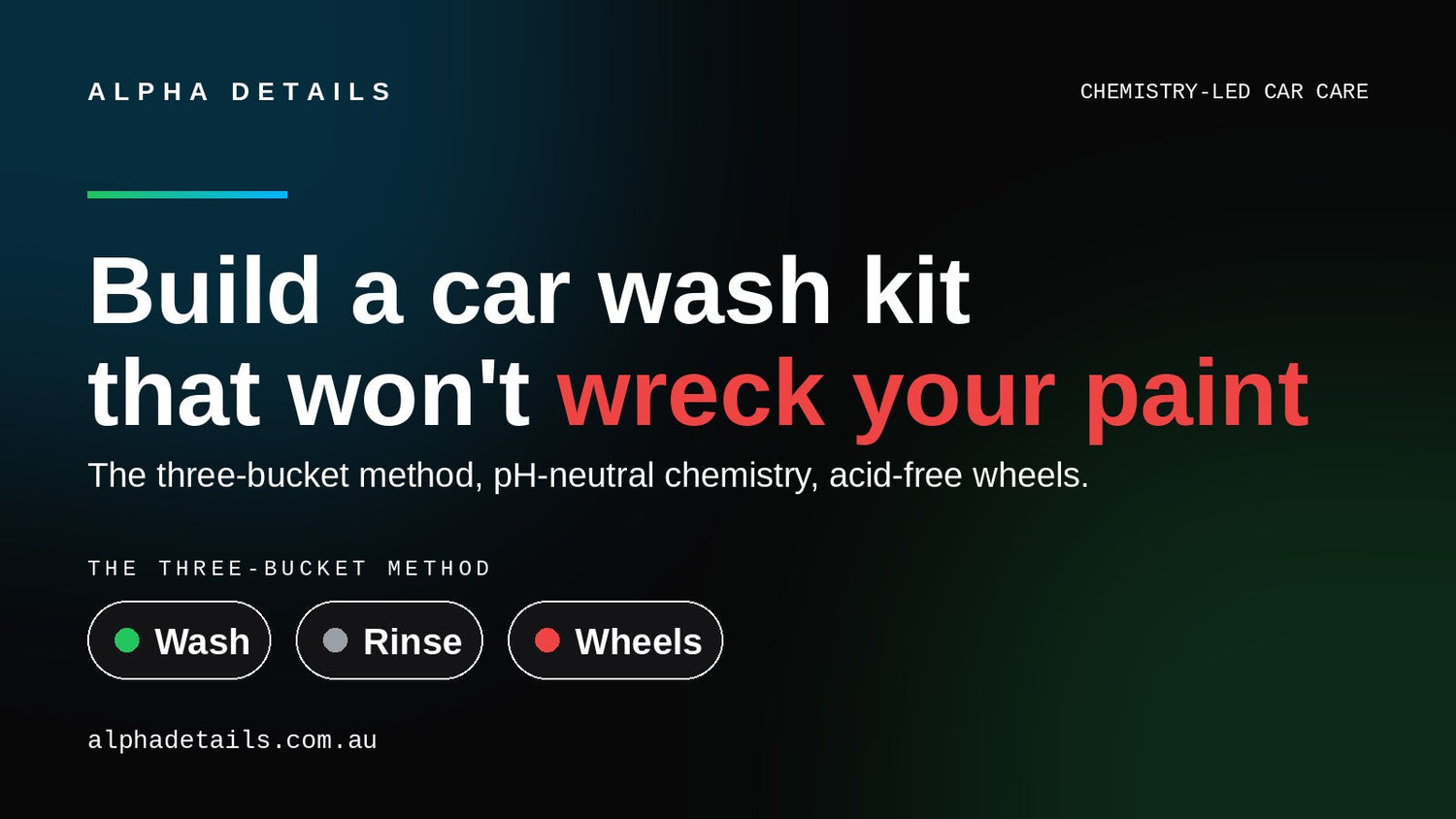
The fix is the three-bucket method: separate water for wash, rinse and wheels, so contamination never crosses back onto your paint.
Grit guards sit in the bottom of each bucket so anything heavy drops out of circulation instead of being scooped back up. Keeping wheel water away from paint water is the single biggest swirl-prevention move most people miss.
pH is the difference between cleaning and stripping
Not all shampoos do the same job. Many cheap, sudsy washes are mildly alkaline — great for cutting grease, but they slowly strip the waxes, sealants and ceramic coatings you've paid to put on. A pH-neutral shampoo cleans by lifting and lubricating dirt rather than chemically attacking the surface, so your protection survives the wash.
That's why a maintenance shampoo like Labocosmetica Sèmper sits at neutral pH — coating-safe, and hyper-concentrated so a tiny amount lubricates a full bucket. The rule of thumb: if you've invested in any protection, your weekly wash should be pH-neutral, full stop.
Your wheel cleaner might be eating your wheels
Wheels get the harshest products in detailing, and that's exactly where the danger hides. The number on the bottle won't warn you — what matters is the active ingredient.
Pre-wash: let chemistry do the work before you touch the paint
The less you physically rub a dirty car, the fewer swirls you create — that's the whole point of a pre-wash. A snow foam laid down with a foam cannon clings to the panel, softens the grime, and rinses most of it away before a mitt ever makes contact.
Here's the clever part. An alkaline pre-wash like Primus 2.0 (pH 11) is brilliant at lifting organic dirt and traffic film — but cheap versions get their punch from sodium hydroxide (caustic soda), which dissolves aluminium oxide and attacks bare alloy and trim: 2Al + 2NaOH + 2H₂O → 2NaAlO₂ + 3H₂↑. A VDA-certified pre-wash gets the same cleaning power from safer surfactant chemistry instead. For coating-friendly weekly foaming, a pH-neutral foam like Nève does the job at neutral pH.
Protect what you just cleaned
A safe wash is the perfect moment to top up protection, because the surface is already clean. A spray-on, rinse-off hydro coat like Beneficia bonds to a wet panel and adds water-beading protection for months — no applicators, no buffing, nothing dragged across the paint. Drying is the last place swirls sneak in, so finish with a plush, dual-sided drying towel and a touchless air dry where you can.
Build it once, or start with a kit
You can assemble all of this piece by piece — we stock every component — or start with one of three kits where the chemistry and the method come matched out of the box, at 10% off versus buying separately.
Two of the kits come with or without a pressure washer, so you're not paying for one you already own.
Prefer Yum Cars? The Yum Cars Wash Bundle 2.0 puts Yum Wash, Yum Wheels, Yum Detailer and Yum Citrus together at 10% off buying them separately. See the full Yum Cars range.

Leave a comment
This site is protected by hCaptcha and the hCaptcha Privacy Policy and Terms of Service apply.