
At Alpha Details, we don't stock products we can't explain. With a chemistry degree and a working detailing studio in Melbourne, every product on our shelf has been assessed on its formulation, its bonding chemistry, and whether its protection claims actually hold up.
The Labocosmetica range by MaFra earns its place. Here's a breakdown of every product we carry and what it's actually doing on your vehicle.
First: Physical Layers vs. Chemical Layers
Before we get into the products, one concept worth understanding: the difference between a physical protection layer and a chemical one.
A physical layer works through mechanical hardness — it creates a solid barrier that resists abrasion, scratches, and contamination through sheer density. A chemical layer works differently: it bonds at the molecular level to the substrate, reacting with the surface to create a durable, chemically resistant shield.
Most quality coatings combine both. Labocosmetica's STC, for example, is formulated as a 70% physical, 30% chemical system — which is part of what gives it that balance of hardness and long-term durability. Understanding this split helps explain why layering products works, and why not all coatings are interchangeable.
The Products We Stock
HPC 2.0 — Hybrid Polysiloxane Coating (Consumer)
Flexible, hydrophobic paint protection. 24 months / 30,000 km.
HPC 2.0 is built on a polysiloxane backbone — a silicon-oxygen chain that gives the coating elasticity and flexibility that a rigid ceramic can't match. That means it moves slightly with the paint, reducing the chance of micro-cracks developing over time.
It delivers super-hydrophobic beading with a distinctive "silk effect," drastically reduces water spotting, and is PFAS-free. For a consumer-grade coating that's relatively straightforward to apply, the level of protection is genuinely impressive.
Best for: Enthusiasts and daily drivers wanting real paint protection without a professional install.
STC — Silicon-Titanium-Ceramic Coating
Standalone ceramic or foundational layer. 4 years / 60,000 km.
STC is where the Labocosmetica range gets serious. The name breaks down the formula: Silicon (SiO₂) for precise adhesion, Titanium Dioxide (TiO₂) for photocatalytic self-cleaning and chemical resistance, and Ceramic for the glass-like hardness and gloss that serious paint protection demands.
That 70/30 physical-to-chemical split means STC creates a hard protective shell while also bonding chemically to the clear coat. It can be used as a standalone coating or as a base layer under HPC Pro for a more complete system — the chemistry between the two products is complementary.
Best for: Professional application, vehicles with corrected paint, or customers who want the full layered approach.
Blindo — Hard Resin Base Coat
Fast-curing physical foundation layer. Up to 5 years when topped with HPC.
Blindo takes a different formulation approach from silica-based coatings — it's a high-molecular-weight hard resin that creates an exceptionally thick, glass-like physical barrier over the clear coat. Think of it as a solid foundation before you apply a hydrophobic topcoat.
What sets it apart technically is the S.F.C. (Self Fast Curing) technology — Blindo cures in 70 minutes without UV lamps, even in lower temperatures. That's a significant advantage in a workshop environment. Paired with HPC, you're looking at up to 5 years of protection.
Best for: Detailers looking for a hard, durable base with fast turnaround between steps.
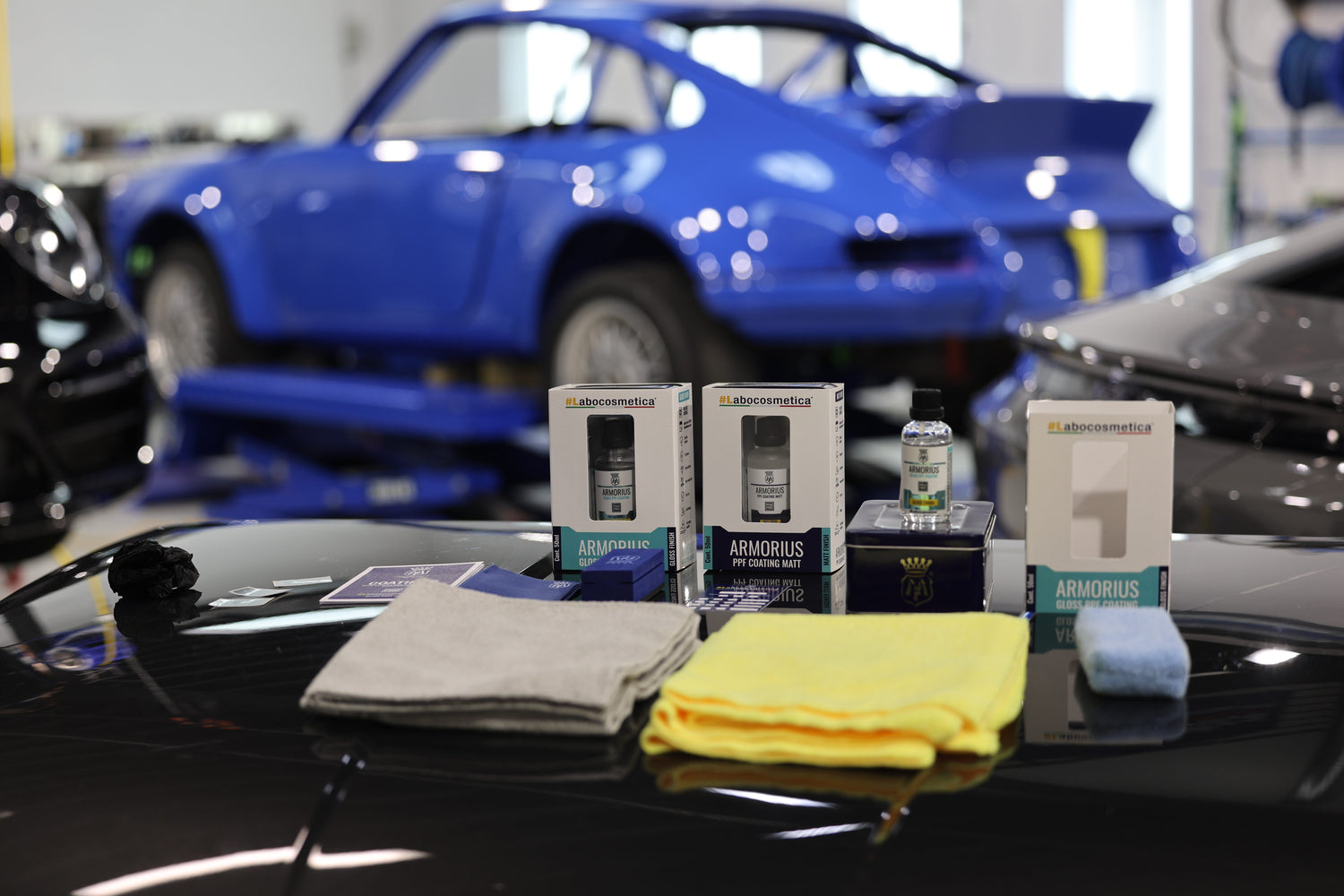
Armorus — PPF & Vinyl Protective Coating (New)
Dedicated coating for paint protection film and wraps. Up to 2 years.
Standard paint coatings don't belong on PPF or vinyl — the chemistry is wrong for the substrate. Armorus is formulated specifically to bond with film and wrap surfaces, available in both Gloss and Matt variants to match whatever finish the vehicle is running.
It enhances hydrophobics on the film, slows natural degradation of the material, and reduces dirt adhesion without altering the appearance of the wrap. For clients investing in quality PPF installs, finishing with Armorus is the right call — it protects the protection.
Best for: Any vehicle with PPF or a vinyl wrap that needs proper, substrate-appropriate coating.
TPR — Trim & Plastic Restorer Coating
True restoration coating for unpainted plastics and rubber. Up to 3 years.
TPR is not a dressing — it doesn't use pigments or silicone to fake a restored look. It's a protective polymer coating that bonds directly to unpainted plastic and rubber surfaces, reviving faded trim by restoring the surface rather than covering it.
The result is a natural, satin factory finish with real UV protection, chemical resistance, and 3-year hydrophobic performance. It's the type of product that quietly makes a full detail look complete rather than cut short at the plastics.
Best for: Faded exterior trim, bumpers, mirror caps, window seals, and interior rubber components.
Not Sure Which Product Suits Your Vehicle?
Every car is different — paint condition, existing protection, how it's used, and what result you're after all factor into which coating or combination makes sense. Message or call us directly and we'll give you a straight recommendation. No upsell, just honest advice from a working detailer who's also a chemist.
We also share regular educational content on Instagram — follow us at @alphadetailsmelbourne for videos breaking down the differences between coatings, physical vs chemical layers, application tips, and plenty of before-and-afters from our Melbourne studio.
Related reading → Want the head-to-head comparison? Read our 2026 chemist's comparison of the best ceramic coatings in Australia — Labocosmetica vs Feynlab, with the marketing claims we refuse to repeat (10H ratings, lifetime warranties, Mohs vs pencil hardness) and how we choose between them for your car.

Leave a comment
This site is protected by hCaptcha and the hCaptcha Privacy Policy and Terms of Service apply.