Ask any ceramic coating forum how to wash a coated car and you'll hear the same three words: "only pH-neutral". It's repeated so often that it's become gospel. It's also a misleading oversimplification. pH by itself doesn't tell you whether a product will damage your coating. What matters is the active ingredient doing the cleaning — and plenty of coating-safe chemistry sits well outside the pH-neutral range.
WHY pH ALONE IS A BAD PROXY FOR DAMAGE
pH measures how many free hydrogen ions are in solution. A pH of 7 is neutral, 14 is the most alkaline, 0 the most acidic. The scale is logarithmic, so each step is a 10× change in ion concentration — pH 12 has ten thousand times more hydroxide ions than pH 8.
That's useful information, but it tells you almost nothing about what those ions are attached to. A product at pH 13 built on NaOH (sodium hydroxide) is a very different chemical animal to a product at pH 13 built on buffered surfactant chemistry with corrosion inhibitors. Both read the same on a pH strip. Only one of them will chew through aluminium and hydrolyse the Si–O network of a ceramic coating.
The same holds on the acid side. A wheel cleaner that relies on HF (hydrofluoric acid) or ABF (ammonium bifluoride) at pH 2 will strip coatings, etch glass and eat through human tissue. A noble-acid shampoo at pH 2 designed around safer organic acids will simply dissolve mineral deposits and leave the coating untouched. Identical pH, completely different outcomes.
The rule that actually matters: the active ingredient decides whether a product is coating-safe. pH is a symptom, not a cause.
WHAT ACTUALLY DAMAGES A CERAMIC COATING
A ceramic coating is a cross-linked matrix of Si–O–Si bonds — silicon and oxygen locked together in a glass-like network, covalently attached to the clearcoat. Damage happens when something breaks those bonds or strips the hydrophobic groups bonded onto the top layer.
Unbuffered strong bases. Raw NaOH and KOH at high concentration hydrolyse siloxane bonds directly. Degreasers and APCs built on these without proper buffering will thin a coating every wash.
Fluoride-based acids. HF and ABF don't just etch — they attack silicon chemistry specifically, which is exactly what a ceramic coating is made of. These belong in industrial settings, not on your paint.
Mechanical abrasion. This one gets forgotten in the pH conversation. Every contact wash — mitts, microfibres, brushes — introduces micro-scratches that grind the Si–O matrix down from the top. Abrasion is the single biggest reason coatings fade before their advertised lifespan, and no pH-neutral shampoo in the world fixes it.
Abrasion is a ceramic coating's worst enemy. The less you abrade it, the longer it lasts — regardless of what the shampoo label says about pH.
THE VDA CERTIFICATION THAT CHANGES THE RULES
The VDA (Verband der Automobilindustrie — German Association of the Automotive Industry) tests car-care products against OEM paint systems, including modern ceramic clearcoats. A product carrying the VDA approval has been proven not to damage the substrates it's designed for.
This is where the "only pH-neutral" rule breaks down in practice. A VDA-certified alkaline pre-wash isn't safe in spite of being alkaline — it's safe because the formulator engineered it to be safe. Corrosion inhibitors, buffering agents, chelating additives and carefully chosen surfactants do the cleaning work while the pH sits well outside the neutral range. The certification is proof that the chemistry works without collateral damage.
THE LABOCOSMETICA SYSTEM — THREE pH ZONES, ALL COATING-SAFE
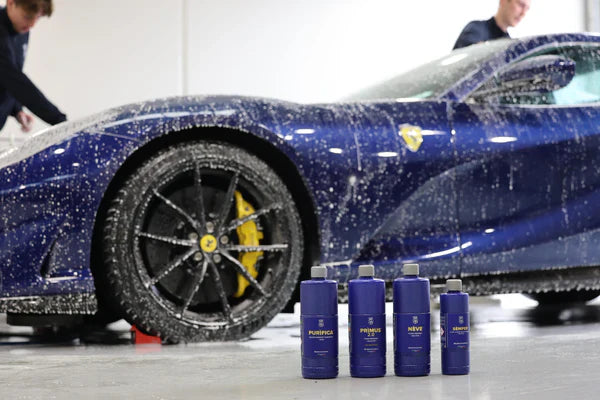
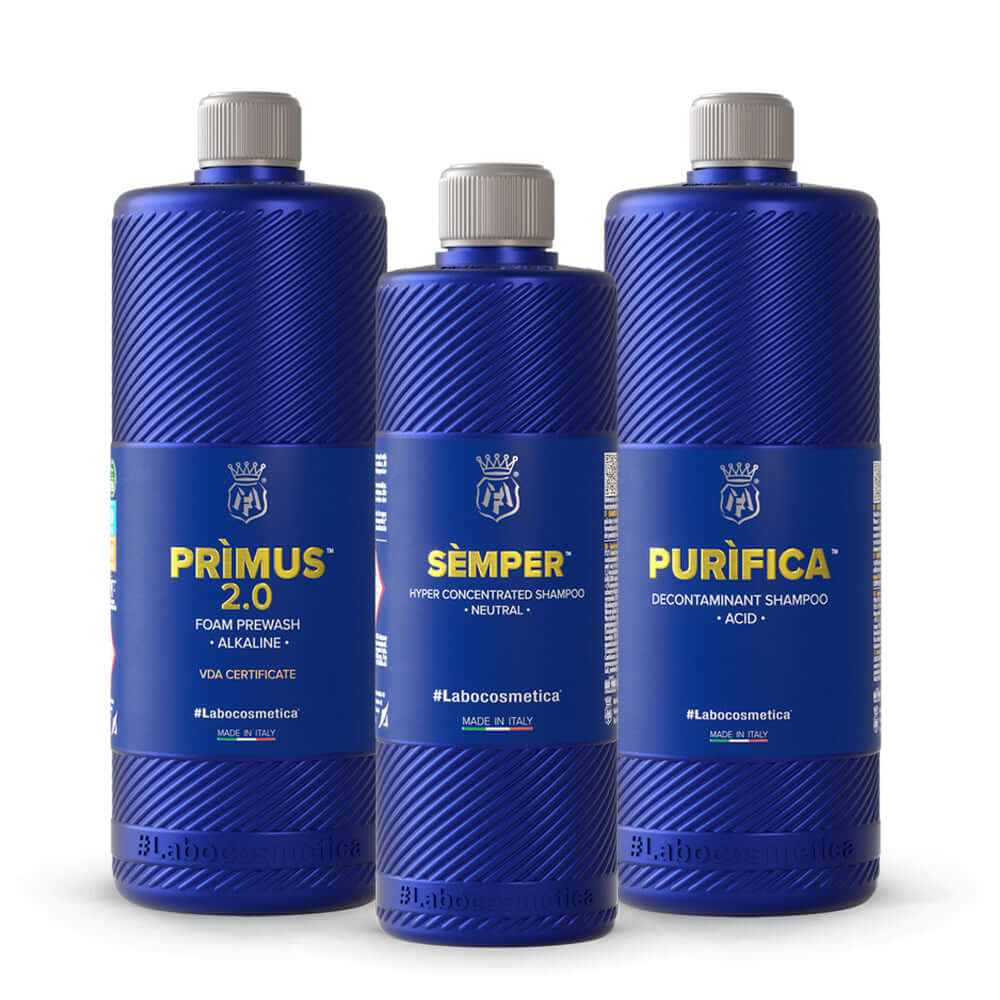
This is why we base our coated-car wash routine around the VDA-certified trio from Labocosmetica. All three are approved for use on ceramic coatings; they just operate in different pH zones for different jobs.
Labocosmetica Neve — pH-neutral snow foam. The safest possible starting point for a contact-free pre-wash. Lifts loose dust and grit before anything touches the paint.
Labocosmetica Primus 2.0 — alkaline pre-wash. Buffered alkaline chemistry that dissolves traffic film, insect residue and organic grime that a neutral product can't shift. VDA-certified coating-safe.
Labocosmetica Purifica — acidic shampoo. Noble-acid formulation that lifts bonded iron and mineral deposits without fluorides. Converts ferrous contaminants into water-soluble complexes that rinse clean. Coating-safe at its working dilution.
Run Neve, Primus and Purifica in a single decontamination cycle and you get a full sweep across the pH range — with zero damage to the coating. Something the "only pH-neutral" rule says shouldn't be possible.
THE ABRASION POINT MOST COATED-CAR OWNERS MISS
Even on the safest chemistry, you can still ruin a coating the old-fashioned way: by scrubbing it. Every pass of a wash mitt drags sub-micron particles across the Si–O network, and over enough washes the top of the coating wears thin. Gloss dulls. Hydrophobicity drops. Clients blame "the coating failing" when the real answer is they washed it to death with a perfectly good shampoo.
The fix is to reduce contact, not to chase pH. A proper pre-wash (Neve, then Primus or Purifica as the job demands) does 60–80% of the cleaning before a mitt touches the paint. Single-bucket method is out; two buckets plus a grit guard is in. For maintenance between proper washes, a spray-and-rinse hydrophobic refresher keeps the surface protected and sheds contamination with minimal mechanical contact. Our preference is Labocosmetica Beneficia, with Labocosmetica Perfecta as a second pick.
WHAT THIS MEANS FOR YOUR WASH DAY
Stop shopping for shampoos by pH number. Start shopping by formulation and certification. A VDA-certified alkaline pre-wash is safer on your coating than an unbranded pH-neutral shampoo full of cheap surfactants. A noble-acid iron remover is safer than an anonymous "pH 7" wheel cleaner that's relying on HF.
And when you do get hands-on with the car, remember that the chemistry you chose is only half the equation. The other half is how much you drag across the surface while you're using it. Less contact, better chemistry, longer-lasting coating. That's the real wash rule for a ceramic-coated car.
For the full breakdown of how we prep, coat and maintain vehicles, see our ceramic coating service page. The VDA-certified Labocosmetica range is available through our store.

Leave a comment
This site is protected by hCaptcha and the hCaptcha Privacy Policy and Terms of Service apply.