
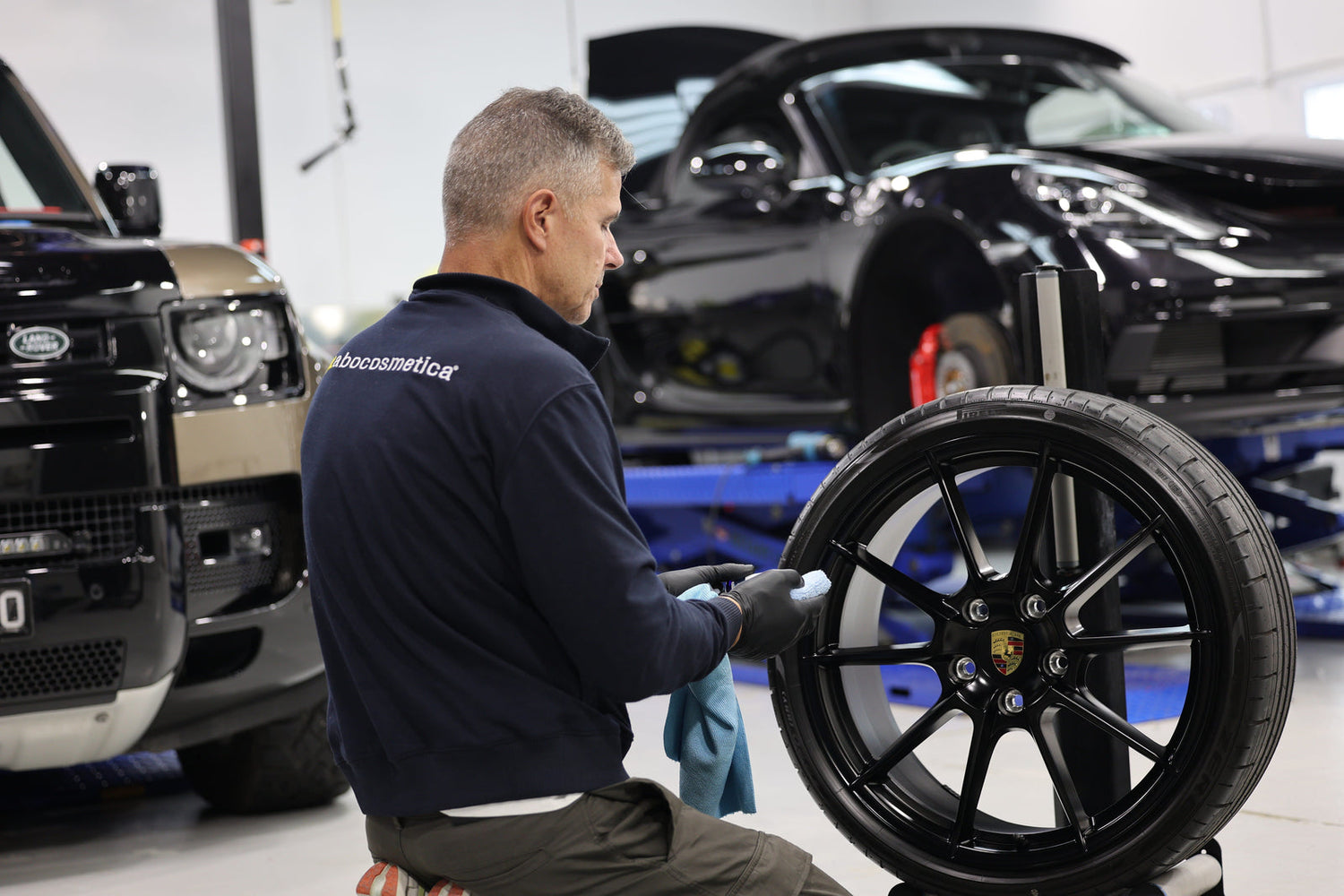
When someone calls us about ceramic coating, one of the first things we ask is: what are you actually trying to protect against? It sounds like a simple question, but the answer changes everything — the coating we recommend, how we prep the paint, and what kind of longevity you can realistically expect. There's no single "best" ceramic coating. There's only the right one for your car, your habits, and your environment.
Here's how we think through it.
The Consultation: What We Need to Know
Before we quote anything, we sit down — either in person or over the phone — and walk through a few things. What's the vehicle? Is it brand new or does it have existing paint damage? Where do you park — undercover, in a garage, or on the street? How often do you drive, and through what kind of conditions? Are you washing the car yourself, or is it going through a touchless wash? What's your budget?
These aren't just polite conversation starters. Each answer directly shapes the recommendation. A daily driver parked outdoors in Melbourne weather faces a completely different threat profile than a weekend car stored in a garage. The first needs serious chemical resistance. The second might benefit more from scratch protection and gloss depth.
The First Decision: Chemical or Physical Protection?
This is the big fork in the road. Every coating falls somewhere on a spectrum between chemical protection and physical protection — and understanding the difference is the key to making the right choice.
Worth knowing →
Chemical protection refers to coatings that bond molecularly to the clear coat, creating resistance against bird droppings, tree sap, UV degradation, and environmental contaminants. Physical protection refers to coatings that build a thicker sacrificial barrier on the surface, offering superior scratch and mar resistance. Many vehicles benefit from layering both.
When a client tells us they're parked under trees every day and dealing with bird droppings and bat mess, we're immediately thinking chemical resistance — a polysilazane-based coating with a Si–N backbone that delivers serious environmental durability. When someone brings in a dark-coloured car prone to swirl marks and wants it looking flawless, we're leaning toward physical protection first.
How We Match Coatings to Real Situations
The daily driver parked outside. This is our most common client. Melbourne's UV, rain, bird droppings, and industrial fallout are relentless. For these vehicles, we typically recommend Labocosmetica HPC Pro — a polysilazane/polymer blend rated for 4 years or 60,000 km. The Si–N (polysilazane) backbone delivers significantly greater chemical resistance than polysiloxane-based alternatives. If your car lives outside, this is the coating that earns its keep.
The newer car in good condition on a budget. Not every vehicle needs the most advanced coating on the shelf. For clients with newer paint that's still in solid shape, Feynlab Ceramic Lite is an excellent entry point — a hydrophobic nano coating rated for 1–2 years with great water beading, UV protection, and ease of maintenance. It's real ceramic protection at a lower price point.
The dark or delicate paint colour. Black, deep blue, dark grey — these colours show every swirl mark and piece of marring. For these vehicles, we reach for Labocosmetica STC, a dual-oxide system combining SiO2 (silicon dioxide) and TiO2 (titanium dioxide). It delivers roughly 70% physical protection and 30% chemical protection, making it outstanding for scratch-prone finishes. We often layer STC with HPC Pro on top — giving the car both the physical scratch resistance and the chemical durability it needs.
Pro tip: The STC + HPC Pro layered system is our most popular combination for daily drivers and outdoor-parked vehicles — a 70/30 physical-to-chemical base topped with 4-year polysilazane chemical resistance.
The client who wants the best of everything. For premium vehicles or clients who want maximum protection and gloss, Feynlab Ultra V3 is a biphasal hybrid ceramic coating — meaning it combines a base coat and top coat chemistry in a single application. It produces a water contact angle of 113°, exceptional gloss depth, and 5-year durability. Professional-use only, and it shows.
The car that needs to heal itself. Feynlab Heal Lite is one of the more interesting coatings we apply. It incorporates a memory polymer within the ceramic backbone that activates at temperatures above 30°C. When light scratches or swirl marks appear in the coating layer, heat from sunlight or warm water triggers the polymer to flow back and self-heal. Applied at up to 5 microns thick with a 5-year warranty, it's designed for darker colours where fine marks are most visible.
The Part Most People Overlook: Preparation
Here's something we tell every client — the coating you choose matters, but the preparation underneath it matters just as much. A $3,000 coating applied over contaminated or swirl-marked paint is a $3,000 waste of money. You've just locked the imperfections in under a semi-permanent layer.
Every ceramic coating at Alpha Details begins with thorough decontamination — iron fallout removal, tar removal, and clay bar treatment to strip embedded contaminants from the clear coat. We then assess the paint under high-intensity lighting to identify swirl marks, scratches, and oxidation. Most vehicles require at least a single-stage machine polish before coating to ensure the surface is as clean and defect-free as possible.
A coating is only as good as the surface underneath it.
This is why we run the same decontamination process before every ceramic coating that we run before PPF — because the chemistry doesn't care what's going on top. If the foundation isn't right, nothing you put over it will perform properly.
Why We Carry Multiple Brands
We're certified applicators and trainers for both Labocosmetica and Feynlab — and we sell every product in both ranges through our online store. We're not locked into pushing one brand. Each range has strengths in different areas, and carrying both means we can genuinely match the right product to the right situation rather than making one coating fit every car.
We also provide training in the Feynlab range to Porsche dealerships — so the people applying your coating are the same people teaching the professionals.
The right ceramic coating isn't the most expensive one — it's the one matched to how you use your car, where you park it, and what you need it to do.
If you're thinking about ceramic coating and want to know what we'd actually recommend for your vehicle, get in touch. We'll walk you through it the same way we've described here — no pressure, just the right advice based on real chemistry.
Phone: 0407 191 223 | Email: detailsalpha@outlook.com
Related reading → If you're weighing up brands, read our 2026 chemist's comparison of the best ceramic coatings in Australia — Labocosmetica vs Feynlab, the marketing claims we refuse to repeat (10H, lifetime warranties, Mohs confusion), and how we match coatings to use cases.

Leave a comment
This site is protected by hCaptcha and the hCaptcha Privacy Policy and Terms of Service apply.