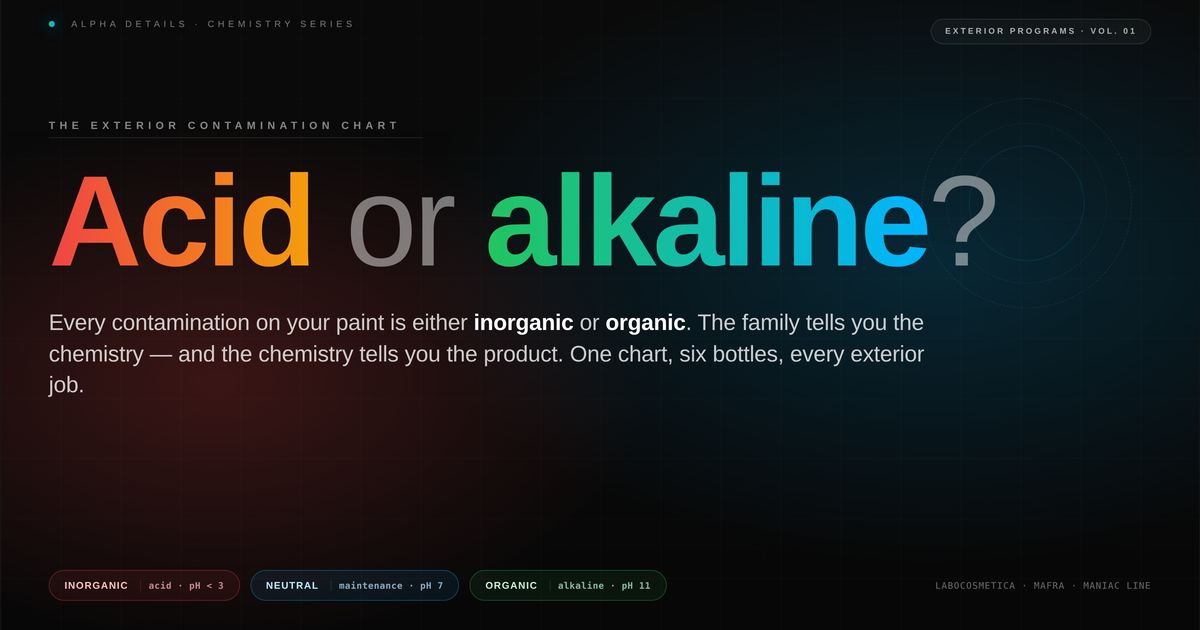
Acid or alkaline? It's the question detailers ask me more than any other — usually phrased as "what do I reach for when I see this on a car?" The answer is almost always chemistry, and the chemistry almost always comes down to one rule: every exterior contamination is either inorganic or organic, and each family has its own way of being removed. Get that right and 90% of your decisions become automatic. Get it wrong and you'll spend twice as long, use twice as much product, and sometimes damage the surface you were trying to clean.
This is the exterior programs chart we use at Alpha Details — the one nobody else has made, a practical contamination-first cheat sheet mapped to the products on our shelf. It mirrors the format of Labocosmetica's interior programs table, but built for the outside of the car, where the chemistry problem is different.
The rule of two
Every mark, stain, film, or deposit you see on the exterior of a car belongs to one of two chemical families. The family tells you which aisle of the shelf to walk to, before you've even thought about dwell time or dilution.
Inorganic contamination. Anything originating from metals or minerals — iron fallout from brake pads, rail dust from brake shavings, water spots made of dissolved calcium and magnesium carbonate, limescale on glass, rust bleed on paint. These don't respond to soap. They respond to acid chemistry, or to iron-specific reactive chemistry (thiol groups — R–SH — that bind ferrous metal and make it water-soluble).
Organic contamination. Anything originating from living things or hydrocarbons — bugs, bird droppings, tree sap, tar, road film, the waxy migration you see as brown streaks on tyre sidewalls. These break down with alkaline chemistry (which hydrolyses proteins and emulsifies oils) or with solvents (for the hydrocarbon-heavy stuff that isn't pH-responsive at all).
That's the entire logic of exterior chemistry in two paragraphs. Everything below is just application.
Labocosmetica's 3pH® system — where this thinking comes from
Crediting where credit is due. The entire reason this chart is structured around inorganic and organic is that Labocosmetica formalised it into a product architecture years before anyone else did. Their 3pH® wash cycle is the industry's clearest application of the rule of two: three shampoos at three different pH values, each one engineered to deal with a specific class of contamination, used in sequence on the same wash.
Step 1 — alkaline pre-wash (pH 11). PRÌMUS 2.0 goes on first, touch-free. Alkaline chemistry hydrolyses organic contamination — bugs, road film, oil, traffic grime — and lifts it off the paint before a mitt ever touches the panel. Dilution per Labocosmetica's own guidance: 1:30 in winter (heavier dirt loads), 1:50 in summer (lighter dirt loads).
Step 2 — acid decontamination foam (pH <3). PURÌFICA goes on as a foam, bottom-up, diluted 1:60. Acid chemistry dissolves inorganic deposits — fresh water spots, mineral film, acid-rain residue — via CaCO₃ + 2H⁺ → Ca²⁺ + H₂O + CO₂. VDA-certified safe even undiluted, so coatings and PPF don't care.
Step 3 — neutral contact wash (pH 7). SÈMPER is the final bucket wash — pH-neutral, high-lubricity, completely safe on coatings, sealants and PPF. This is where the mitt actually touches the paint, and because the first two stages have already stripped and dissolved everything the paint can't tolerate, SÈMPER's only job is carrying away the static dirt without introducing marring.
Three pH values, three chemistries, one wash. That's the system. The chart below is just what happens when you extend the same thinking from the wash cycle to every exterior contamination a detailer actually sees on the bench.
Which family is it? A quick classifier
When a detailer sends me a photo of something weird on a panel, the first thing I try to do is place it in one column or the other. Once it's in a column, the chemistry answer is almost always obvious. Here's the shortlist we use on the shop floor.
| INORGANIC — metals & minerals | ORGANIC — bio & hydrocarbons |
|---|---|
| → Acid or iron-reactive chemistry | → Alkaline or solvent chemistry |
| Iron fallout — orange specks on paint | Bugs — protein splatter from grille/bumper |
| Brake dust — grey haze on wheels | Bird droppings — uric acid plus bio |
| Rail dust — transport fallout on horizontal panels | Tree sap — sticky resin, often on bonnets |
| Water spots — white rings from sprinklers, hard water, rain | Tar & bitumen — black flecks from road surface |
| Limescale on glass — hazy film on windscreen corners | Adhesive residue — from stickers, tape, dealer decals |
| Rust bleed — orange weeping from bolts or stone chips | Engine grease — oily black film in bay |
| Cement splatter — construction fallout hardened on paint | Tyre-wall browning — antiozonant bloom on sidewall |
| Road film — general diesel-soot-plus-oil haze |
The tell in one sentence. If the contamination came from metal, rock or water, it's inorganic and wants acid. If it came from a plant, an animal, or a fuel, it's organic and wants alkaline or solvent. That single question — "where did this come from?" — solves most of the decisions for you before you've even opened the product shelf.
The six-product kit
You don't need thirty products to handle every car that comes through. You need six, and if you choose them properly they'll cover almost anything the road can throw at a vehicle. We run Labocosmetica as the primary line at Alpha Details because of their VDA certification (the German automotive-industry surface-compatibility standard), Mafra (Labocosmetica's parent house) for the specialist solvents, and Maniac Line as a strong parallel alternative. All three are on our shelves; all three come out of the same Italian chemistry house.
Alkaline pre-wash. This is your organic-contamination frontline — road film, bugs, traffic grime, the everyday dirt that comes off before you touch the car. Our pick is Labocosmetica PRÌMUS 2.0 at a verified pH of 11, the world's first VDA-certified pre-wash, built on alkaline surfactant chemistry rather than sodium hydroxide. No free caustic salts means no 2Al + 2NaOH + 2H₂O → 2NaAlO₂ + 3H₂↑ reaction eating your alloys. The Maniac Line alternative is Maniac Line FOAM GUN Prewash.
Neutral shampoo and foam. For maintenance washes, coating-safe contact washing, and anywhere you don't need aggressive chemistry. Labocosmetica SÈMPER is the bucket-side primary — pH-neutral, high-lubricity, safe over ceramics, waxes, and PPF. Labocosmetica NÈVE is the matching pH-neutral snow foam for the foam gun / cannon side of the same wash. The Maniac Line parallel is Maniac Line NEUTRAL FOAM.
Iron remover. The inorganic Fe workhorse. Labocosmetica SIDERO is formulated for iron plus limescale, which makes it excellent on wheels where both contaminations show up together. The active thiol chemistry binds to ferrous particles and turns them a deep purple-red as they dissolve. The Maniac Line alternative is Maniac Line IRON Remover.
Insect, sap, tar and adhesive remover. This is the solvent slot — for contamination that isn't pH-responsive because it's hydrocarbon-based (tar, bitumen, adhesive) or polymerised organic (tree sap, aged bug residue). Three products divide the work here, all from the Mafra house. Maniac Line INSECT Remover handles bugs, fresh sap, and general organic splatter — spray, dwell, wipe. Mafra DECA FLASH is the dedicated tar and adhesive remover — official Mafra description: "softens and dissolves tar, resins, and glue from any smooth or rough surface." It's the one you reach for when the road has thrown hot-mix asphalt, wheel-arch tar, or old sticker residue at the panel. Mafra RESIN OFF is the specialist tree sap / resin remover — when the sap is heavy, crystallised, or has been on the paint long enough to harden, this is the product purpose-built for it, safe on paint, glass and plastic. Deca Flash will also clear sap (the label officially covers resins), but Resin Off is the targeted tool for the job.
Acid and water-spot chemistry. This is the inorganic side of the kit — products that dissolve mineral deposits via the standard reaction CaCO₃ + 2H⁺ → Ca²⁺ + H₂O + CO₂. Three Labocosmetica products sit on this shelf and they're meant to be used differently, not interchangeably. Labocosmetica PURÌFICA is the acid snow foam / bucket shampoo — pH below 3 at working dilution, VDA-certified safe even undiluted, used during the wash itself to dissolve fresh water spots and minor mineral film before they etch. Labocosmetica PRELÙDIO ACIDIC is the acidic presoak for rinseless and waterless systems — spray, dwell one minute, wipe off; tailored for limescale, hard water stains, and sandy rain residue, with PPF-safe chemistry. Labocosmetica ÈNERGO is the dedicated heavy-duty water-spot and limescale remover — the one you reach for when the deposits have already etched. Use it on glass, on etched paint marks, and on the limescale rings sprinklers leave on bodywork. The Maniac Line alternatives in this category are Maniac Line DESCALE FOAM (acid shampoo) and Maniac Line WATER SPOT Mineral Remover.
A quick note on why we lead with chemistry here and not with clay. Clay is a mechanical abrasive — it shears off what's stuck to the clear coat — and once you've clayed a panel you've effectively committed to polishing it afterwards to restore the finish. That's a significantly bigger job, both in time and in clear-coat removal, than handling the problem chemically. If the water spot is still in the "fresh" stage, a correctly-diluted PURÌFICA wash or a PRELÙDIO presoak dissolves the deposit without touching the paint layer at all. Save clay for genuine embedded contamination that chemistry can't reach, not for hard water marks that still respond to acid.
Alkaline APC. The alkaline workhorse for everything else — tyre sidewalls, engine bays, trim, wheel wells, stubborn organic residues that the pre-wash didn't finish. Labocosmetica gives us two in this slot and they cover different situations. Labocosmetica DÙCTILE is the concentrated alkaline APC — deep clean, reconditioning, and engine bay duty at 1:3 with steam; it's PFAS-free, Alcantara®-approved, and dilutes all the way out to 1:10 for maintenance work. Labocosmetica VARIUS is the ready-to-use version of the same idea — no dilution required, safe on leather, vinyl, paint, and plastic, engineered to the equivalent strength of Ductile at roughly 1:7 so you can reach for the spray bottle without mixing. Ductile when you want the concentrate and the dilution control, Varius when you want the bottle in your hand. The Maniac Line equivalent is Maniac Line APC.
That's the kit. Six bottles. Every contamination below maps to one or two of them.
Inorganic programs — metals and minerals
This is the acid side of the chart. Every row here is a metal or mineral contamination, and every row is cleaned with iron-reactive chemistry or a mineral acid. Never let acid dry on paint, always rinse between steps, and always work on a cool surface in the shade.
| Contamination | Primary | Alternative | Dilution |
|---|---|---|---|
| Iron fallout on paint | SIDERO | Maniac IRON | Pure |
| Brake dust on wheels | SIDERO | Maniac IRON | Pure |
| Rail dust | SIDERO | Maniac IRON | Pure |
| Water spots (fresh) | PURÌFICA in foam or bucket | Maniac DESCALE FOAM | Per label |
| Water spots (etched) | PRELÙDIO · ÈNERGO | Maniac WATER SPOT | 1:5 · Pure |
| Limescale on glass | ÈNERGO | Maniac WATER SPOT | Pure |
| Rust staining / bleed | SIDERO, follow w/ ÈNERGO | Maniac IRON | Pure |
A quick note on iron-remover chemistry. The purple-red colour change you see when you spray it on a dusty wheel isn't a gimmick — it's the thiol group (R–SH) binding to ferrous particles and forming a soluble iron-thiolate complex. The visual confirms the reaction is happening. Once the colour stops appearing, the iron is gone and it's time to rinse before any product dries.
Organic programs — bio and traffic grime
This is the alkaline side of the chart. Proteins from bugs, uric acid residue from bird droppings, the oily-sooty mix of road film from combustion engines. Alkaline chemistry hydrolyses proteins and emulsifies oils, which is why a good pre-wash does 70% of the cleaning before you've touched the car with a mitt.
| Contamination | Primary | Alternative | Dilution |
|---|---|---|---|
| General road film · maintenance | PRÌMUS 2.0 | Maniac FOAM GUN | 1:10 |
| Heavy traffic grime | PRÌMUS 2.0 | Maniac FOAM GUN | 1:5 |
| Bugs on paint | Maniac INSECT | PRÌMUS 2.0 pre-soak | Pure |
| Bird droppings (fresh) | SÈMPER wash immediately | Maniac NEUTRAL | 1:10 |
| Bird droppings (etched) | VARIUS + polish | Maniac APC | 1:5 |
| Tree sap / resin | Mafra RESIN OFF | Maniac INSECT · Mafra DECA FLASH | Pure |
| Tar / bitumen | Mafra DECA FLASH | Maniac INSECT | Pure |
| Adhesive / sticker residue | Mafra DECA FLASH | Maniac INSECT | Pure |
| Engine-bay grease | VARIUS | Maniac APC | 1:3–1:5 |
| Tyre wall browning (bloom) | Maniac WHEEL & TYRE | PRÌMUS 2.0 in spray bottle, 1:5 | RTU · 1:5 |
| Rubber transfer on paint | Mafra DECA FLASH | Follow w/ SÈMPER | Pure |
| Glass — road film | NITIDO | Maniac GLASS | RTU |
A word on tyre wall browning, because it's one of the most commonly misdiagnosed things we see. That brown streaking on a sidewall isn't dirt — it's the rubber's own antiozonant protectants migrating to the surface, oxidising, and going tan. The technical name is blooming. Alkaline chemistry emulsifies the waxy film off. The fastest clean is Maniac Line WHEEL & TYRE Cleaner ready-to-use with a stiff brush. If you don't have a dedicated tyre cleaner on the bench, decant PRÌMUS 2.0 into a spray bottle at around 1:5, spray, dwell, agitate. After that, a proper tyre dressing like Labocosmetica NERO locks in the finish.
Golden rules before you spray
Test in a hidden area first. Especially on aged clear coat, unfamiliar trim, or old vinyl wraps. Chemistry that's safe on a factory finish isn't always safe on a re-sprayed panel.
Never mix acid and iron-remover chemistry in a single puddle. Thiol-based iron removers and mineral acids can generate unpleasant off-gas if they meet in concentration. Rinse between the two steps. Wheels first with iron remover, rinse, then acid shampoo if needed — never both at once.
Don't let anything dry on paint. Work in shade, on a cool panel, and keep surfaces wet. A dried alkaline pre-wash leaves spots. A dried acid leaves etching.
Dwell time beats pressure. Let the chemistry do the work before you agitate. Two minutes of dwell on a bug-crusted bumper saves five minutes of scrubbing and reduces the risk of marring.
Wheels first, body second, always. Brake dust is the single worst contamination on the car. Handle it first, rinse thoroughly, and then move to the paint.
VDA certification is your safety net. Products like Primus 2.0 and Purifica have been tested against automotive surfaces under the VDA standard. When you're working on a customer car with coatings, PPF, or soft trim, that certification is the difference between "effective" and "effective without damage."
Why most ceramic coatings "fail" — and why the 3pH cycle prevents it
Here's something worth sitting with, because it changes how you think about maintenance washing on a coated car. Most ceramic coatings that look "dead" haven't actually failed. The coating is still there. What's failed is the surface of the coating — it's become loaded with inorganic deposits the owner's maintenance wash was never designed to remove.
The chemistry is straightforward. A ceramic coating is a glass-like hydrophobic surface. When water beads up and rolls off, the minerals suspended in that water — calcium, magnesium, iron — don't roll off with it. They migrate to the edge of each droplet as the water evaporates (the same coffee-ring effect, but in miniature across thousands of droplets), and they bond to the top layer of the coating. Over weeks and months, that mineral film builds up. Hydrophobicity drops. Slickness goes. The surface starts to feel rough instead of glassy. The owner says "my coating has failed" — but the coating is still there, under a layer of inorganic crust.
A neutral shampoo on its own can't solve this. Neutral chemistry is formulated to be safe over coatings, but safe means it also won't touch the mineral film that's killing the coating's performance. You need acid chemistry to dissolve the deposits without stripping the coating underneath. That's precisely what PURÌFICA was engineered to do — VDA-certified safe on coatings and PPF, but acidic enough to take the mineral film off. One maintenance wash through the 3pH cycle, and a coating that looked "dead" usually comes back to factory-spec beading.
If you run a coating service at your shop, this is the single most important thing to educate the client on. Coatings don't die from organic contamination. They die from inorganic buildup the maintenance wash never removed. The rule of two, and Labo's 3pH architecture, is the long-term answer.
Start here
Save this chart. Send it to the apprentice who keeps asking you which bottle to grab. Build your shelf around the six categories, not around collecting bottles, and most exterior jobs simplify into a short sequence: pre-wash, wheels and tyres, contact wash, decontaminate what's left, dry, done.
The full product range is at alphadetails.com.au. If you're new to the chemistry-driven approach, the Labocosmetica line is the easiest starting point because of the VDA compatibility testing — it takes one variable (surface safety) out of the equation so you can focus on technique. If you want the parallel workhorse line, Maniac Line covers the same categories at a sharper price point.
Build the six-product kit
Everything in the chart above, on the shelf at Alpha Details. Free shipping over A$95.


Questions on any specific contamination we didn't cover? Drop them in the comments or tag us on Instagram — we'll add the next rows to this chart and keep it living.

Leave a comment
This site is protected by hCaptcha and the hCaptcha Privacy Policy and Terms of Service apply.