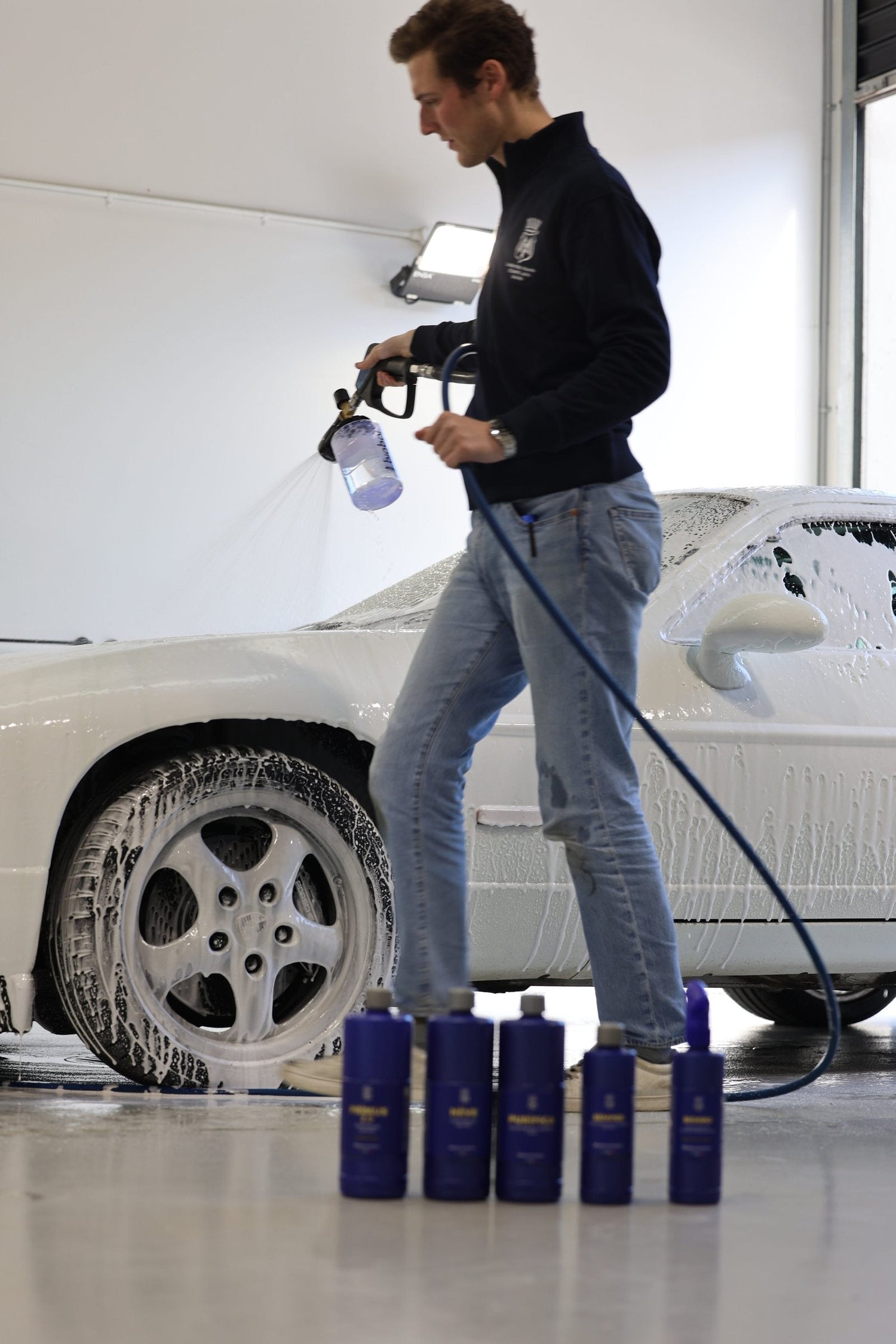
A snow foam is judged on the wrong things almost universally. How thick it is, how long it clings, what pH is printed on the front. None of those tell you whether the product is safe on the wheels it is about to run down, and the number on the front is the least useful of the three.
This chapter is about what is actually in an alkaline pre-wash, ranked from what good formulation looks like down to what we will not stock — and then where the pre-washes on our shelf land against each other. It is part of our car care chemistry handbook; if you want the product-by-product comparison instead, we ran six real snow foams from pH 3 to 13 separately.
Seven things worth knowing before your next drum lands.
Sodium hydroxide is the ingredient to avoid, and the reason is aluminium. Aluminium is passive from roughly pH 4 to 8.5. Above that the protective oxide dissolves and the metal itself is consumed.
Sodium metasilicate is not the aggressor — it is the aluminium protector. Almost every detailing article has this backwards, including an earlier version of our own notes.
pH is not the measure. Alkali reserve is. Two foams at pH 12 behave completely differently depending on how much buffering sits behind the number.
"Phosphate-free" and "NTA-free" are real formulation decisions, not marketing. NTA is IARC Group 2B and phosphates are prohibited under the EU Ecolabel criteria for this product category.
A neutral foam can out-clean an alkaline one on the right soil. Encapsulation chemistry lifts road film without needing alkalinity at all.
Never let an alkaline pre-wash dry on the car. Silicate that dries forms films and spots that are genuinely difficult to remove. That is a technique warning, not a chemistry one.
The cheapest foam on our shelf is a legitimate first choice on a coated car. We would rather tell you that than sell you up.

What makes an alkaline pre-wash dangerous — and it isn't the pH
Alkaline chemistry is the correct answer to oils, fats, road film, insect residue and general organic grime. That part is not controversial. What is worth arguing about is which alkaline ingredient is producing the pH, because two pre-washes reading pH 12 can behave completely differently on a wheel.
The substance at the centre of it is sodium hydroxide — caustic soda — and the problem is aluminium. Aluminium protects itself with a thin, tightly adhering oxide layer, and that layer is amphoteric: it dissolves in strong acid and in strong alkali. Take it away and the metal underneath is attacked directly:
2Al + 2NaOH + 2H₂O → 2NaAlO₂ + 3H₂↑
Aluminium, caustic soda and water give sodium aluminate and hydrogen gas. The US Department of Energy's own work on aluminium–water reactions puts it plainly: the oxide layer prevents the reaction, and the reaction requires "continual removal and/or disruption of the hydrated alumina layer." The Aluminium Federation give the working window as roughly pH 4.0 to 8.5 — outside it, aluminium dissolves.
On a car that shows up as etched and pitted bare alloy, chalked and whitened trim, hazed polished metal, and stripped wax or sealant. The trim damage in particular is not reversible with chemistry.
Sodium metasilicate is not the villain in that bottle. It is the bodyguard. Silicates are added to alkaline cleaners specifically as aluminium corrosion inhibitors. In alkali, aluminate ions coming off the dissolving oxide react with silicate in solution and are deposited back onto the surface as an aluminosilicate film that blocks further attack — one published study measured inhibition efficiency rising from about 10% to about 60% as sodium silicate went from 1 mM to 20 mM. PQ Corporation, who make the stuff, describe it as forming "a physical barrier to prevent alkali attack and protect sensitive glazed dishware, glass, and metallic surfaces."
Two honest limits. The protection has a ceiling — patent work found silicate and carbonate systems protecting aluminium up to about pH 12.7 with sodium carbonate and about pH 13.1 with potassium carbonate, with damage consistently beyond. And silicate that dries on a surface forms films and spots that are genuinely difficult to remove. So: rinse, and don't let an alkaline product dry on the car.
Pre-wash ingredients, best to worst
Alkaline surfactant systems with no free caustic
The premium approach: get the cleaning from the surfactant package, the builders and the chelators rather than from raw hydroxide, and keep the pH moderate. This is what a VDA-certified pre-wash is doing, and it is why one can sit at pH 11 and still be safe on trim, alloys, film and coatings.
Encapsulating neutral chemistry
Surfactants plus sequestrants that wrap road film and carry it off without alkalinity doing the work. Genuinely effective on ordinary traffic film, completely indifferent to whatever protection is on the paint, and usually the cheapest route. Not the answer on heavy grease or a neglected 4WD.
Sodium carbonate (soda ash)
A moderate alkaline builder. Raises pH, boosts detergency, softens water — and cannot reach the pH that hydroxides reach. Milder by nature rather than by dilution.
Sodium silicate / metasilicate
Builder, buffer and aluminium corrosion inhibitor, as above. Its presence in a heavy-duty alkaline product is a good sign, not a bad one. Just rinse properly and never let it dry.
Alcohol ethoxylates and APG surfactants
The nonionic workhorses that do the actual degreasing and wetting. Modern, readily biodegradable, and what replaced the nonylphenol chemistry the industry has spent twenty years getting rid of.
Alkanolamines (MEA, TEA)
Semi-volatile alkalinity that helps cut oily film and then largely leaves. Sensible at low levels in a formulation; watch ventilation rather than paint.
Potassium hydroxide (KOH)
Chemically the same problem as NaOH, but more soluble and more often used in properly inhibited industrial formulations. Alongside silicates, a sensible dilution instruction, and a trade user who actually measures, that is a different situation to a ready-to-use consumer bottle.
Free sodium hydroxide in a consumer pre-wash
Cheap, effective, and it dissolves the oxide layer that is the only thing protecting the alloy. Add the fact that most people never measure a dilution and you have the single most common cause of ruined wheels and chalked trim we see walk through the door.
Phosphate builders and NTA chelators
Phosphates work and are prohibited under the EU Ecolabel criteria for hard-surface cleaners on nutrient-loading grounds. NTA is worse: IARC classify nitrilotriacetic acid and its salts as Group 2B, possibly carcinogenic to humans, and Australia's own industrial chemicals assessment assigns trisodium NTA "suspected of causing cancer, Category 2". This is why "phosphate-free" and "NTA-free" on a pre-wash label are worth reading rather than skimming past.
Nonylphenol ethoxylates (NPE)
An old, cheap, effective nonionic that degrades to nonylphenol, classified as an endocrine disruptor. The EU restricts NPEs at and above 0.1% in cleaning products under REACH Annex XVII, and Australia's IMAP assessment concluded industrial use "may pose an unreasonable risk to the aquatic environment". Alcohol ethoxylates and APGs do the same job.


Where our pre-washes land on that scale
It is easy to write about ingredients to avoid and then quietly sell products containing them. So here is our own range measured against everything above — including where the cheapest bottle wins.
Labocosmetica PRIMUS 2.0 · pH 11
Alkaline cleaning power with no free caustic salts — the alkalinity comes from the surfactant and builder package rather than from hydroxide. It was the first pre-wash to hold VDA certification, which is independent material-compatibility testing against paint, alloys, trim, rubber, film and coatings. This is the reference point for the whole "pH 11 can be safer than pH 9" argument.
Koch Chemie AF Active Foam · pH 9.5
Mild alkalinity, and the label does the two things we look for: phosphate-free and NTA-free. Given the ranking above, that second claim is not decoration. A genuinely well-behaved everyday pre-wash and, litre for litre, cheaper than the premium alternative.
MIRCH Kraken Blizzard · pH 7–8
Australian-made, effectively neutral, and it works by encapsulation — surfactants and sequestrants wrapping the road film — rather than by alkalinity at all. High hydrotrope content so it mixes without agitation in cold or hard water, and high enough in solids that around 30 mL foams a whole car. This is the cheapest product in this table and on a coated car it is a completely legitimate first choice. We are not going to pretend otherwise.
Bilt Hamber Touch-Less · pH 10.5
Built on sugar-derived surfactant chemistry, and the only brand in this table that publishes enough data to calculate your dose properly — which is why we could build a working dilution calculator for it and could not for anyone else. Used at its stated Panel Impact Ratio of 0.5% routine to 2% heavy soiling it is a genuinely touchless product rather than a marketing claim. Auto-Foam is the higher-cling sibling.
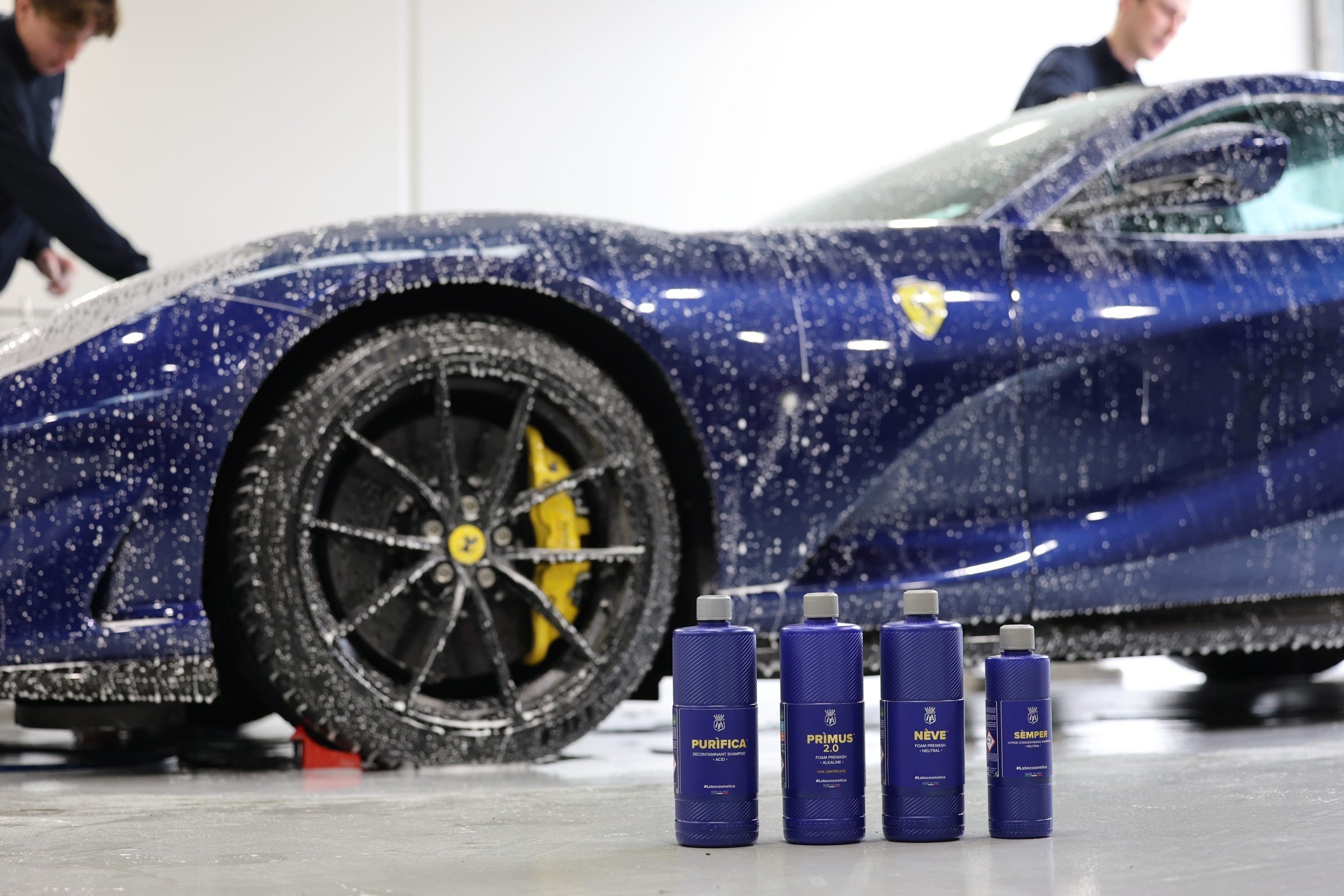
Labocosmetica NEVE and Koch Chemie GSF · pH 7 and 7.5
Neutral foams strong enough to work as a genuine pre-wash. GSF at pH 7.5 is the safe default over any coating or wax. NEVE is phosphate-free and hard-water tolerant, and is the foam stage of the 3-pH system rather than the bucket product — that is SEMPER, and putting NEVE in a bucket kit is one of the more common mistakes we correct.
The straightforward alkaline foam-gun option at the value end of the range. Does the job on ordinary road film without a certification premium attached, in 1L and 4.5L.
Where the acid stage fits, and why the 3-pH order is not arbitrary
Alkaline chemistry handles organic contamination. It does nothing for mineral deposits, alkaline residue or bonded inorganic film — and that is the entire reason the professional wash is three stages rather than one.
The acid stage often makes a car look like its coating has come back to life. Sometimes that is exactly what happened — mineral contamination masking a perfectly healthy coating has been removed. But if the product also deposits a hydrophobic ingredient, the apparent recovery is part cleaning and part deposition, and beading alone cannot tell you which. We go through that in is your ceramic coating actually on your car.
Our acid stage is PURIFICA, which reads below pH 3 and is VDA certified safe even undiluted because the acids are buffered organic acids rather than mineral or fluoride chemistry. It is also a genuine shampoo, not just a foam — put it in the bucket when inorganic contamination is the problem, because agitation plus acid beats foaming alone on mineral deposits. The full acid ranking is in the wheel cleaner chapter.
Tell us your car and your water, we'll tell you the foam
Coated, wrapped, filmed, bare, or a work 4WD that lives on a gravel road — and whether you are on tank water. The right pre-wash changes with all of it, and sometimes the answer is the cheapest bottle on the shelf.
Why is sodium hydroxide bad in a snow foam?
Because of aluminium. Aluminium protects itself with a thin oxide layer that is amphoteric — it dissolves in strong acid and in strong alkali. Once sodium hydroxide strips that layer, the metal itself is consumed: 2Al + 2NaOH + 2H₂O → 2NaAlO₂ + 3H₂. The Aluminium Federation give the safe working window as roughly pH 4.0 to 8.5. On a car that shows up as etched and pitted bare alloy, whitened or chalked plastic trim, hazed polished metal and stripped wax or sealant, and the trim damage is not reversible. Alkaline cleaning is the correct approach for road film — the objection is specifically to raw caustic soda doing the work instead of an inhibited surfactant and builder system.
Is sodium metasilicate harmful in a snow foam?
No — it is generally the protective ingredient, and most detailing content has this backwards. Silicates are added to alkaline formulations specifically as aluminium corrosion inhibitors. In alkali, aluminate ions released from the dissolving oxide react with silicate in solution and deposit back onto the metal as an aluminosilicate film that blocks further attack; one published study measured inhibition rising from about 10% to about 60% as sodium silicate went from 1 mM to 20 mM. The protection does have a ceiling — patent work found it holding to roughly pH 12.7 with sodium carbonate and pH 13.1 with potassium carbonate — and dried silicate leaves films that are hard to remove, so rinse thoroughly and never let an alkaline product dry on the car.
Is a higher pH snow foam always more aggressive?
No. The pH figure describes hydrogen ion concentration, not what is producing it or how much buffering sits behind it. Under the GHS rules a pH at or above 11.5 only creates a presumption of corrosivity, and both the OSHA and EU CLP texts say that presumption must be checked against the product's alkali reserve — how much acid it takes to bring it back to neutral. A pH 11 pre-wash built on alkaline surfactants and inhibited with silicates can be materially safer than a pH 9.5 product built on free caustic. Dilution, dwell time, temperature and the substrate involved all move real-world aggressiveness more than a point of pH does.
What does "phosphate-free" or "NTA-free" mean on a snow foam label?
Both are genuine formulation decisions with a cost attached. Phosphates are effective builders that drive nutrient loading in waterways, and the EU Ecolabel criteria for hard-surface cleaning products prohibit them outright. NTA — nitrilotriacetic acid — is a chelator that IARC classify as Group 2B, possibly carcinogenic to humans, and which Australia's industrial chemicals assessment lists as suspected of causing cancer, Category 2. Notably NTA biodegrades well, so the objection to it is toxicological rather than environmental persistence. Modern readily biodegradable chelators such as GLDA and MGDA do the same job without either problem.
Can a pH-neutral snow foam actually clean a dirty car?
Yes, on ordinary road film. Neutral pre-washes work by encapsulation — surfactants and sequestrants surrounding and lifting the film so it rinses away — rather than by chemically breaking down soil with alkalinity. On a coated, waxed or wrapped car that is often the better trade, because nothing in the product is working against the protection layer. Where a neutral foam runs out of ability is heavy grease, baked-on organic contamination and badly neglected vehicles, which is where a properly inhibited alkaline product earns its place.
Should you put snow foam on a wet or a dry car?
Dry, if the product is being used as a genuine pre-wash. Rinsing first puts a film of water between the surfactant and the soil, which dilutes the product at exactly the moment it needs to make contact with the organic film it is meant to lift. A dry application gives the surfactants direct access to the contamination. The one thing that matters more than either is that the product must not be allowed to dry on the panel — work out of direct sun, keep the dwell within the maker's stated window, and rinse thoroughly.
US Department of Energy, aluminium–water reactions · Aluminium Federation, aluminium corrosion and the pH 4.0–8.5 window · PQ Corporation, sodium silicates technical literature · published silicate corrosion-inhibition study and US Patent 4,457,322 on alkaline aluminium protection · OSHA Hazard Communication Standard Appendix A §A.2.3.1 and EU CLP Annex I §3.3.3 on pH and acid/alkali reserve · IARC Monographs Vol. 73 and AICIS/NICNAS assessment, nitrilotriacetic acid · REACH Annex XVII entry 46 and AICIS IMAP assessment, nonylphenol ethoxylates · EU Ecolabel draft criteria, hard surface cleaning products · manufacturer technical data for the products named.

Leave a comment
This site is protected by hCaptcha and the hCaptcha Privacy Policy and Terms of Service apply.