
Run your hand over a freshly washed bonnet with a sandwich bag over your fingers. If it feels gritty, that is not dirt. It is iron: brake dust and rail dust that landed on the paint hot, embedded itself in the clear coat and has been oxidising in there ever since. No shampoo shifts it, and neither does anything alkaline. It has to be chemically dissolved, and that is the one job an iron remover does.
We stock nine of them. People ask us which is the best iron remover in Australia almost every week, and the honest answer is that they nearly all use the same active and the differences are in the details: pH, concentration, odour, how the film clings, what it costs per litre, and what the manufacturer will and won't put in writing. So here is the comparison, from the safety data sheets rather than the marketing.
Sixty seconds. The detail is underneath.
They nearly all run on the same active. A thioglycolate (sodium or ammonium mercaptoacetate) that chelates iron into a water-soluble complex. The purple bleed is the iron leaving.
Neutral in the bottle, mildly acidic on the panel. Chelating iron releases hydrogen ions. That is why you rinse, never let it dry, and why brake rotors flash-rust afterwards.
For paint: Bilt Hamber Korrosol or Koch Chemie RRR. The two that declare their active and its concentration on the SDS.
For wheels: Bilt Hamber Auto-Wheel. Same thiol, formulated to cling, and pH-neutral so it will not slowly etch a lacquered or diamond-cut face.
Indoors or hate the smell: Labocosmetica Sidero or MIRCH Gaia Purge. Sidero also pulls limescale in the same pass.
Volume: Gaia Purge 10 L, Maniac Line 5 L, DIY Detail 3.8 L. Cost per litre is where these three win.
None of them contain hydrofluoric acid or bifluoride. Every product on this page is fluoride-free, and that is deliberate.


How an iron remover actually works
Almost every colour-changing iron remover on the market is built on a thioglycolate, usually sodium or ammonium mercaptoacetate. The thiol group on that molecule grabs the iron in the embedded particle and pulls it into a water-soluble complex, so it rinses away instead of staying welded to your paint. The purple-to-red bleed you watch run down the panel is that iron complex leaving in solution. It is a progress bar, not a gimmick, and when the colour stops deepening the reaction has run its course.
Two things about that reaction are worth knowing. First, the coloured complex is often described online as ferric thioglycolate, but thioglycolate is also a reducing agent, and the published chemistry is not settled on exactly which iron oxidation state you are looking at. We won't pretend it is. Second, and more useful:
An iron remover reads neutral in the bottle and does not stay neutral on the panel.
Chelating iron releases hydrogen ions, so the film sitting on your paint turns mildly acidic as it works. That is why every bottle says rinse thoroughly and never let it dry, and it is why bare cast-iron brake rotors flash-rust within minutes of the rinse. More on that below.
The other way to dissolve iron is with a strong acid, and the cheap way to do it is hydrofluoric acid or ammonium bifluoride, which becomes hydrofluoric acid the moment it meets water. It works, and it etches alloy and clear coat while it does. Hydrofluoric acid also penetrates skin without immediate pain and strips calcium from the body, which is why a burn over a small area can be a medical emergency. Every product on this page is fluoride-free. That is a deliberate line we hold.
What "pH neutral" tells you, and what it doesn't
Most iron removers advertise themselves as pH neutral or pH balanced. On the safety data sheets the real numbers run from about 5.5 to 8, which is neutral enough to be safe on clear coat, painted wheels, glass and coatings when used as directed. But pH alone does not tell you how strong the product is. The number that matters is the concentration of the active, and only some manufacturers publish it. Where they do, we have listed it. Where they don't, we say so rather than invent a figure.
Head to headThe nine we stock, on published numbers
Every figure below is the manufacturer's own, taken from the SDS or the product datasheet. "Not published" means exactly that.
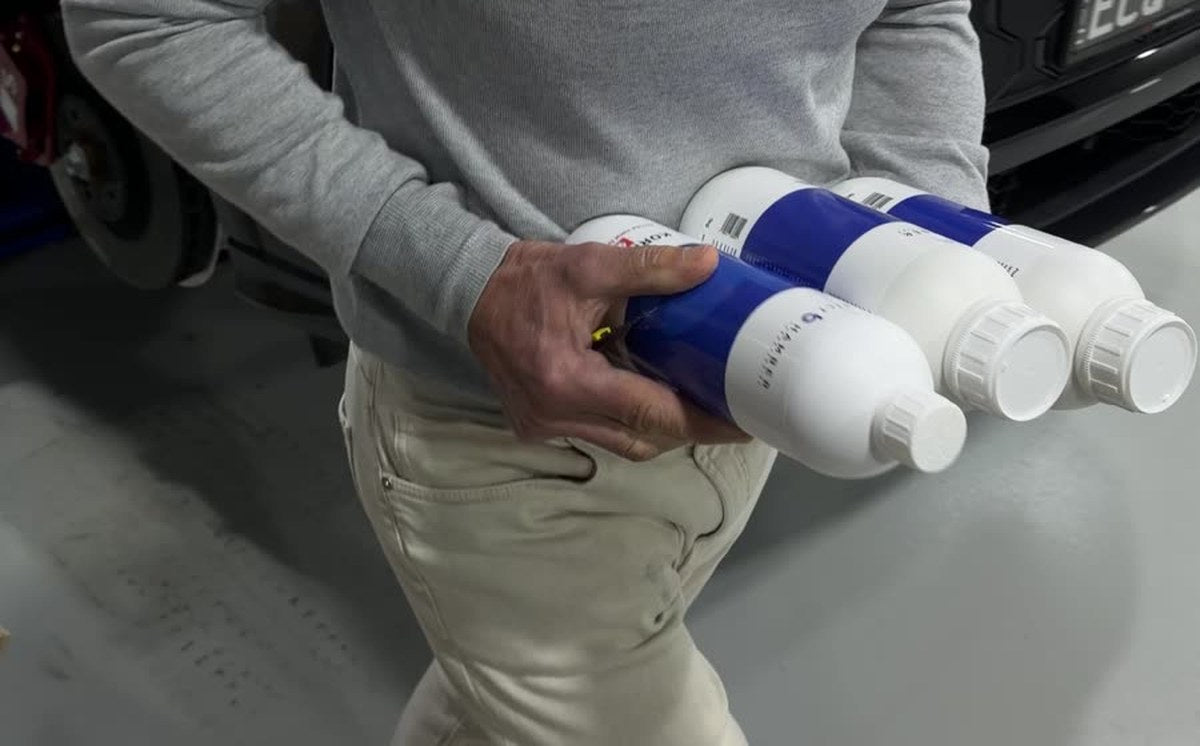
Bilt Hamber Korrosol. The most transparent formulation on the shelf: sodium mercaptoacetate declared at 15 to 25 percent on the SDS, pH 5.5 to 7.0, no strong acids and no alkalis. Ready to use, 15 seconds to 5 minutes dwell depending on temperature. Built to spread across paint, so it is our first pick for bodywork before claying. The active is a skin sensitiser, so nitrile gloves. Keep it off chrome-look plastic centres and chrome films.
Bilt Hamber Auto-Wheel. The same thiol active at 10 to 30 percent, paired with an ether sulfate surfactant for degreasing, and formulated to cling to the vertical, awkward faces of a wheel rather than run off. If you only buy one product for wheels, this is it, because it is the one that will not etch a lacquered or diamond-cut face over repeated use.
Koch Chemie RRR Reactive Rust Remover. Ammonium mercaptoacetate at 15 to 40 percent, the highest declared concentration in this group, at a genuinely neutral pH 7 to 8. Ready to use, 3 to 6 minutes, and the film is balanced to stay wet through that window. Koch specifically flag polished aluminium as a surface to test first.
Labocosmetica Sidero. The one that does two jobs. Sidero removes iron and limescale, and shows you both: it goes purple as it dissolves iron, then shifts toward green-bronze as it pulls calcium. It is a slow-drying gel that clings to verticals, it is heavily lubricated so you can brush-agitate painted wheels safely, and it is the low-odour option, which matters if you decontaminate indoors. Dilutable to a maximum of 1:4, neat for heavy contamination. Labocosmetica state it can be used in direct sun because of the slow-drying gel, which no other product here claims.
Maniac Line Iron Remover. Mafra's acid-free, pH-balanced formula, and Mafra do not publish a numerical pH, so neither will we. Ready to use or diluted to a maximum of 1:1, 3 to 4 minutes on rims and 3 to 5 on bodywork. Approved on steel, aluminium, light alloy, painted, chromed and polished rims, bodywork and glass; Mafra exclude unpainted or unprotected metal and do not recommend it on motorcycles. The 5L is good value for a workshop.
MIRCH Gaia Purge. Made in Melbourne, and the value pick by a distance: 500 mL, 2.5 L and a 10 L drum. It pairs the iron reaction with surfactants and sequestering agents so it cleans and degreases as it works, and adds hydrotropes so the film stays wet longer in warm conditions, which is a real advantage in an Australian summer. The mercaptan smell is significantly reduced. Dwell 2 to 4 minutes, cool surface, do not let it dry.
Soft99 Iron Terminator. A thioglycolate iron remover from Japan, pH balanced, 2 to 5 minutes dwell. Straightforward and well made; it does what the label says without a specialty angle.
Armour Detail Supply IRON. pH-neutral and low-odour, with wetting agents for a longer dwell of 3 to 5 minutes. Armour list it as safe on paint, plastic, glass and chrome, and advise keeping it off uncoated metals because of staining.
DIY Detail Iron Remover. pH-neutral, reduced odour, and the longest suggested dwell in the group at 3 to 8 minutes, with light agitation on stubborn spots. The 3.8 L jug suits a busy garage.


Where Korrosol and RRR win
They tell you what is in the bottle and how much. Sodium mercaptoacetate at 15–25%, ammonium mercaptoacetate at 15–40%, both with a published pH. When you are choosing what to put on paint, a declared active beats a marketing adjective every time.
Where Sidero and Gaia Purge win
Real-world usability. Sidero clings as a gel, pulls limescale in the same pass and can go on in the sun. Gaia Purge cleans while it reacts, stays wet in the heat and costs a fraction per litre. Neither will clear the room with mercaptan.
So which one should you buy?
Paint, on a car you maintain. Korrosol or Koch RRR. Both declare their active and concentration, both sit in the safe pH band, both are ready to use. Korrosol is built to spread across paint; RRR carries the highest declared concentration.
Wheels. Auto-Wheel, because it was formulated to cling to a wheel, and because a neutral thiol is what you want on lacquered or diamond-cut faces that an acid cleaner would slowly ruin.
Working indoors, or the smell puts you off. Sidero or Gaia Purge. Sidero also handles limescale in the same pass, a real bonus on a car that has sat under sprinklers.
A workshop doing volume. Gaia Purge in the 10 L, Maniac Line in the 5 L, or DIY Detail in the 3.8 L. Cost per litre is where these three win.
Heavily neglected wheels. That is a different chemistry. We do stock an acid-based Soft99 kit for it, but it belongs in a different article with its own precautions.
Where it goes in the wash
An iron remover goes on a clean, cool car. Wash first, so the product is reacting with embedded iron rather than fighting through road film, and never on a hot panel or in direct sun (Sidero being the stated exception). On wheels, our own order is presoak first, then pressure wash, then the contact wash, and the iron remover is the presoak. On paint, iron remover comes before the clay bar every time: strip the iron chemically and the clay is not dragging sharp ferrous particles across your clear coat, which is the whole argument in our clay bar guide. And nothing goes over the top of contamination, so decontaminate before any wax, sealant or coating.
Bare cast-iron brake discs that have just been rinsed with an iron remover will bloom orange within minutes, and that dust lands straight back on the wheel you have just cleaned. Spray Hyde's Serum Rustopper on the wet rotor before you move on.
All nine, in stock in Melbourne
Alpha Details in Heidelberg West carries every iron remover on this page and ships Australia-wide, free over A$95. Not sure which one suits your car? Ask. We use every one of these in the studio, which is how we know the differences are real.
What is the best iron remover in Australia?
For paint on a maintained car, Bilt Hamber Korrosol or Koch Chemie RRR, both of which declare their thioglycolate active and concentration on the safety data sheet. For wheels, Bilt Hamber Auto-Wheel. For low odour or indoor use, Labocosmetica Sidero or MIRCH Gaia Purge. For volume, MIRCH Gaia Purge in 10 L.
Are iron removers safe on ceramic coatings?
The thioglycolate iron removers in this article run pH 5.5 to 8 and contain no strong acids or alkalis, so used as directed on a cool surface and rinsed before they dry, they are coating-safe. Labocosmetica state Sidero restores the beading on an existing coating.
Why does iron remover turn purple?
The thioglycolate active chelates the iron in embedded fallout and pulls it into a coloured, water-soluble complex. The purple is the iron leaving the surface in solution. When the colour stops deepening, rinse.
Is iron remover acidic?
In the bottle, no: the products here sit between about pH 5.5 and 8. On the panel, the film turns mildly acidic as it chelates iron, because the reaction releases hydrogen ions. That is why you rinse thoroughly and never let it dry, and why brake rotors flash-rust afterwards.
Do I use iron remover before or after washing?
After washing and before claying, on a cool surface out of direct sun. On wheels it is the presoak, before the pressure wash and the contact wash.
Which iron remover has the least smell?
Labocosmetica Sidero and MIRCH Gaia Purge are the two low-odour formulas we stock; Armour IRON and DIY Detail Iron Remover are also reduced-odour.

Leave a comment
This site is protected by hCaptcha and the hCaptcha Privacy Policy and Terms of Service apply.