
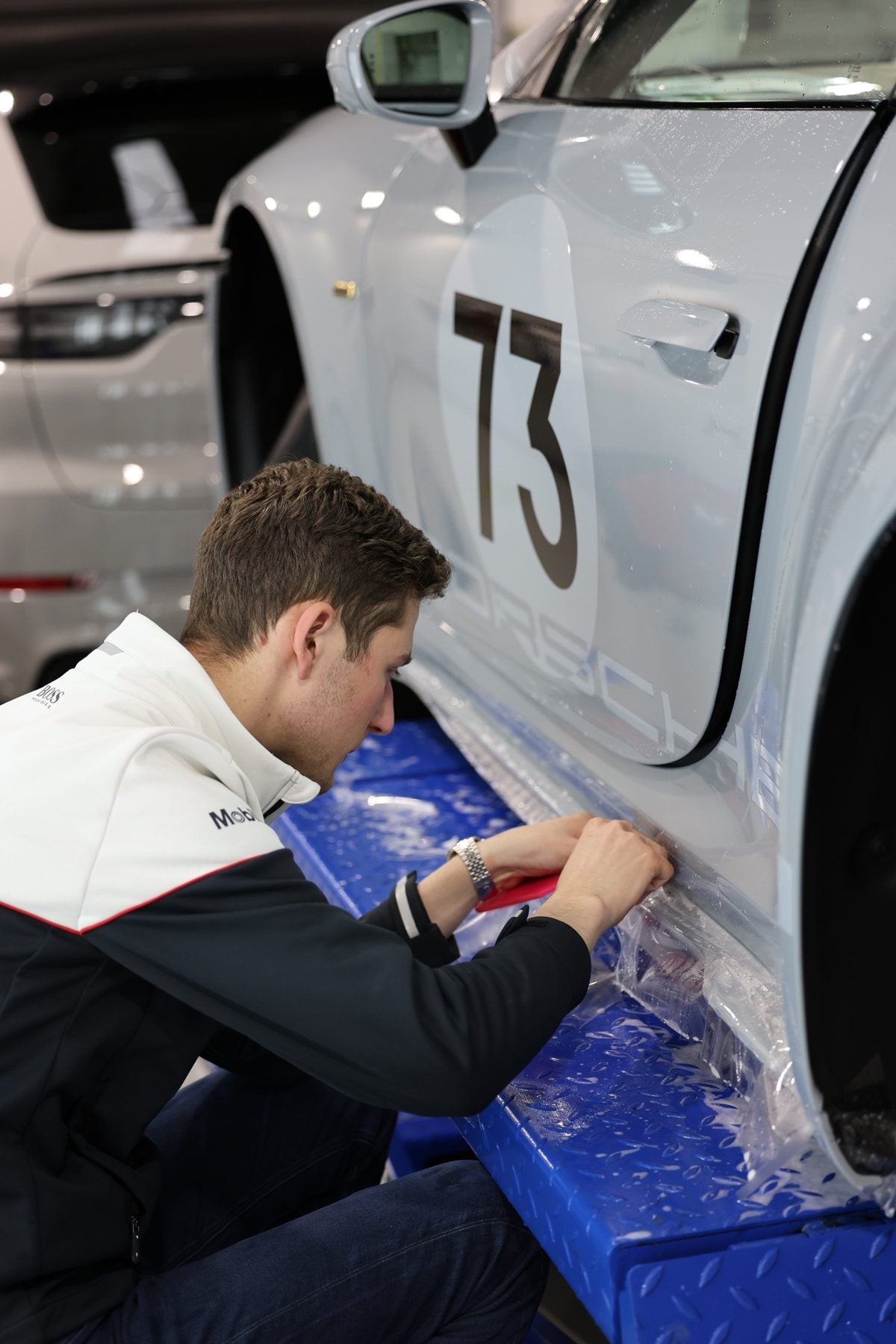
Paint protection film is the only product on your car that protects the paint by sacrificing itself. Which means the film is the thing that now needs looking after — and almost nothing sold for paint is formulated for it.
Somebody asked us this week whether the Car Care Chemistry Handbook could cover caring for film with the products we actually sell. Fair question, and a bigger one than it looks, because most PPF care advice is written by people who sell film rather than people who wash it every week.
This is the routine we run in the studio in Heidelberg West, with the reasoning behind each step and the dilutions off Labocosmetica's own data sheets.
Six things that decide whether film lasts its warranty or looks tired in two years.
Film is thermoplastic polyurethane, not thicker clearcoat. Softer, thermo-sensitive, and it has an edge that can be lifted. Everything below follows from those three facts.
Decide the coating question first. The film makers themselves instruct you to seal the film — but with a coating built for film, not one built for paint.
Abrasives are a last resort, not maintenance. Polishing paint removes clearcoat you can spare. Polishing film removes the self-healing topcoat, and it does not grow back.
The acid shampoo is not an occasional product. Labocosmetica built RENOVA to be washed with — every wash if you want. It is half of what they call the 2pH+ film cycle, with LÌBERA.
Grey film is contaminated, not dirty. Scrubbing makes it worse. It needs drawing out, which is a different chemistry entirely.
Most film damage we see was done by the owner, not the road. Usually a pressure washer at an edge, a tunnel wash, or a solvent-heavy bottle meant for paint.

What paint protection film actually is
Film is thermoplastic polyurethane. Polyurethane is an elastomer — it stretches, absorbs impact and returns to shape, which is exactly why it stops a stone chip that would have cratered your paint. On top of that base layer sits an elastomeric topcoat with self-healing behaviour: heat gives the polymer chains enough mobility to flow back over a light scratch and close it.
Every useful property of the film is also its weakness. It is softer than clearcoat, so it marks more easily under a mitt. It is thermo-sensitive, so it responds to heat and chemistry in ways paint does not. It has a physical edge where the film stops and the panel continues, and that edge can be lifted. And because the surface is more open than a baked clearcoat, it takes fine contamination in and holds it — which is why neglected film goes grey rather than simply dirty.
Film doesn't fail like paint fails. It hazes, it stains from the inside, and it lifts at the edges — three problems paint never has.
None of that is a reason to be nervous about owning it. It is a reason to use products built for film, in an order that makes sense.
Decision oneAre you coating the film, or not?
Settle this before you think about shampoo, because it changes the routine that follows.
The film makers themselves say to seal it. Feynlab — whose PPF Flex we fit — ship a 30 ml bottle of their PPF & Vinyl Ceramic V3 coating inside every full roll of film. The film manufacturer puts the coating in the box. That is not a detailer upselling you; it is the maker's own view of what a finished installation looks like. A film with nothing on top has its topcoat doing all the work against UV, bore water, bird acid and road salt.
But a coating made for paint is not automatically the right coating for film.
A paint ceramic coating
Formulated to cure hard on a rigid substrate. Film stretches on impact and flows to self-heal — a coating that cannot move with it is the wrong tool, and the prep such coatings usually assume (a machine polish) is the single worst thing you can do to film.
A film-specific coating
Built to bond to polyurethane and vinyl and stay flexible on it. Labocosmetica state that ARMORIUS Gloss and Matt are compatible with self-healing films and do not hinder that function, and rate the coating at up to two years. Feynlab say the same of their own film coating — heat-activated self-healing continues to work normally underneath it.
ARMORIUS comes in a gloss version and a matt version, and the distinction matters more than people expect: anything that adds gloss will patch a satin finish, and a patchy satin bonnet looks far worse than a dirty one. Application is a thin, level layer, a one-to-two-minute flash, a gentle buff, then twelve hours away from moisture and about seven days to full cure — which is why we apply it in the studio rather than sell it as a DIY bottle.


Do not prepare film the way you would prepare paint. No compound, no polish, no abrasive of any kind. Polishing removes clearcoat you can afford to lose; on film it removes the self-healing topcoat, permanently, and no coating puts it back. If film needs prep before a coating, it gets a deep chemical cleanse — never a machine.

If you decide against coating, you are not stuck. You just move the protection into the wash itself, which is the entire point of the shampoo below.
The first two daysWhat to do with brand new film
Don't wash it for 48 hours. That is our instruction and the industry standard, and it exists to let the adhesive cure. Some coloured and printed films want longer, so the card that came with your car is the one that counts.
Small bubbles and haze under the film are normal. They disappear as the adhesive finishes wetting out over the first week or two. Don't press them, don't chase them, don't let anybody else "fix" them.
Then wash every one to two weeks. The interval matters more than the products do. What ruins film is contamination sitting on it and drying.
Bird mess and bug splatter come off the same day. Both are acidic and both etch film exactly as they etch paint.
The weekly wash: two steps, ten minutes
Labocosmetica call this the 2pH+ cycle — an alkaline TFR followed by a contact wash, built specifically for film rather than borrowed from the paint range. Step one is always LÌBERA. Step two is your choice of two shampoos, and which one you pick is the only real decision in the whole routine.


Step one: the pre-wash
LÌBERA's point of difference is cleaning power at low alkalinity — it comes from Labocosmetica's T-7V surfactant blend rather than from brute pH, and it is the first TFR to carry VDA certification. Car cool, out of the sun, diluted around 1:20 for heavy road film. Mist it onto dry bodywork bottom to top with a pump sprayer, give it three to six minutes, never let it dry, then rinse at high pressure bottom to top.
Everything this step removes is grit that never gets dragged across the film by a mitt. Dragged grit is where nearly all film marring comes from.
Step two: the contact wash — REVÌTAX or RENOVA
REVÌTAX is neutral pH on Labocosmetica's own data sheet, so it cleans without stripping whatever protection is already there, and it carries solubilised siloxanes that anchor to the surface as you wash. In practice, every wash tops the film's beading and slickness back up instead of slowly wearing it down. Labocosmetica list PPF among its compatible materials and rate the beading and sheeting at up to four months, with maximum protection eight hours after application — so keep the car dry overnight if you can.
Three buckets: wash, rinse, wheels. Plush mitt, straight lines, top down, one panel at a time. Then dry with a blower, or a plush towel laid on and lifted rather than pressed and dragged.
The alternative is RENOVA, and it is not a once-a-season product. This is worth being clear about, because it gets written up everywhere as a deep-clean treatment. Labocosmetica describe it as the first acidic-pH traffic film remover shampoo on the market, with a dual application mode — a cosmetic maintenance shampoo, or an intensive localised treatment — and they specify that at dilutions between 1:5 and 1:50 it does not require an alkaline cleaner in the preliminary phase at all. It is highly lubricated by design: a dense foam that reduces friction and the micro-abrasion risk that comes with washing film. VDA certified for thermo-sensitive surfaces, satin film included.
So the honest answer to "which shampoo?" is: REVÌTAX when you want protection topped up as you wash, RENOVA when the car sees mineral contamination — hard water, sprinklers, coastal air, a dusty commute. Both are contact washes you can use every single week. RENOVA at 1:50 will also carry the whole wash on its own if you're short on time and skipping the pre-wash.
Wash with the acid shampoo every time and nothing ever gets the chance to build up in the film. The film simply stays clean.
That is the part worth understanding. Film goes grey because contamination accumulates in it slowly, over months, faster than a neutral shampoo can take it back out. Run RENOVA as your regular contact wash and you are removing mineral residue at the same rate the road deposits it — so the film never reaches the dull stage at all, and the corrective products further down this page become something you rarely need rather than something you plan for.
Swap REVÌTAX for SÀTINO, which is built for matte paint and vinyl and carries no gloss agents. Same method, same three buckets. And if you're coating, it's ARMORIUS Matt or nothing.

The half of the dirt a neutral shampoo can't reach
An alkaline pre-wash and a neutral shampoo will handle organic soiling all day: road film, oils, insects, exhaust residue. What they will not touch is mineral. Water spots, limescale from sprinklers and bore water, and atmospheric fallout are inorganic, and they need the other end of the pH scale.
On paint you would reach for PURÌFICA. On film you reach for RENOVA — Labocosmetica's own comparison is that PURÌFICA is a descaling shampoo for neglected paint, while RENOVA was developed to penetrate film that has absorbed traffic film and contamination into its thermo-sensitive structure. Different job, different product, same idea.


The chemistry doing the work is ethoxylated surfactants, chelating agents and anti-redeposition stabilisers, which is why it lifts mineral residue out of the film's micro-pores instead of just scrubbing the surface. As light routine maintenance it goes in at 1:200 — five millilitres in a litre, by mitt onto an already wet surface, then rinsed. At 1:50 it becomes the whole wash.
The 1:10 spot treatment dwells for sixty seconds maximum, then rinses immediately. That limit is not a suggestion.
And never let the two pH extremes meet on the panel. Alkaline first, rinse properly, then acid. Neutralised chemistry on a wet panel does nothing except waste both bottles.
When film looks dull rather than dirty
This is the failure owners describe as "the film has gone grey", and it is largely preventable — it is what happens when mineral contamination goes years without being addressed. But once it is there, washing harder makes it worse. The contamination isn't sitting on the surface — it's in the micro-layers of the topcoat, drawn in over months of heat cycling. Scrubbing only marks the film; solvents dry it out.
LIMPIA is built for that specific problem. It works by capillary action, drawing embedded grime back out of the film, with no solvents and no abrasives, so the elasticity and clarity of the topcoat are left alone. Ready to use: shake, spray onto the film, wipe with a clean microfibre. No rinsing, no equipment, safe indoors and safe waterless — which makes it the one product here you can use in an apartment car park. Seasonally, before a coating, or whenever the film looks flat.
For bugs, sap and tar the rule is blunt: get them off as soon as you can, while they are still soft. A dedicated PPF-safe cleaner first, and for a stubborn stain a 50/50 mix of isopropyl alcohol and water on the towel rather than sprayed at the panel, kept off the surrounding paint. What you avoid is the whole aisle of solvent-heavy tar removers, and any wax or polish carrying dyes, abrasive compounds or petroleum solvents.
Last resort onlyWhy we don't clay or polish film
Self-healing is not a property of the film. It is a property of the topcoat — a thin outer layer carrying polymers with a memory effect, which flow back into position when they are warmed. Feynlab describe exactly that on PPF Flex. Everything the film does at its surface — healing, water beading, stain resistance — lives in that one layer.
Which sets a hard boundary, and STEK state it plainly in their own FAQ: a scratch that penetrates the topcoat will not self-heal. Past that layer there is nothing to recover. They make the same point about automatic washes, which raise the odds of a scratch going deep enough to cross it.
Every abrasive pass spends topcoat you cannot put back, and the self-healing goes with it.
That is the whole argument against reaching for a machine. Pioneer, who manufacture film, put it in writing: from a manufacturer's standpoint polishing PPF is generally not recommended, because it can damage the protective topcoat, and once that layer is compromised the film can lose some of its self-healing, its hydrophobic performance and its resistance to staining. Polishing paint costs you clearcoat you can spare. Polishing film costs you the function you paid for.
Clay is the same argument in slower motion. A clay bar works by shearing bonded contamination off the surface — mechanical, not chemical — and it is being dragged across an elastomeric topcoat that is softer than the clearcoat it sits on. It is not a catastrophe, and plenty of shops do it. But it spends a little of the same finite layer, and on film there is a chemical route to the same result: RENOVA on the mineral contamination, LIMPIA on what has soaked into the film. Neither touches the surface at all.
Heat first. Chemistry second. Abrasives last, and only on film that is already compromised. If a mark will heal in the sun, that is the repair. If contamination is the problem, dissolve it. Claying and polishing come out only when a film is dull or marred beyond what chemistry can fix, and even then it is a decision to trade some self-healing for some clarity — made deliberately, on a film that is near the end of its life anyway, not as part of a maintenance routine.
What nobody publishes is how much you spend: there is no manufacturer figure for topcoat thickness, and no measurement of how many passes cost you the healing. That absence is exactly why we treat it as a one-way door.

What actually kills film
Automatic and brush washes. Rotating brushes scratch the topcoat and, worse, catch and lift edges. There is no safe version of this on film.
A pressure washer held close to an edge. At least 60 cm back, a wide 40-degree fan, never aimed into a seam. This is the most common way a good installation gets ruined by its owner.
Anything abrasive as routine maintenance. Compounds, polishes, clay, scouring pads, cheap sponges, rough towels. Good microfibre only — see the section above for the one exception.
Strong solvents and thinners. Including most supermarket tar removers.
Service-station traffic film removers. Industrial TFRs are built for painted fleet vehicles on a schedule, not for a thermo-sensitive film with an adhesive line.
Waxes carrying dyes, abrasives or petroleum solvents. Pigment stains film, abrasives strip the topcoat, and petroleum distillates attack the adhesive line at the edges.
Letting any product dry on the surface. Every product above says it, and it's the instruction people skip.
Washing a hot car in direct sun. Film is thermo-sensitive. Heat plus chemistry plus evaporation is how you get staining.
Self-healing is heat-activated. Feynlab put it plainly on their own film: in most conditions ambient sunlight generates enough warmth for the topcoat to flow back over a light scratch by itself, and for faster results gentle heat — a heat gun, or warm water poured over the area — accelerates it. Park it in the sun, or reach for the kettle and the hose, not the polisher.
Reaching for a polish instead is how a scratch that would have vanished by itself becomes a permanent dull patch.
What we'd actually put on your car
Labocosmetica LÌBERA + REVÌTAX
The pre-wash and the contact wash. One alkaline product, formulated for film; one neutral one that tops up protection as it cleans. This pairing is the whole weekly routine.
Replaces REVÌTAX on satin and matte. No gloss agents, so nothing patches.
The acidic TFR shampoo, and the other half of the 2pH+ cycle. Safe as a contact wash every time — Labocosmetica's own dual-mode positioning — and at 1:50 it carries the wash without a pre-wash step. The one to reach for wherever water is hard.
Corrective rather than routine. The right answer to grey film, and the right prep before coating.
Labocosmetica ARMORIUS Gloss / Matt
Studio-applied. Twelve hours dry, seven days to full cure, and rated by Labocosmetica at up to two years.
Paint ceramic coatings on film · service-station TFR · any polish
Not because of the brand on the bottle — because none of the three were formulated for a moving, thermo-sensitive polyurethane surface with an exposed adhesive edge.
All of it sits together in the PPF and wrap care collection, alongside the Feynlab PPF Flex film itself.


Had film fitted? Bring it in and we'll check the edges.
Free, ten minutes, no purchase needed — we'll look at the edges, tell you honestly whether the film needs a deep cleanse or just a better wash routine, and say so if the answer is the products you already own.
Can I put a normal ceramic coating on my PPF?
You can seal film, and the film makers expect you to — Feynlab include a bottle of their own film coating inside every roll of PPF Flex. But choose a coating made for film. Coatings formulated for clearcoat are designed to cure hard on a rigid surface, while film stretches on impact and flows to self-heal, so a rigid coating is the wrong tool on a moving substrate. Labocosmetica's ARMORIUS exists specifically for polyurethane and vinyl films and comes in separate gloss and matt versions so it doesn't alter a satin finish. The bigger risk isn't the coating itself but the prep a paint coating usually assumes: machine polishing removes the film's self-healing topcoat permanently.
Will a coating stop the film self-healing?
No, provided it is a film-specific coating. Labocosmetica publish that both ARMORIUS Gloss and Matt are compatible with self-healing films and do not hinder that function, and Feynlab say the same of their own PPF and vinyl coating. Worth remembering that heat is what does the healing, so a coated panel behaves no differently in the cold — sunlight or warm water still does the work either way.
How often should I wash a car with paint protection film?
Every one to two weeks, and immediately after anything acidic lands on it. Bird droppings and bug residue etch film the same way they etch paint, and the damage is done while they sit and dry rather than at the moment of impact. The washing interval matters more than which products you use — film that is washed regularly with a decent pH-neutral shampoo will outlast film that gets a perfect chemical routine once a season.
Can I use my normal car shampoo on PPF?
A genuinely pH-neutral shampoo won't hurt film. The problem is usually what sits beside it on the shelf: the alkaline snow foam, the wheel cleaner overspray, the solvent-heavy quick detailer. Those are the ones to change first. A shampoo that also deposits protection, like REVÌTAX, does more for film than a plain neutral shampoo because it tops the surface back up every wash instead of leaving it bare.
Is an acidic shampoo safe to use on PPF every wash?
Yes, when it's formulated for film. Labocosmetica's RENOVA is an acidic-pH traffic film remover shampoo with a dual application mode — cosmetic maintenance shampoo, or intensive localised treatment — and it is VDA certified for thermo-sensitive surfaces including satin film. Its high lubrication is deliberate: the dense foam reduces friction during the contact wash, which is where film picks up marring. At dilutions between 1:5 and 1:50 Labocosmetica state it doesn't need an alkaline cleaner beforehand at all. The thing that isn't safe every wash is the 1:10 localised spot treatment, which dwells for sixty seconds maximum and then rinses immediately.
Can I pressure wash a car with PPF?
Yes, on flat panels, at a sensible distance with a wide fan, and never pointed at an edge or a seam. Our rule is the nozzle at least 60 cm off the surface with a 40-degree tip, and edges cleaned by hand with a soft mitt instead. The risk isn't pressure hitting the middle of a panel — it's water getting under a film edge and lifting it, which is a repair rather than a clean.
Why has my paint protection film gone grey or cloudy?
Because film absorbs fine contamination rather than just carrying it on the surface. The film expands and contracts with heat, and traffic film, oils and environmental fallout work their way into the micro-layers of the topcoat, which reads as a dull grey cast that washing doesn't shift. The fix is a deep cleanser that draws the contamination back out — Labocosmetica's LIMPIA is built for this — not more aggressive washing and definitely not polishing, which removes the topcoat. If the film is genuinely yellowing rather than greying, that's UV degradation of the film itself and it's a warranty conversation with your installer — Feynlab, for instance, warrant PPF Flex structurally for ten years with a four-year cosmetic warranty covering UV degradation, oxidation and fading.
Dilutions, dwell times, pH values and durability figures for LÌBERA, RENOVA, LIMPIA, REVÌTAX, SÀTINO and ARMORIUS are Labocosmetica's own published technical data, including RENOVA's dual-mode positioning and the 1:5 to 1:50 range at which they state no alkaline pre-wash is required. We are an authorised stockist and we run this range in a working studio every week.
Self-healing behaviour, film construction and warranty terms are Feynlab's published product information for PPF Flex, the film we install. That a scratch penetrating the topcoat will not self-heal is STEK's own published FAQ; that polishing is not recommended from a manufacturer's standpoint, and can cost self-healing, hydrophobics and stain resistance, is Pioneer's. No manufacturer publishes a topcoat thickness or a measurement of what polishing costs, so we don't quote one. Cure times, pressure-washer distances and the prohibitions on abrasives, solvents and dye-bearing waxes are our own studio practice, built from fitting and maintaining film every week. Film brands publish their own care documents and the numbers differ — the card that came with your car is the one that governs your warranty.
Where a claim could not be sourced to a manufacturer or a primary document, it is not in this article.

Leave a comment
This site is protected by hCaptcha and the hCaptcha Privacy Policy and Terms of Service apply.