A water spot is a ring of minerals your rinse water left behind when it dried. Fresh, it sits on top of the paint and an acid lifts it in under a minute. Leave it in the sun for a summer and it etches into the clear coat, and no chemical brings that back: it needs polishing.
We stock five dedicated water spot removers, and they are more different than the shelf suggests. Two sit at pH 1, one at about pH 3, one at pH 3.5, and one is a lactic-acid formula with no hazard classification at all. One is a gel, one is a wipe-on, wipe-off finish for coated cars, and three are spray-and-rinse. Every figure below is the maker's own; where a maker does not publish a number, we say so.
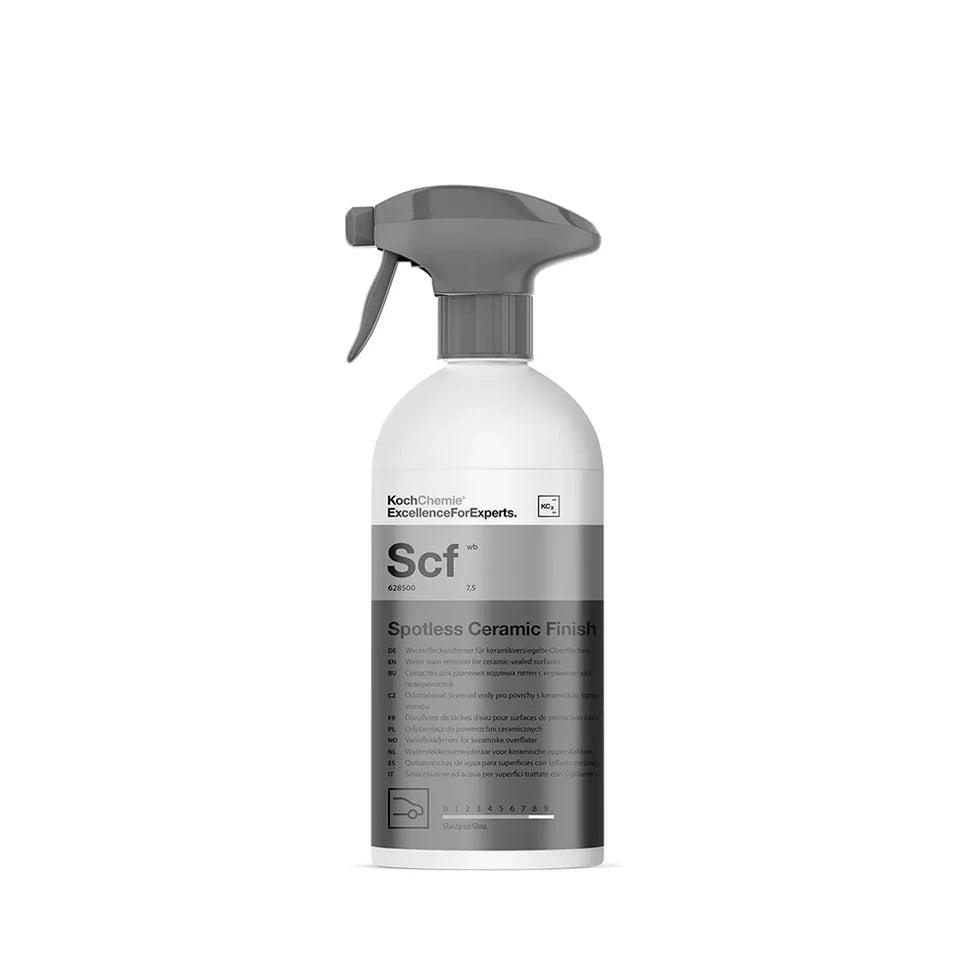
Ceramic-coated car, light spots: Koch Chemie SCF. The only wipe-on, buff-off product here, and Koch state it removes spots on ceramic-sealed cars without affecting the sealant.
Everyday spots on any car, best value: MIRCH Neptune Wrath. About pH 3, made in Australia, coating-safe diluted according to MIRCH.
Stubborn mineral deposits and acid-rain marks on paint and glass: Labocosmetica Ènergo. A pH 1 gel that clings where you put it, and doubles as a glass-coating prep.
Glass, chrome and bodywork, spot by spot: Maniac Line Water Spot. pH 1, ready to use, 30 seconds a spot.
The gentlest start: DIY Detail Water Spot Remover. Lactic acid, spray on and hose off, not classified as hazardous on its safety data sheet.


Three kinds of water spot, and which one a chemical can fix
Type 1, mineral deposits. Calcium and magnesium carbonate left on top of the surface. Any acid dissolves carbonate into a soluble salt, and a chelator holds the calcium in solution so it rinses off. This is what every product here is for.
Type 2, bonded minerals. Deposits that have baked on and partly bonded to the clear coat or the coating. They need a stronger acid, longer contact or a few rounds, which is where the pH 1 products earn their place.
Type 3, etching. The deposit, often concentrated by heat, has eaten a shallow crater into the clear coat. The minerals may be gone but the outline stays, because the paint itself is now the wrong shape. That is a polishing job. DIY Detail say it plainly: deeply etched spots may need polishing.
If you are not sure which you have, start with the mildest product, and step up only if the spots survive. Our pH guide explains why a lower number is not automatically a better choice.
If the whole car has gone dull and stopped beading, the problem is a mineral film, not individual spots, and an acid shampoo is the right tool. A dedicated water spot remover is for the marks that survive it.
The five we stock, on the makers' numbers
Koch Chemie SCF Spotless Ceramic Finish
The odd one out, and the reason it suits coated cars. SCF is not rinsed off: Koch have you spray it onto a microfibre, wipe a thin film onto the panel, leave it up to three minutes and polish it off. Koch describe it as gentle removal of water and limescale stains on ceramic-sealed vehicles without affecting the sealant, and say it restores colour depth and a streak-free shine. It was designed alongside Koch's own coatings and slots into their routine after a pre-wash, Reactivation Shampoo and drying. Koch say not to use it on warm surfaces or in the sun.
MIRCH Neptune Wrath
MIRCH make Neptune Wrath in Australia and describe it as a concentrated acidic spray at about pH 3. Use it neat on severe spotting and diluted on lighter marks and protected surfaces; MIRCH say it is safe on ceramic coatings when diluted and removes minerals without damaging existing protection. MIRCH state it contains no hydrochloric, hydrofluoric or sulphuric acid. Spray, leave 30 to 60 seconds, agitate, rinse, in the shade on a cool panel. MIRCH do not publish a dilution ratio.
Labocosmetica Ènergo
Ènergo is the strongest tool here and it is built that way on purpose. Labocosmetica designed it for limescale and acid-rain marks on glass and bodywork, to cut down polishing time, and as a primer that purifies glass before a glass coating. It is a gel, so it stays on vertical glass and treats a single area without running. Labocosmetica's directions: work on a wet car, panel by panel, from neat to 1:5 with a glove, and rinse; for marks that remain, a few neat drops on a cotton pad, worked for up to five minutes, then a damp microfibre. Labocosmetica state it does not damage paint or plastic parts. Their own cautions matter: never in the sun or on a hot panel, never let it dry, avoid neat product on delicate, soft or single-stage paint, and expect scratches to look more visible afterwards because the minerals that were filling them are gone.
Maniac Line Water Spot
Ready to use at pH 1, built from methanesulphonic, glycolic and formic acids. Maniac Line list glass, paint, chrome, plastic, emblems and wheel nuts, and say it is safe on painted surfaces and improves the bond of a sealant, coating or wax applied afterwards. Their limits are tight: 30 seconds on a spot, 60 seconds at most on a persistent one, never let it dry, and do half a windscreen at a time. Maniac Line say not to use it on motorcycles and to take care on delicate plastics.
DIY Detail Water Spot Remover
A spray-on, hose-off lactic acid formula for fresh and light hard-water spots. DIY Detail list glass, paint, metal, headlights, chrome and wheels, and say deeply etched spots may need polishing. Leave it one to two minutes, agitate with a microfibre, rinse and repeat if needed, then put a wax or sealant back on. Its safety data sheet does not classify it as hazardous, the only one in this group.
The decisionWhich one should you buy?
Coated car, fresh spots after a wash or the sprinklers. Koch SCF, or Neptune Wrath diluted.
Uncoated paint, light spotting, first time doing this. DIY Detail, then step up if needed.
Spots that survived the gentle option, or limescale on glass. Ènergo or Maniac Line, short contact, small sections.
Prepping glass for a glass coating. Ènergo, which Labocosmetica designed partly for that job.
The outline is still there after all of this. It is etched. Stop adding acid and book a polish.
Safety, from the data sheets
The two pH 1 products are corrosive concentrates. Labocosmetica's ingredient sheet for Ènergo lists hydrochloric acid and ammonium bifluoride, and the label carries H314, causes severe skin burns and eye damage. Fluoride-based acids are exactly why a product like this stays a targeted spot treatment, used as the label directs, and never goes into a wash. Maniac Line Water Spot is labelled Danger, H302 and H314. Koch SCF is labelled Danger, H315 and H318. MIRCH publish no safety data sheet for Neptune Wrath. For all of them: nitrile gloves and eye protection, a cool panel in the shade, small sections, and rinse or wipe off before anything dries.
All five, in stock in Melbourne
Send us a photo of the spots in good light. We can usually tell you from that whether it is a chemical job or a polishing job.
What is the best water spot remover in Australia?
For a ceramic-coated car, Koch Chemie SCF, which Koch say removes water spots on ceramic-sealed vehicles without affecting the sealant. For everyday spotting at the best price, MIRCH Neptune Wrath. For stubborn mineral deposits and acid-rain marks on paint and glass, Labocosmetica Ènergo. For a gentle first try, DIY Detail Water Spot Remover.
Will a water spot remover damage my ceramic coating?
Koch say SCF works on ceramic-sealed cars without affecting the sealant, and MIRCH say Neptune Wrath is safe on ceramic coatings when diluted. The other makers make no coating claim either way. Use the mildest product that works, on a cool panel, and do not let it dry.
Why are my water spots still there after using a remover?
If the outline stays after a remover has had its full contact time, the spot has etched into the clear coat. The minerals are gone but the paint is now the wrong shape, and only polishing fixes that.
Can I use a water spot remover on glass?
Yes. Labocosmetica, Maniac Line, MIRCH and DIY Detail all list glass. Labocosmetica also designed Ènergo to prep glass before a glass coating.
What is the difference between an acid shampoo and a water spot remover?
An acid shampoo removes a thin mineral film from the whole car during the wash. A water spot remover is a stronger, targeted treatment for individual marks that survive the wash.
Labocosmetica product page, data sheet (Rev. 2, 2023) and ingredient sheet (2026) for Ènergo · Koch-Chemie product page, product information and safety data sheet (v0003, 2026) for Spotless Ceramic Finish · MIRCH product page for Neptune Wrath · Maniac Line product page, technical data sheet and ingredient sheet for Water Spot · DIY Detail product page and safety data sheet for Water Spot Remover · prices are Alpha Details retail at the time of writing.

Leave a comment
This site is protected by hCaptcha and the hCaptcha Privacy Policy and Terms of Service apply.