Why the number on the back of your product matters — exponentially more than you think.
Most people treating car care products like detergent are leaving serious results on the table. The chemistry behind professional detailing isn't complicated, but it is precise. And the most misunderstood concept — even among experienced enthusiasts — is pH.
At Alpha Details, we've built our product selection and process around a chemistry-first philosophy. Understanding why we reach for one product over another, and why we treat pH as a critical variable rather than a footnote, is what separates a safe, effective detail from one that wastes time, effort, or risks damage.
What Is pH — and Why Does the Formula Matter?
pH is defined by the equation pH = −log₁₀[H⁺]. That square-bracketed [H⁺] represents the concentration of hydrogen ions in solution. The negative logarithm means the scale works in reverse — lower numbers mean higher hydrogen ion concentration, which means more acidic. Higher numbers mean lower hydrogen ion concentration, which means more alkaline (also called basic).
The single most important thing to understand about this equation is what the logarithm does to the scale. pH is not linear. It is exponential. Every single step on the pH scale represents a 10× change in chemical strength — not a 1-unit change.
pH 11 → pH 12 is not one step stronger. It is 10 times more aggressive. pH 12 is 100,000 times more alkaline than pH 7.
This is where most people get it wrong. They look at a label that says pH 12 and compare it to one that says pH 11, thinking the difference is modest. In reality, that single-digit gap is a tenfold increase in chemical aggressiveness. Choosing the wrong product, or using a high-pH cleaner routinely when a mid-range one would do, isn't just inefficient — it can accelerate degradation of coatings, rubber, and paintwork.
pH Scale Reference
| pH Level | Relative Strength (vs. Neutral) | Target Contamination |
|---|---|---|
| pH 0–6 | Acid — mineral dissolution | Water spots, cement, inorganic scale |
| pH 7 | Neutral — no reaction | Safe maintenance cleaning |
| pH 8 | 10× more alkaline than neutral | Light organic film |
| pH 9 | 100× more alkaline than neutral | Moderate traffic film |
| pH 10 | 1,000× more alkaline than neutral | Heavy organic contamination |
| pH 11 | 10,000× more alkaline than neutral | Targeted degreasing |
| pH 12+ | 100,000× more alkaline than neutral | Aggressive organic & rubber oxidation |
The Three Functional Chemistry Zones
In professional detailing, products are selected based on one core principle: match the chemistry to the contamination. There are three zones on the pH scale, each targeting a fundamentally different type of dirt or contamination.
Acidic (pH 0–6): Inorganic Contamination
Acids dissolve inorganic mineral structures. When your car sits near roadworks, construction sites, or simply accumulates water spots over time, mineral compounds bond directly to your paintwork or glass. These are ionic, mineral-based deposits — calcium carbonate from hard water, calcium silicate from cement, iron phosphates from brake dust. An alkaline cleaner won't touch them. You need an acidic solution to break those mineral bonds through a chemical dissolution reaction.
Labocosmetica Energo and Purifica sit in this zone. Energo is formulated for paint and body panels, targeting water spots and mineral contamination. Purifica targets wheel surfaces, dissolving the inorganic iron deposits that brake dust leaves behind. Using these products is a targeted, controlled intervention — not a routine wash.
Neutral (pH 6–8): Safe Maintenance Cleaning
Neutral chemistry is your regular-use zone. Products in the pH 6–8 range produce no aggressive chemical reaction with paint, coatings, rubber, or glass. They clean through surfactant action — the same basic soap-and-water principle — without introducing any risk of chemical degradation.
Labocosmetica Neve sits here. As a pH-neutral snow foam, it's designed for contact-free pre-wash and regular maintenance washes on coated vehicles. It will not disturb a ceramic coating's bond, will not accelerate rubber aging, and is safe to use weekly.
Alkaline (pH 8–14): Organic Contamination
Alkaline chemistry breaks down organic contamination — traffic film, oils, greases, diesel residue, and the biological compounds that accumulate on lower panels and rear sections of daily-driven vehicles. The mechanism here is saponification and emulsification: alkaline solutions break apart the molecular chains of oils and organic films, allowing them to be rinsed away.
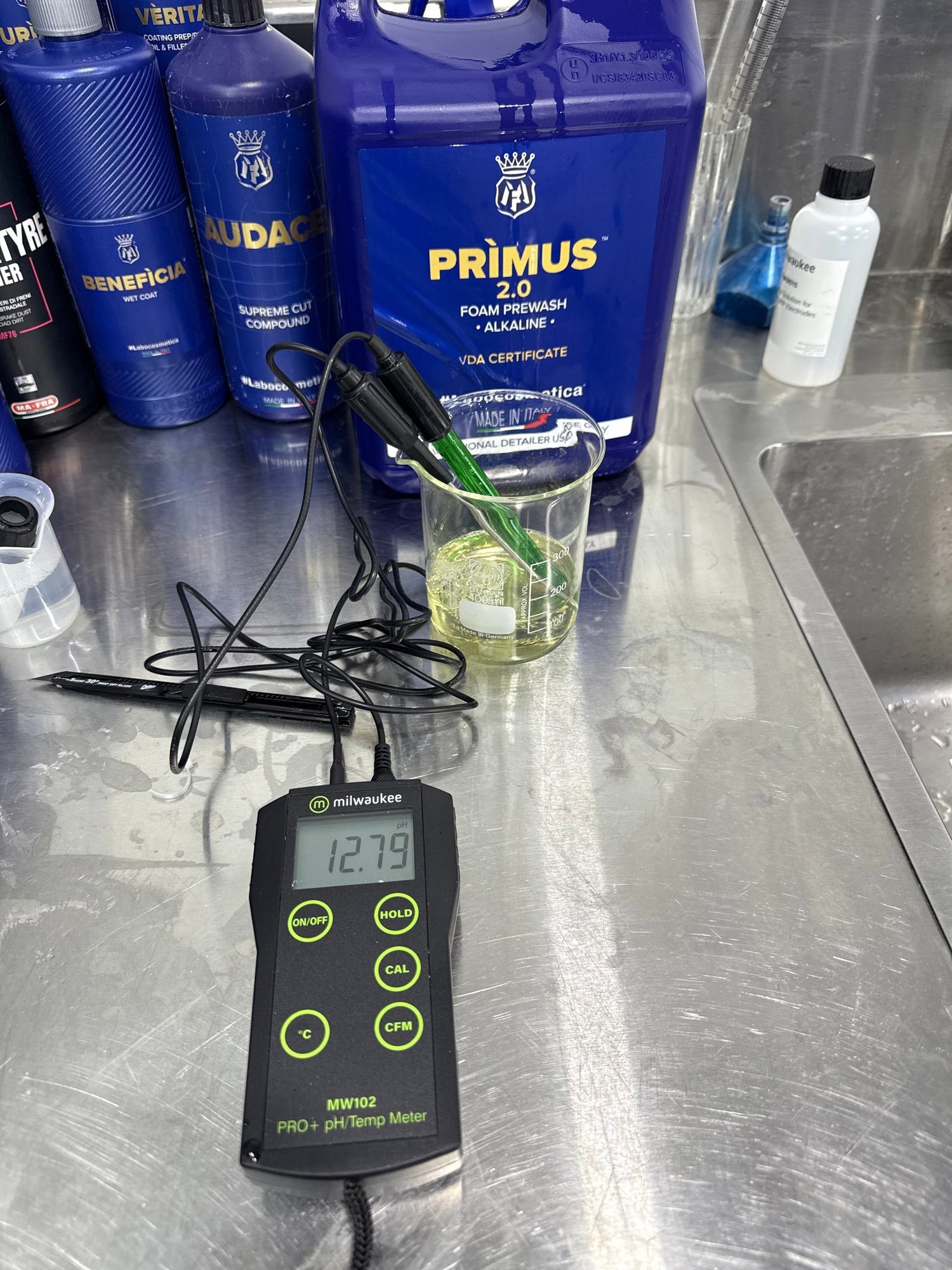
Labocosmetica Primus operates as a strong alkaline pre-wash, capable of removing 90% of organic contamination before contact washing even begins. It is formulated for routine pre-wash use. Mirch Grime Reaper operates at a higher pH and should be used as a targeted, specific-purpose tool — not as a general-purpose spray-on pre-wash.
The distinction between a pH 11 product and a pH 12+ product is not cosmetic. Routine use of a high-pH alkaline on a coated vehicle will progressively attack the coating's SiO₂ matrix. pH-matched product selection isn't just about cleaning performance — it's about long-term protection.
Buffering: Why Dilution Doesn't Always Change the pH
This is the concept that surprises even chemistry-literate detailers. When you dilute a product with water, common sense suggests the pH should shift toward neutral. For unbuffered solutions, this is broadly true. But professional-grade detailing chemistry is buffered — and buffered systems behave differently.
A buffer is a chemical system — typically a weak acid paired with its conjugate base, or a weak base paired with its conjugate acid — that resists changes in pH when diluted or when small amounts of acid or base are added. The buffer equilibrium absorbs the change without a significant shift in hydrogen ion concentration.
Dilution reduces volume — but a buffered product maintains its pH. This is how a premium product at 1:10 dilution can still deliver meaningful cleaning chemistry.
In practical terms, this means a buffered alkaline pre-wash diluted to a 1:10 ratio is not simply one-tenth as alkaline. The buffering capacity maintains pH across a range of dilutions, which is why correctly formulated products continue to perform at the dilution ratios specified on the label. This is also why cheap, unbuffered products often fail to deliver on their label claims — a diluted unbuffered product really does lose pH rapidly and with it, cleaning efficacy.
Understanding buffering explains why product selection matters beyond marketing claims. When you're paying for a premium product like Labocosmetica Primus, part of what you're paying for is the formulation chemistry that ensures it performs predictably at the dilution ratio it's designed for — not just out of the bottle.
Three Real-World Scenarios from Our Workshop
Cement Contamination from Roadworks
A vehicle returns from roadworks exposure with fine inorganic cement bonded to the paintwork. Calcium silicate compounds have set on the surface, and because they are mineral-based, they cannot be emulsified or lifted by alkaline chemistry. A pH-neutral wash will do nothing. Mechanical polishing without chemical pre-treatment risks marring the paint.
The correct approach is a targeted acid application — Labocosmetica Energo — which dissolves the mineral structure through chemical reaction, releasing the contamination without mechanical abrasion. The result is clean paintwork without paint correction required.
Heavy Traffic Film on a Daily Driver
Lower panels and rear sections of a vehicle driven in urban traffic accumulate a complex organic matrix: diesel particulates, rubber tyre abrasion, exhaust residue, road oils. This contamination is organic in nature — responsive to alkaline chemistry.
Labocosmetica Primus applied as a pre-wash breaks down this organic film before any contact wash occurs. In practice, this removes up to 90% of contamination in the pre-wash stage, meaning the contact wash carries far less abrasive load and delivers a significantly safer result for the paint surface.
Tyre Browning (Quinone Discolouration)
Tyre browning is a specific chemical phenomenon. Tyre manufacturers incorporate antioxidant compounds — predominantly p-phenylenediamine derivatives — to protect the rubber from ozone degradation. When these antioxidants oxidise as part of doing their job, they form quinone compounds, which are brown in colour and migrate to the tyre surface. This is not surface dirt — it is a chemical transformation embedded in the rubber itself.
Removing quinone browning requires high-pH alkaline chemistry to break down these oxidised organic compounds. Mirch Grime Reaper, operating at an aggressive alkaline pH, is the appropriate targeted tool for this application — not a general-purpose pre-wash, and not anything acidic.
Alpha Details Product Chemistry Map
Every product in our store occupies a deliberate position on the pH scale.
| Product | pH Zone | Role | Targets |
|---|---|---|---|
| Labocosmetica Energo | Acidic | Inorganic removal | Water spots, cement, minerals |
| Labocosmetica Purifica | Acidic | Wheel & brake dust | Inorganic iron contamination |
| Labocosmetica Neve | Neutral | Snow foam / wash | Safe maintenance cleaning |
| Labocosmetica Primus | Strong alkaline | Pre-wash | Traffic film, oils, grease |
| Mirch Grime Reaper | Aggressive alkaline | Targeted degreasing | Organic oxidation, tyre browning |
The Principle Behind the Practice
Every detailing result — whether a flawless finish or a coating failure — comes back to chemistry. The question is never just "what product did you use?" It's whether the chemistry of that product was matched to the nature of the contamination it was meant to address.
Acid for inorganic. Alkaline for organic. Neutral for maintenance. And within alkaline, always match the pH aggressiveness to the task — because pH 12 is not just a little stronger than pH 11. It is ten times stronger.
This is why we say detailer first, chemistry driven. Understanding the exponential pH scale, the behaviour of buffered products under dilution, and the fundamental chemistry behind contamination types is what separates a professional result from a good-faith attempt.
Continue reading
- pH in Car Detailing — Part 2: Why pH doesn’t tell the full story
- pH in Car Detailing — Part 3: What actually cleans your car
- Physical vs Chemical Ceramic Coatings — what the labels actually mean
Shop the full Labocosmetica range at alphadetails.com.au

Leave a comment
This site is protected by hCaptcha and the hCaptcha Privacy Policy and Terms of Service apply.