In our last post, we broke down the pH scale and showed you just how aggressive each step really is — every single number represents a 10× increase in chemical strength. If you haven’t read that one yet, start there.
But here’s the thing we didn’t tell you: pH alone does not tell you how corrosive or damaging a product really is.
Two cleaners can sit at the exact same pH and behave completely differently on your car. One strips aluminium, destroys trim, and breaks down coatings. The other cleans just as hard — and leaves everything intact. The difference isn’t the number on the scale. It’s what’s behind it.
pH Measures Strength — Not Safety
The pH scale tells you one thing: the concentration of hydrogen ions (or hydroxide ions) in a solution. That’s it. It tells you how acidic or alkaline something is, but it says nothing about what chemical is producing that acidity or alkalinity — and that’s where the real danger lives.
Think of it this way: a pH 12 product made with sodium hydroxide (caustic soda) and a pH 11 product made with safer alkaline surfactants will both register as “highly alkaline.” But the sodium hydroxide product will actively dissolve aluminium, degrade rubber and plastic trim, and strip protective coatings on contact. The other won’t.
The same principle applies on the acid side. A pH 2 wheel cleaner made with hydrofluoric acid (HF) and a pH 2–3 acid shampoo made with buffered noble acids will both read as “strongly acidic.” One will etch your alloys and is genuinely lethal on skin contact. The other is VDA-certified safe even when used undiluted.
The label says “alkaline” or “acidic.” It doesn’t say what’s making it that way. That’s the blind spot — and it’s a big one.
The Alkaline Side: Sodium Hydroxide
Sodium hydroxide (NaOH), also known as caustic soda or lye, is one of the cheapest ways to push a product to a high alkaline pH. It’s effective at cutting through grime, which is why budget manufacturers use it. But it comes with serious collateral damage.
On aluminium surfaces — window trims, roof rails, wheel faces — NaOH dissolves the protective aluminium oxide layer that naturally forms on the metal. Once that layer is gone, the sodium hydroxide reacts directly with the aluminium itself, producing sodium aluminate and hydrogen gas:
2Al + 2NaOH + 2H₂O → 2NaAlO₂ + 3H₂↑
The result is pitting, etching, and visible surface damage that cannot be polished out. On plastic and rubber trim, NaOH causes discolouration and premature degradation — the chalky, faded look you see on neglected cars is often accelerated by harsh alkaline cleaners. It also strips waxes and sealants on contact and can undermine ceramic coatings with repeated use.
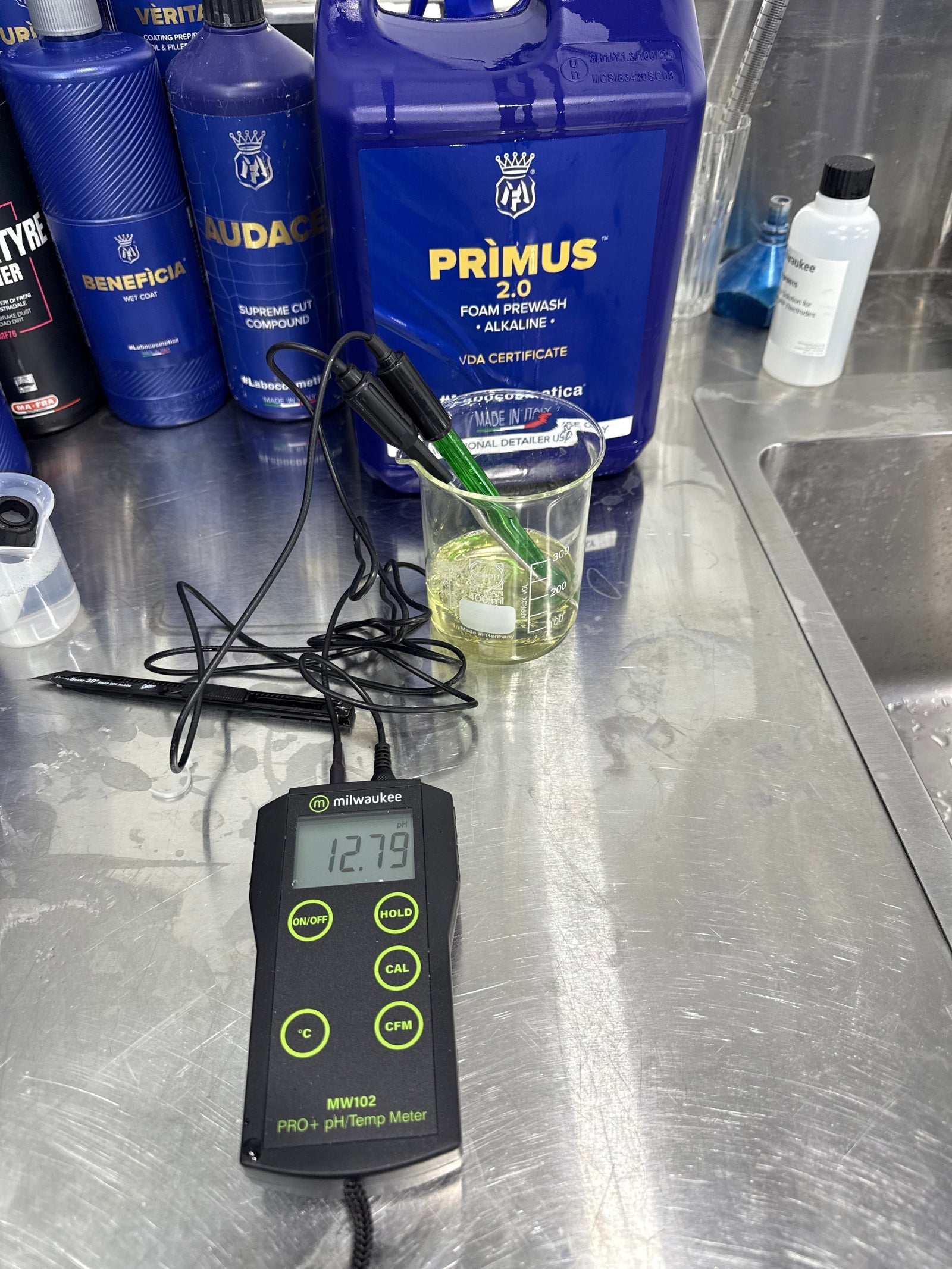
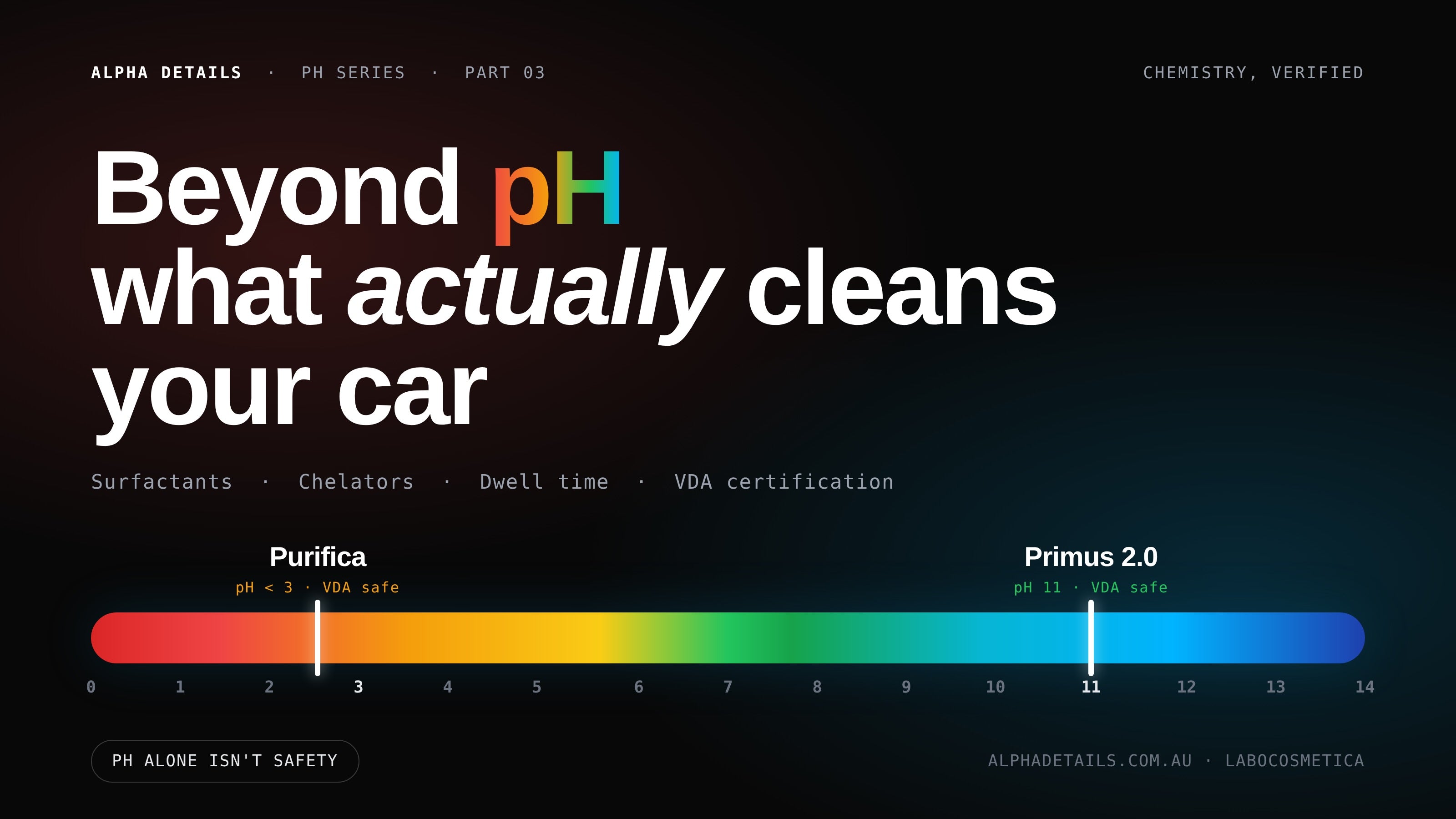
Compare that with Labocosmetica Primus 2.0, which sits at pH 11. It’s formulated as an alkaline detergent without free caustic salts — meaning it achieves serious cleaning power through safer alkaline chemistry rather than brute-force sodium hydroxide. The result is a pre-wash that dissolves road grime, bugs, and organic contamination without touching your trim, alloys, or coatings.
Primus 2.0 is also the world’s first pre-wash to achieve VDA certification — but we’ll get to what that means in a moment.
The Acid Side: Hydrofluoric Acid and Ammonium Bifluoride
If the alkaline side is bad, the acid side is worse.
Many cheap wheel cleaners and acid-based products use hydrofluoric acid (HF) or its close relative, ammonium bifluoride (ABF). ABF is sometimes marketed as a “safer alternative,” but that’s misleading — when ABF dissolves in water, it essentially converts to HF through a chemical reaction. Same danger, different label.
HF is effective at dissolving brake dust and mineral contamination, which is why it’s used. But it’s also one of the most dangerous chemicals you can encounter in a consumer product. Unlike other acids, HF doesn’t cause immediate pain on skin contact. It penetrates tissue silently, seeps into deeper layers, and reacts with calcium in your bones — converting it to calcium fluoride. By the time you feel the burn, the damage is already deep. Exposure to an area as small as your palm can be fatal.
On your car, HF eats through clear coats and corrodes alloy wheels, leaving a dull, permanently damaged finish. The International Carwash Association (ICA) has recommended that the entire industry discontinue the use of HF and ABF. Yet many cheap products still contain them.
Now compare that with Labocosmetica Purifica — the world’s first acid shampoo designed specifically for car detailing. Purifica uses buffered noble acids — no HF, no ABF — and achieves a working pH of less than 3 at standard dilution. It dissolves limescale films, mineral deposits, and acid rain residue while remaining VDA-certified safe even when used undiluted.
What Is VDA Certification — And Why Does It Matter?
This is the part most product labels won’t tell you. And it’s arguably the most important thing to look for.
The VDA (Verband der Automobilindustrie) is the German Association of the Automotive Industry — the same body that sets standards for the likes of BMW, Mercedes-Benz, Audi, Porsche, and Volkswagen. When a car care product earns VDA certification, it means it has been independently tested against the most delicate materials found in modern vehicles and confirmed not to cause damage.
That’s not a marketing claim. It’s not a self-awarded badge. It’s third-party verification from the organisation that literally represents the automotive manufacturers themselves.
Labocosmetica is the first car care company in the world to achieve VDA certification. They also hold TÜV ISO 9001 (quality management), ISO 14001 (environmental management), and OHSAS 18001 (occupational safety) certifications. Both Primus 2.0 and Purifica carry VDA certification.
This is the difference between trusting a pH number on a label and trusting a product that’s been independently verified not to damage your car.
What to Look for When Buying Cleaners
Here’s the practical takeaway — three things to check before you buy any alkaline or acid cleaner for your car.
Don’t trust pH alone. Two products at the same pH can have completely different corrosion profiles depending on what’s producing that acidity or alkalinity. A high pH doesn’t automatically mean “better cleaning” — it might just mean more damage.
Ask what’s making it alkaline or acidic. If a product uses sodium hydroxide, hydrofluoric acid, or ammonium bifluoride as its active ingredient, it’s taking shortcuts at the expense of your car’s surfaces — and potentially your health. Look for formulations that achieve cleaning power without free caustic salts or HF.
Look for third-party certifications. VDA certification is the gold standard. It means an independent body — not the manufacturer — has tested the product against delicate automotive materials and confirmed it’s safe. If a product doesn’t carry independent certification, you’re taking the manufacturer’s word for it.
The Bottom Line
pH tells you how strong a product is. It doesn’t tell you how safe it is. The chemistry behind the number is what determines whether a product cleans your car or damages it — and most labels won’t give you that information.
That’s why we stock Labocosmetica. Not because of marketing claims, but because of verified chemistry. VDA-certified. No caustic salts. No HF. No ABF. Products that are engineered to clean hard and protect everything they touch.

Leave a comment
This site is protected by hCaptcha and the hCaptcha Privacy Policy and Terms of Service apply.