Two blog posts ago we established that the pH scale is logarithmic — a product at pH 13 is ten thousand times more alkaline than one at pH 9. Then we argued that pH alone doesn't tell you whether a cleaner is safe, because two products at the same pH can behave completely differently depending on what chemical is producing that pH.
If that's true — if a pH 13 pre-wash can be safer than a pH 10 one, and a pH 2 shampoo can be safer than a pH 5 one — then pH is almost useless as a standalone safety signal. Which leaves a fair question: what actually cleans the car, then? And more importantly, what should you look at on a product label if pH isn't the answer?
This is Part 3. We're going beyond the number.
What actually breaks a bond
Dirt, road film, brake dust, iron fallout, and the bonded grime that sticks to paint after a long drive are all held onto your car's surface by a mix of electrostatic attraction, chemical bonds, and mechanical interlock. Cleaning is the process of breaking those bonds without breaking the surface underneath.
Three kinds of chemistry do most of that work. They usually show up together, and none of them is "pH" in isolation.
Surfactants are molecules with a water-loving head and an oil-loving tail. They wedge themselves between grime and paint, lift the grime off the surface, and suspend it in the water so it rinses away instead of redepositing. A well-formulated surfactant package can clean extraordinarily well at a gentle pH — the cleaning power comes from the molecule's architecture, not from chemical aggression.
Chelators are molecules that grab metal ions and hold onto them. Iron fallout, calcium deposits, the rust-coloured specks you see on white paint after a summer — those are all metals bonded to your clear coat. A chelator like EDTA or a buffered noble acid will lock onto the iron atom, pull it off the surface, and carry it away in the rinse. A pre-wash or shampoo with the right chelator removes contamination that pH on its own simply can't touch.
Contact time (dwell time) is the variable no one on social media talks about. Chemistry is a reaction, and reactions take time. A safe, well-formulated pre-wash at pH 11 that's allowed to dwell for five minutes will out-clean an aggressive pH 13 caustic pre-wash rinsed off in thirty seconds. Every professional detailer I know would rather use a gentler product for longer than a harsh product in a hurry. The car lasts longer. So does your skin.
Why Primus 2.0 cleans without wrecking the car
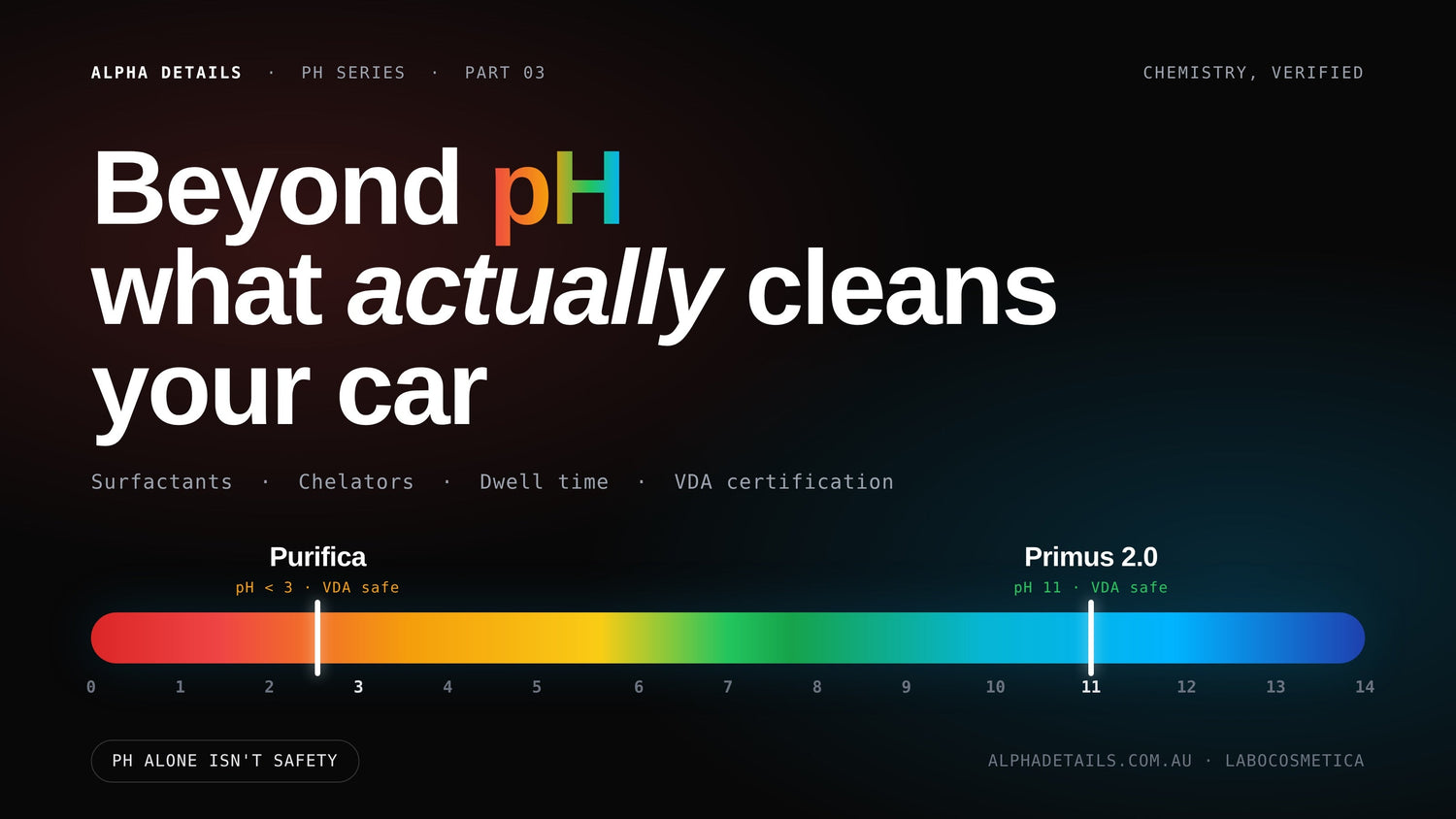
Primus 2.0 is a good example of the principle at work. Its pH sits at 11 — firmly alkaline, the range where road film and oils dissolve fastest. What it doesn't contain is free caustic salts. No sodium hydroxide. Alkaline cleaners of the cheap variety use NaOH because it's the fastest path to a high pH, but NaOH is also what produces this reaction when it meets bare aluminium:
2Al + 2NaOH + 2H₂O → 2NaAlO₂ + 3H₂↑
Aluminium oxide dissolves, hydrogen gas releases, and the alloy pits. Rubber discolours. Plastic trim whitens. Coatings strip. All of it is permanent.
Primus 2.0 gets to pH 11 through a surfactant-led alkaline chemistry instead. It's why it holds VDA certification — the German Automotive Industry Association's independent material compatibility test, which checks a product against paint, alloys, trim, PPF, rubber, and coated surfaces. It's the world's first VDA-certified pre-wash. Most cheap snow foams could not pass that test, which is exactly why most cheap snow foams can't make that claim.
Why Purifica works at pH under 3 and still doesn't corrode anything
Purifica goes the other way. It's acidic — pH under 3 at working dilution — and it's a shampoo, which traditionally is a combination nobody formulates because acidic shampoos burn off coatings and etch alloys. Purifica doesn't, because it uses buffered noble acids instead of the cheap aggressive acids the wheel-cleaner industry has historically relied on.
The acid you want to avoid is hydrofluoric acid (HF), or its chemical sibling ammonium bifluoride (ABF), which converts to HF in water. HF etches alloys, dulls clear coat, and — this is the part that should make any detailer stop and read twice — penetrates human skin without immediate pain, then strips calcium from bone:
2HF + Ca²⁺ → CaF₂ + 2H⁺
It can kill from exposure to a palm-sized patch of skin. The International Carwash Association recommended the entire industry stop using HF and ABF years ago. Plenty still do, because it's cheap and it works fast.
Purifica uses acids that decontaminate — removing iron fallout, mineral deposits, and the stuff that bonds into clear coat after a few thousand kilometres of Australian road — without any of the risk. It's VDA-certified safe even undiluted. That last word matters. VDA's test is rigorous at working dilution. Certifying a product as safe at full strength means the formulation has virtually no destructive pathway at all.
What to actually look at on a product label
The surfactant package. Non-ionic surfactants are generally gentler than ionic ones. If a product lists its surfactant system specifically — not just "cleaning agents" — that's a good sign the formulator cares what's in the bottle.
The active chemistry. On an alkaline product: does it name a specific alkaline builder, or just claim "high pH"? A product proud of its chemistry lists the active ingredient. A product ashamed of it hides behind a pH number. On an acidic product: look explicitly for the absence of HF and ABF. If those aren't listed as not-present, assume they might be.
Certifications. VDA is the gold standard because it's independent, expensive to pass, and specifically tests the automotive surfaces you care about. TÜV, ISO 9001, and OHSAS 18001 cover manufacturing quality and safety but don't certify the product against car surfaces the way VDA does. A product with all four — Labocosmetica holds the full set — is a product whose manufacturer has put in the work.
Dwell-time instructions. A label that specifies a minimum and maximum contact time is a label from a formulator who understands their own chemistry. A label that tells you "spray and wipe immediately" often means the active chemistry can't sit on the surface safely.
Closing the series
Three posts ago we started with a simple statistic — the pH scale is logarithmic, each step is ten times stronger. We followed that by arguing the pH number alone is almost meaningless without the active ingredient that produces it. This post sits on top of those two, and the conclusion is the one I want every customer walking into detailing chemistry to leave with:
The right question is never "what pH is it?" The right question is "what is it actually made of, and has an independent body tested it against the surfaces I care about?"
At Alpha Details we stock Labocosmetica specifically because they answer that second question — in writing, with certification. If you've got a product at home and you're not sure about it, send us the label. We'll read it with you.

Leave a comment
This site is protected by hCaptcha and the hCaptcha Privacy Policy and Terms of Service apply.