
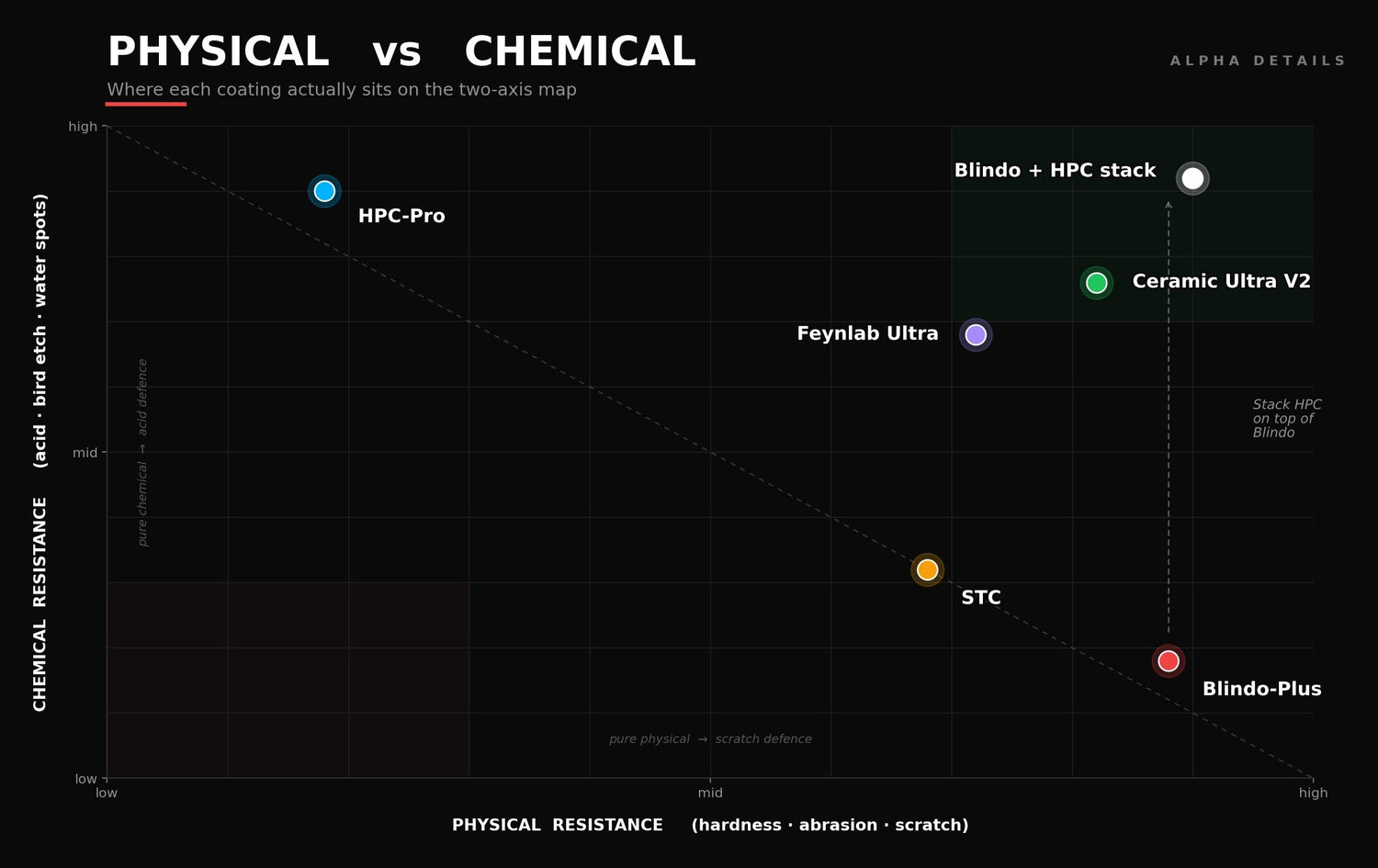
One bottle says 100% physical. The one next to it says 100% chemical. If you've seen our last Instagram reel you already know where this is going — but a minute wasn't enough. So here's the full chemistry version, and by the end you'll understand why the labels on those bottles matter and why none of it works unless the panel underneath is treated correctly.
The thing most coating buyers get wrong
When people ask which ceramic is "the hardest," they're asking the wrong question. Hardness and chemical resistance are two different axes, not two points on the same scale. A coating can be rock-hard and still get etched by a bird dropping. Another can shrug off an acid attack and still mark under heavy wash induction. The industry shorthand — "physical" and "chemical" — is trying to communicate that in two words, but the story underneath is worth understanding properly.
What "100% physical" actually means
Ceramic coatings are built around a silicon dioxide (SiO₂) backbone. When the coating cures, silicon atoms bond to oxygen atoms in a three-dimensional cross-linked network — Si–O–Si bonds running in every direction, forming a dense glass-like matrix on top of your clear coat. That rigid, highly cross-linked lattice is what people are describing when they say "hard."
Most quality coatings also include titanium dioxide (TiO₂), which plays a different role — it's a UV absorber, acting like a molecular sunscreen for the paint underneath. TiO₂ isn't doing the heavy mechanical work; the SiO₂ network is.
Worth knowing →A 9H pencil hardness rating is the top of the pencil scale — but that's the pencil scale, not the Mohs scale. A 9H pencil rating is roughly Mohs 3–4, similar to window glass. It's meaningful for resisting marring, swirls and wash-induced scratches. It isn't armour.
This is why the crash-helmet analogy fits: it's a hard shell that takes the impact of daily wash cycles and minor contact, not a force field.
What "100% chemical" actually means
Chemical resistance is a different problem entirely. The everyday threats to your paint aren't mechanical — they're acidic. Bird droppings sit around pH 3–4 thanks to uric acid. Bug remains leave behind enzymes and proteins that break down coatings. Industrial fallout carries reactive iron and sulphur compounds. Water spots are mineral deposits that etch as they dry. Acid rain, tree sap, road film — none of these scratch the coating. They react with it.
A pure cross-linked SiO₂ network is tough, but Si–O bonds are not chemically inert forever. Under prolonged acid attack, especially from a drying bird dropping baking in Australian sun, the silica network can slowly hydrolyse and etch. That's why you still see etch marks on cars that were ceramic-coated years ago.
This is where polysilazane chemistry changes the game. A polysilazane coating uses a Si–N backbone — silicon and nitrogen alternating, described by the formula [R₂Si–NR]ₙ. When applied to a car, the Si–H and Si–N–H groups on the polymer react with atmospheric moisture and oxygen. The nitrogens are displaced as ammonia, and what's left crosslinks into an ultra-dense Si–O–Si and Si–N–Si hybrid network on top of your paint.
The result is a final film that's denser and more uniform than a standard SiO₂ coating, and that density is what resists chemical attack. Acids and alkalis both have a harder time finding a path through the network to the clear coat underneath — which is why the polysilazane and hybrid-ceramic automotive coatings are the ones that publish broad pH resistance (Feynlab's automotive range is rated pH 2–12, with industrial versions going wider still). That's the bird-etch, acid-fallout, NaOH-wheel-cleaner defence, and it's not about being "harder." It's about being tighter.
Water spots are a separate problem worth being honest about. A water spot is a mineral deposit — calcium, magnesium, silica — left behind when a droplet dries. The permanent ones etch in thanks to a bit of acidity and the concentrating effect of UV and heat. A polysilazane top layer can resist the etching phase that makes a spot permanent, but no coating prevents water spot deposition. In fact, the tighter the bead, the more concentrated the mineral ring when that droplet dries. Drying the panel is what prevents water spots. A coating just limits the damage if you don't.
How a coating actually attaches — physical bonding
Before any of the above chemistry matters, the coating has to stick. And there are two completely different mechanisms doing that job — a physical one and a chemical one — and they happen in that order.
Physical bonding is what takes over in the first seconds after application. The coating's silane precursors contain silanol groups (Si–OH) that form when the alkoxy groups on the molecule hydrolyse in the thin moisture layer on the panel. Those silanol groups aren't covalently anchored to the paint yet — they're held in place by hydrogen bonding between the Si–OH groups on the coating and the hydroxyl (–OH) groups on the clear coat surface, plus van der Waals forces across the contact area, plus mechanical interlocking with the microscopic texture of the paint. This is why a coating feels "wet" during that short initial window — the physical layer is in place but the chemistry hasn't happened yet.
Physical bonding is strong enough to keep the coating sitting on the panel, but it's reversible. If you wiped at it aggressively in the first thirty seconds, you'd lift it. What locks it in permanently is the next step.
How a coating actually attaches — chemical bonding
Within minutes, those hydrogen-bonded silanol groups begin a condensation reaction with the hydroxyl groups on the clear coat. Two –OH groups come together, water is released, and what was a weak hydrogen bond becomes a covalent Si–O–Si siloxane bond — the same oxygen-bridged silicon bond that holds glass together. At the same time, silanol groups on neighbouring coating molecules condense with each other, building the cross-linked network sideways across the panel.
Two hydroxyl groups condense. What was weakly held by hydrogen bonding is now fused by a covalent oxygen bridge.
The coating is now chemically fused to the clear coat. It's no longer sitting on the paint; it's part of the paint's outermost layer. That's the real difference between a ceramic coating and a wax — wax is physical bonding only, held by weak forces that wash off. A true ceramic coating is chemistry.
Why the surface has to be pristine
Here's where a lot of coating jobs fail, and it has nothing to do with which bottle you used.
A coating can only form covalent Si–O–Si bonds to a clear coat surface that still has accessible, unblocked hydroxyl groups. Every silicone-based spray sealant, every lingering wax residue, every tyre-shine mist that drifted onto the panel last month, every fingerprint oil — all of it sits on top of those –OH sites and physically blocks the silanol from reaching them. When the coating can't condense to the clear coat, it only cross-links with itself, forming a film that's held down by nothing more than van der Waals forces. It looks like it bonded. It beads water for a week or two. And then it starts lifting.
This is why paint correction, panel wipe, and IPA decontamination before coating aren't optional steps. They're the reason the coating actually becomes a coating and not a wax.
Oxidation matters the minute the paint cures
Here's the uncomfortable bit. Clear coat begins to oxidise almost as soon as it finishes curing. UV radiation and atmospheric oxygen start breaking the long polymer chains in the clear coat within days, scavenging electrons and degrading the polyurethane/acrylic network. Modern clear coats include UV absorbers — benzotriazoles and hindered amine light stabilisers — to slow this down, and they work. But they don't stop it. They delay it.
Oxidised clear coat has fewer intact hydroxyl groups, more surface defects, and a layer of degradation products that sits where you want your silanol bonds to form. It also has reduced gloss, reduced clarity, and a microscopically rougher texture. All of which means a coating applied to oxidised paint bonds worse, looks worse, and lasts shorter than the same coating applied to freshly corrected, decontaminated paint.
This is why we insist on a proper correction stage — not because we're trying to upsell, but because levelling off the oxidised surface layer exposes a new, reactive hydroxyl-rich layer underneath. Coat that, and you're bonding to fresh clear coat. Coat neglected paint straight out, and you're bonding to a weak layer of oxidised polymer that's already on its way out.
Why this matters more for detailers than for clients
If you're a detailer reading this, none of the above is new chemistry — but it's the chemistry that separates a professional coating job from a hopeful one. Every claim in this post is worth checking yourself. The physical/chemical split isn't marketing fluff; it's two different molecular mechanisms. The bonding process isn't vague; it's hydrogen bonding transitioning to covalent condensation. The surface prep isn't superstition; it's the only way the condensation reaction reaches the substrate.
Fact-check everything. Clients are paying for a result that lasts four years, and "looks good on day one" is the easiest result in detailing to fake. The coatings that actually last are the ones applied onto a correctly prepared surface by someone who understands why each step of the prep exists. When we're precise about pre-wash chemistry, about correction, about panel wipe residue, about humidity at application — it's because every one of those variables affects whether Si–OH groups find their counterparts on the clear coat and condense, or whether they evaporate into a half-bonded film that'll lift in a year.
The chemistry is the job. Everything else is paperwork.
Why the best systems use two bottles
Now the video makes sense. Blindo-Plus is the 100% physical base: a hard resin clear base coat, cross-linked for mechanical durability. HPC-Pro is the 100% chemical top: hybrid polysilazane, cured into a dense chemical-resistant overlayer. Used on their own, each one is brilliant at one job and weaker at the other. Layered together, the Blindo provides the scratch-resistant foundation and the HPC-Pro takes the acid hits before anything reaches the base layer.
That's not marketing. That's two different chemistries doing two different jobs, stacked in the right order — on a surface that's been prepared to accept them.
Where STC fits
STC (SiO₂ + TiO₂ coating) is Labocosmetica's single-bottle compromise — 70% physical, 30% chemical in one application. It's PFAS-free, runs about four years stand-alone, and gives most daily-driven cars more than enough protection on both axes. If you want to push the chemical resistance further, you can top STC with HPC-Pro and effectively build a two-layer system from a simpler starting point.
It's a sensible choice when the job doesn't justify the full Blindo system but the owner still wants real, long-term protection.
Feynlab Ceramic Ultra — hybrid chemistry by construction
Labocosmetica's approach to combining physical and chemical resistance is to stack two chemistries in sequence. Feynlab's approach in their Ceramic Ultra is different: build the hybrid into the lattice itself. Instead of a pure SiO₂ network, Ceramic Ultra cures into a lattice that combines silica (SiO₂), silicon nitride (Si₃N₄), and silicon carbide (SiC) — three ceramic species in one film.
Two strategies for the same problem. Both work — they just solve it differently.
Each one contributes something different. The SiO₂ fraction provides the familiar cross-linked glass matrix. The Si₃N₄ contribution brings chemical resistance similar to what polysilazane chemistry delivers — the Si–N bonds are significantly harder for acids to hydrolyse than pure Si–O bonds, so acid fallout and bird etching meet a genuinely tighter defence. The SiC fraction is the mechanical heavy-hitter: silicon carbide is one of the hardest industrial ceramics known, and even a small amount woven into the lattice raises the film's abrasion resistance meaningfully.
The more recent Ceramic Ultra V2 takes it further with Feynlab's patented "Biphasal" technology, combining a basecoat and topcoat into a single product — so the film itself has two distinct phases: a more resilient foundation phase and a harder, denser outer phase, applied in one step rather than two. It's not self-healing (that's a separate Feynlab chemistry in their Self Heal range), but it is genuinely flexible, scratch-resistant, and chemically tough because the hybrid is built into the molecules themselves.
Think of it this way: Labocosmetica's Blindo + HPC system is a two-layer approach, where each layer specialises. Feynlab Ceramic Ultra is a one-layer hybrid, where the lattice is intentionally mixed at the molecular level. Both strategies work — they just solve the physical/chemical trade-off differently. Which one is better for a given vehicle depends on the paint condition, the climate the car lives in, whether it's a daily driver or a weekend car, and how the owner actually uses it.
Why we work with Feynlab and Labocosmetica — and almost no one else
There are a lot of ceramic brands on the market and plenty of them make louder claims than either Feynlab or Labocosmetica. Ten-year durability. Graphene-infused everything. 10H pencil hardness ratings that don't exist on the pencil scale. The reason we don't carry most of those brands is simple: the chemistry on the bottle has to match the chemistry in the bottle, and the best indicator that a brand is telling the truth is what they're willing to say on the label.
Labocosmetica prints the split. "70% physical, 30% chemical." "100% physical." "100% chemical." They tell you what the base chemistry actually is — SiO₂ + TiO₂ for STC, hybrid polysilazane for HPC-Pro. They disclose PFAS-free status, list their VDA certifications on products where they hold them, and they don't claim things they can't back. When a company tells you exactly what's in the product and exactly what it's good and not good at, that's a company that trusts its chemistry.
Feynlab is the same philosophy expressed differently. They publish their lattice composition — silica, silicon nitride, silicon carbide. They're clear about what self-healing means and, just as importantly, about which products in their range don't self-heal so a client buying Ultra isn't expecting something the coating doesn't do. Their patent disclosures on the Biphasal chemistry are public, which means the claims are verifiable rather than buzzwords.
Different car, different conditions, different answer. That's the whole game.
That transparency is what lets us actually do our job. A coating selection should be driven by what the vehicle needs, what the climate throws at it, and what the owner's tolerance is for maintenance — not by whichever brand has the most aggressive marketing that year. Because Feynlab and Labocosmetica both tell you what's in their bottles, we can line them up against the car in front of us and pick the right tool for that specific paint.
And then there's PPF
If the car wears Paint Protection Film, the coating has to sit on polyurethane — not clear coat — and that's a completely different surface chemistry. The new Armorius range is formulated specifically for PPF, with a gloss version that amplifies the film's clarity and a matte version that preserves satin finishes without changing the look. Application is true wipe-on, wipe-off, which on a full PPF car is the difference between a few hours and a full day of work.
How to read a coating's spec sheet now
Pencil hardness (9H, 10H). Tells you how the cured film resists marring and fine scratches. Useful, but not a measure of real-world impact resistance.
Physical/chemical split. Tells you how the chemistry is weighted between mechanical hardness and acid resistance. A higher physical number means a tighter cross-linked network. A higher chemical number usually means polysilazane or a similar dense-overlayer chemistry is involved.
PFAS-free. Worth looking for. PFAS ("forever chemicals") are being phased out across the automotive chemistry industry for environmental and regulatory reasons. All three Labocosmetica ceramics in the range — STC, HPC-Pro, and Blindo-Plus — are PFAS-free.
Layerability. The coatings worth paying for are the ones that work in a system, not just as standalones. That's how you get the best of both axes without compromise.
Tying this back to the pH series
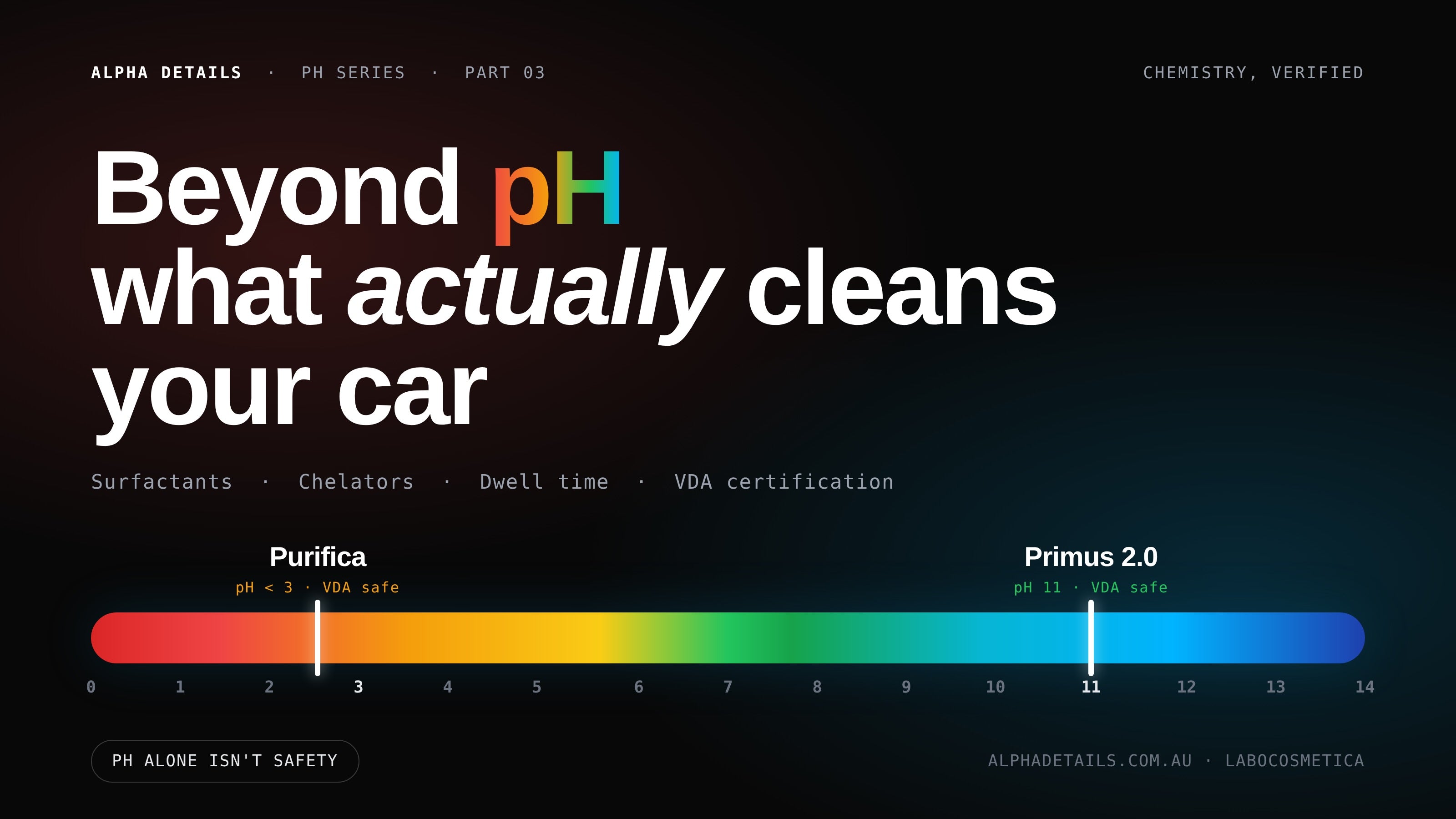
If you followed our three-part pH series (Part 1, Part 2, Part 3), the framing here should feel familiar. pH is the attacker — it tells you how aggressive a chemical threat is. Coating chemistry is the defender — it determines whether your paint actually survives that attack. A bird dropping at pH 3.5 can sit on an uncoated clear coat and etch it in hours. That same drop on a polysilazane-topped coating can be washed off a week later with no mark, because the acid can't get through the network fast enough to do damage.
That's the whole point of understanding the chemistry: knowing what's attacking your paint tells you what kind of defence you actually need, and knowing how the defence bonds tells you why the prep work before the coating matters as much as the coating itself.
Choosing your system
The full ranges are on the store, organised by brand so you can pick the chemistry that fits your build:
|
TWO-LAYER SYSTEMS · PPF
Labocosmetica
Blindo-Plus, HPC-Pro, STC and the Armorius range for PPF. Stack them to build the right defence for the car in front of you. Browse Labocosmetica → |
HYBRID LATTICE · SELF HEAL
Feynlab
Ceramic Ultra and Ultra V2, plus the Self Heal line. One-bottle hybrids where the chemistry is mixed at the molecular level. Browse Feynlab → |
If you're not sure which combination fits your car, your driving environment, and your maintenance habits, send us a DM. Coating selection is one of the few decisions in car care where getting it right really does save you money over the next four years.
Questions about the chemistry, the application, or which system suits your build? DM us on Instagram or message us through the site. This is where the chemistry degree earns its keep.

Leave a comment
This site is protected by hCaptcha and the hCaptcha Privacy Policy and Terms of Service apply.