
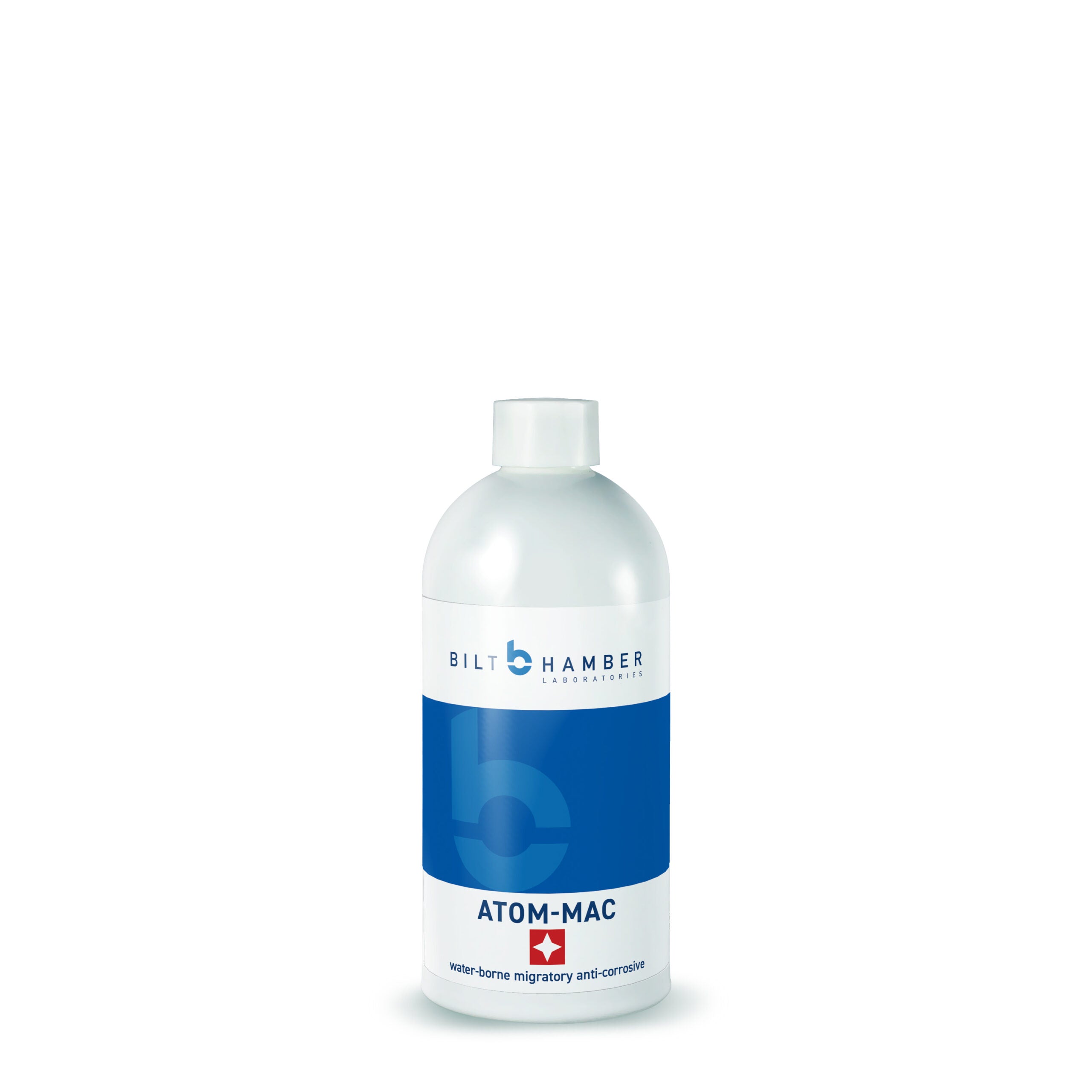
Bilt Hamber Atom-Mac | Vapour-Phase Corrosion Inhibitor
A corrosion inhibitor that protects metal it never touches
This is the most interesting chemistry in the Bilt Hamber catalogue, and almost nobody explains it properly.
Atom-Mac is a vapour-phase corrosion inhibitor — a VpCI. Bilt Hamber's SDS declares it as an amine carboxylate salt at 20–35%, CAS 38344-72-8. That CAS number resolves to morpholinium octanoate — the 1:1 salt of octanoic acid and morpholine. It is textbook amine-carboxylate VCI chemistry, and Bilt Hamber declare it openly, which is more than most manufacturers in this category do.
How a vapour-phase inhibitor actually works
The amine carboxylate has enough vapour pressure to volatilise in an enclosed space. The volatile amine migrates through the vapour phase, dissolves into the thin film of moisture that's always present on steel, raises the local pH and adsorbs onto the surface. The carboxylate anion then chemisorbs onto the metal and forms a passivating monolayer.
The consequence is the useful bit: it protects surfaces the liquid never physically reached. The back of a box section. The inside of a seam. The underside of a bolt head. This is why Bilt Hamber tell you to bag or seal the item — you are trying to trap the vapour, not just wet the metal.
The flash-rust problem it solves
Anyone who has stripped rust with Deox-C or Deox-Gel, or wet-blasted a panel, knows the feeling: you now have chemically clean, utterly bare steel, and it will bloom orange within the hour. Add Atom-Mac at 2% to your rinse water and it doesn't. That alone justifies the bottle.
Dilution
Dilute in deionised or distilled water — Bilt Hamber are specific about this, and tap water minerals will work against you.
General use: 2–5%. Motorcycles and bicycles: 1–2%. Cars with disc brakes: 5%. Enclosed voids: 2ml of neat product per litre of void volume. After Deox-C, Deox-Gel or blasting: 2% in the rinse water. Pressure washer: aim for 2% at the nozzle, applied at the end of every wash.
It's water-borne, it's safe on painted surfaces, and the SDS records it at pH 7 — neutral. It carries no CLP dangerous classification, though Bilt Hamber advise an A2 or A2-P2 respirator if you're atomising it.
Safety Data Sheet (Australia)
Download the Bilt Hamber Atom-Mac SDS (PDF)