Three pH levels. Three products. One uncompromised wash. This is the question we get asked more than any other — so we built the answer in full.
The question we get asked more than any other
Walk into our detail bay on any given week and there is one question that comes up more than every other question combined: "Why do I need three different products to wash my car?" Customers see the line-up of bottles, see the price tag attached to a full Labocosmetica 3-pH system, and they want to know what they are actually buying. The answer is chemistry — and once you understand the chemistry, the three bottles stop looking like an upsell and start looking like the only sensible way to clean a car without damaging the paint, the wax, or the ceramic coating you just paid four figures for.
This guide is the answer in full. Three products, three pH levels, every claim verified against Labocosmetica's published data sheets. Read it once and you will never look at a wash bay the same way again.
A 60-second pH primer
The pH scale runs from 0 to 14. Pure water sits at 7, the neutral midpoint. Anything below 7 is acidic, anything above is alkaline. The number itself is logarithmic, which sounds like a maths-class technicality but matters enormously here: each step on the pH scale is a tenfold change in the concentration of hydrogen ions. A solution at pH 4 is ten times more acidic than one at pH 5. A solution at pH 12 is one hundred times more alkaline than one at pH 10. This is why "pH 11 alkaline pre-wash" and "pH 7 shampoo" describe two completely different chemical environments, not two slightly different soaps.
Different contaminants need different pH environments to be lifted off the paint efficiently. The trick is matching each contaminant to the chemistry that actually breaks its grip on the surface, instead of asking one neutral shampoo to handle everything and inevitably leaving most of it behind.
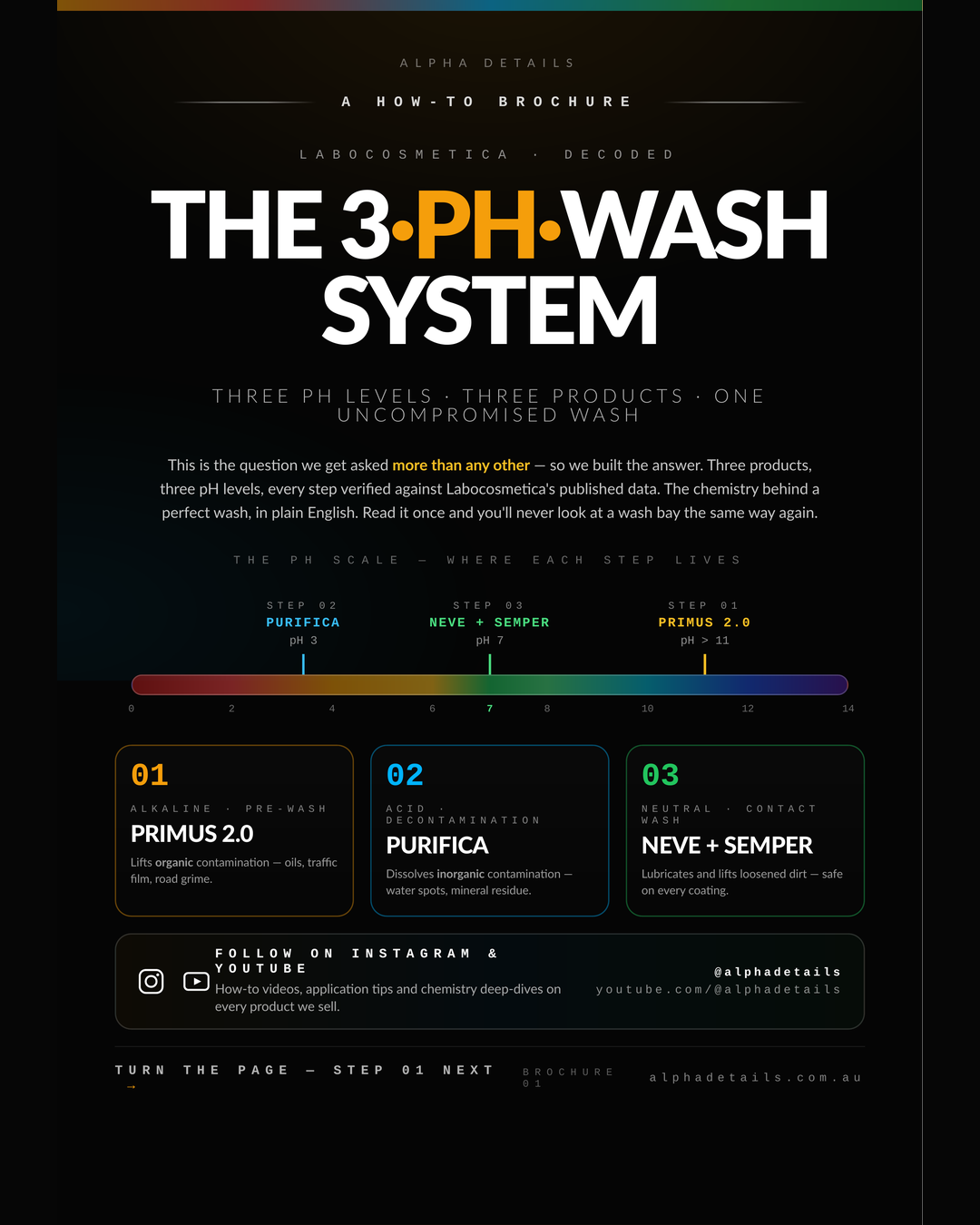
The pH Scale — Where Each Step Lives
Step 01 — Primus 2.0: the alkaline pre-wash (pH > 11)
The chemistry. Primus 2.0 is an alkaline foam pre-wash sitting above pH 11, formulated with surfactants and an alkaline buffer system that targets organic contamination — engine oil residue, traffic film, road grime, tar films, bug residue, the protein-based binders in road dust. Alkaline chemistry breaks these down by saponifying fats and oils (turning them into water-soluble soaps) and by hydrolysing protein bonds. Importantly, Primus 2.0 carries Labocosmetica's VDA certification, which means independent German testing has confirmed it is compatible with the most delicate automotive substrates — trims, plastics, soft paints — despite the strong pH.
Apply to a dry vehicle. No pre-rinse. A wet panel carries a thin water film that locally dilutes the foam where they meet, lowering the working surfactant concentration at the moment of contact. Worse, water beads on top of hydrophobic contaminants like oils and tar, sitting between the cleaner and the dirt — a barrier the surfactants must displace before they can act. Foam also clings better to dry paint than to a wet film, so dwell time and contact area are both maximised on a dry vehicle.
Dilution. For a 1-litre foam cannon, dilute Primus 2.0 at 1:5 for winter or heavy soiling (200 ml of product in the 1 L cannon) and 1:10 for summer or lighter soiling (100 ml). Apply bottom to top. In hot conditions, work half the vehicle at a time to prevent the foam drying on paint.
Dwell three to five minutes, then rinse with high pressure. Three minutes minimum to let the chemistry actually engage with the contamination — five maximum, because a foam that dries on paint becomes a residue you have to remove instead of a contaminant solvent.
Avoid: direct sunlight, hot panels, letting it dry on the paint.
Step 02 — Purifica: the acid decontamination (pH 3)
The chemistry. Purifica is the world's first acid shampoo for car detailing — Labocosmetica launched it in 2016. It targets inorganic contamination, which is the category Primus deliberately leaves behind. Inorganic contamination is dominated by mineral deposits: calcium carbonate from hard water, iron particles from brake dust and rail dust, salt residue from coastal air or winter roads, the silicate-mineral binders in dust from sandy rain. These contaminants do not respond to alkaline chemistry — they respond to acids, which protonate carbonate scale (CaCO₃) into water-soluble carbonic acid and chelate dissolved metals into solution.
"Acid on my paint?" Purifica is built on a blend of buffered noble acids, not aggressive industrial acids. Buffered means the working pH stays controlled even as the acid does its job. Noble acids are organic acids selected specifically because they dissolve mineral scale without attacking the wax, sealant or ceramic coating sitting on top of the paint. Purifica carries the same VDA certification Primus does, and Labocosmetica explicitly states it is safe on paint, PPF, glass, aluminium, plastic and existing protective coatings.
This is not an every-wash product. Use Purifica when you see visible water spotting on the paint, when your ceramic coating's hydrophobic beading is flattening out (which usually means a mineral film is masking the coating, not that the coating itself has failed), or after the vehicle has been exposed to salt, sandy rain or snow. Before any paint correction work, run a full Purifica decontamination as part of the standard 3-step prep — corrected paint with mineral contamination still bonded to it will look spectacular for a week and disappointing for the rest of its life.
Dilution depends on the job. For a standard snow-foam decontamination through a foam cannon, dilute 1:10 (100 ml in 1 L) and dwell 4–5 minutes before rinsing. For contact-wash decontamination in the bucket, where the mechanical action of a mitt lifts bonded water spots loose, dilute 1:100 (10 ml in 1 L water). For visible water spots that need direct attention, spray 1:30 directly on the spot and dwell 1–2 minutes. For the heavy-duty combination — coastal salt, sandy rain, snow — Labocosmetica recommends 1:5 in the foam cannon followed by mechanical action with a mitt soaked in 1:400 bucket dilution.
Step 03 — Neve + Semper: the neutral contact wash (pH 7)
The chemistry. The contact-wash step — where a mitt actually touches the paint — uses neutral pH because anything else would be a risk to the wax, sealant or ceramic coating you have just preserved through the first two steps. Neutral surfactants do not dissolve protective layers. They lubricate. They lower the friction between the mitt and the paint to a point where the loosened contamination from steps one and two can be lifted away without dragging grit across the clear coat and creating swirl marks.
Why two products. Neve is a neutral foam shampoo with cleaning power Labocosmetica describes as comparable to an alkaline — high-surfactant, designed to cling to the panel, biodegradable and phosphate-free. We foam Neve onto the vehicle through the cannon and then wash through the foam with the mitt rather than rinsing it off first. The foam itself becomes the lubricated wash medium. Semper goes in the bucket — its job is to add a second layer of lubricity to the mitt itself. Semper is super-concentrated and strongly lubricated, formulated specifically for the two-bucket method. The result is slip on the surface and slip in the mitt, which is the belt-and-braces approach to preventing marring.
Neve in foam cannon mode. Dilute Neve 1:25 to 1:50 (40–80 ml in 1 L cannon) and apply onto the panel. Leave it on the surface — do not rinse before contact. Wash through the foam with a clean microfibre mitt, working top to bottom in straight strokes, light pressure. Final rinse only.
Semper in bucket mode. Dilute Semper at 1:1000 (10 ml in a 10 L bucket), or up to 1:1500 in soft water. Run a proper two-bucket method with grit guards to keep wash water clean. The Semper is what gives the mitt its glide.
Don't underestimate Neve. Neve is strong enough on its own to act as a neutral pre-wash on a vehicle that is only lightly contaminated. If the car is genuinely just dusty rather than dirty, you can foam Neve, dwell five minutes, rinse before drying, and call it done. Before paint correction, however, always run the full 3-step cycle — Primus, Purifica, then Neve plus Semper. Cutting corners at the prep stage shows up in the final result.
Why the order matters
Alkaline first, acid second, neutral last. There is a reason for the sequence. Alkaline chemistry handles the loose, easy-to-dissolve organic film — getting it off first means the acid step does not waste any of its working concentration on contamination that does not need acid chemistry. Acid second means the alkaline residue is fully rinsed away before the acid arrives, so the two never meet on the paint and partially neutralise each other. And neutral last means the contact step — the only step where physical pressure touches the clear coat — happens with a chemistry that cannot harm any wax, sealant or coating you are protecting.
Get the system
The full Labocosmetica 3-pH wash system is available on our store as a bundle or individual bottles. Whether you are buying your first proper detailing chemistry or restocking your detail bay, we have the bottles, the foam cannons and the wash mitts to run the routine end to end. If you want the printed brochure version of this guide — the one we include with every line sale of the 3-pH system — it is in your order pack.
Get the Labocosmetica 3-pH Wash Bundle
Primus 2.0 + Purifica + Semper, ready to run the routine end to end. Available on the store now.
Follow Alpha Details on Instagram for application videos, chemistry deep-dives and product reviews on everything we sell. The science of detailing is what separates a good wash from a great one, and we are happy to keep showing the working.

Leave a comment
This site is protected by hCaptcha and the hCaptcha Privacy Policy and Terms of Service apply.