
Most "best ceramic coating in Australia" articles are written by people who have never held an applicator pad. They list ten brands, copy the marketing copy from each one, sprinkle in some affiliate links, and call it a guide. That isn't what this is.
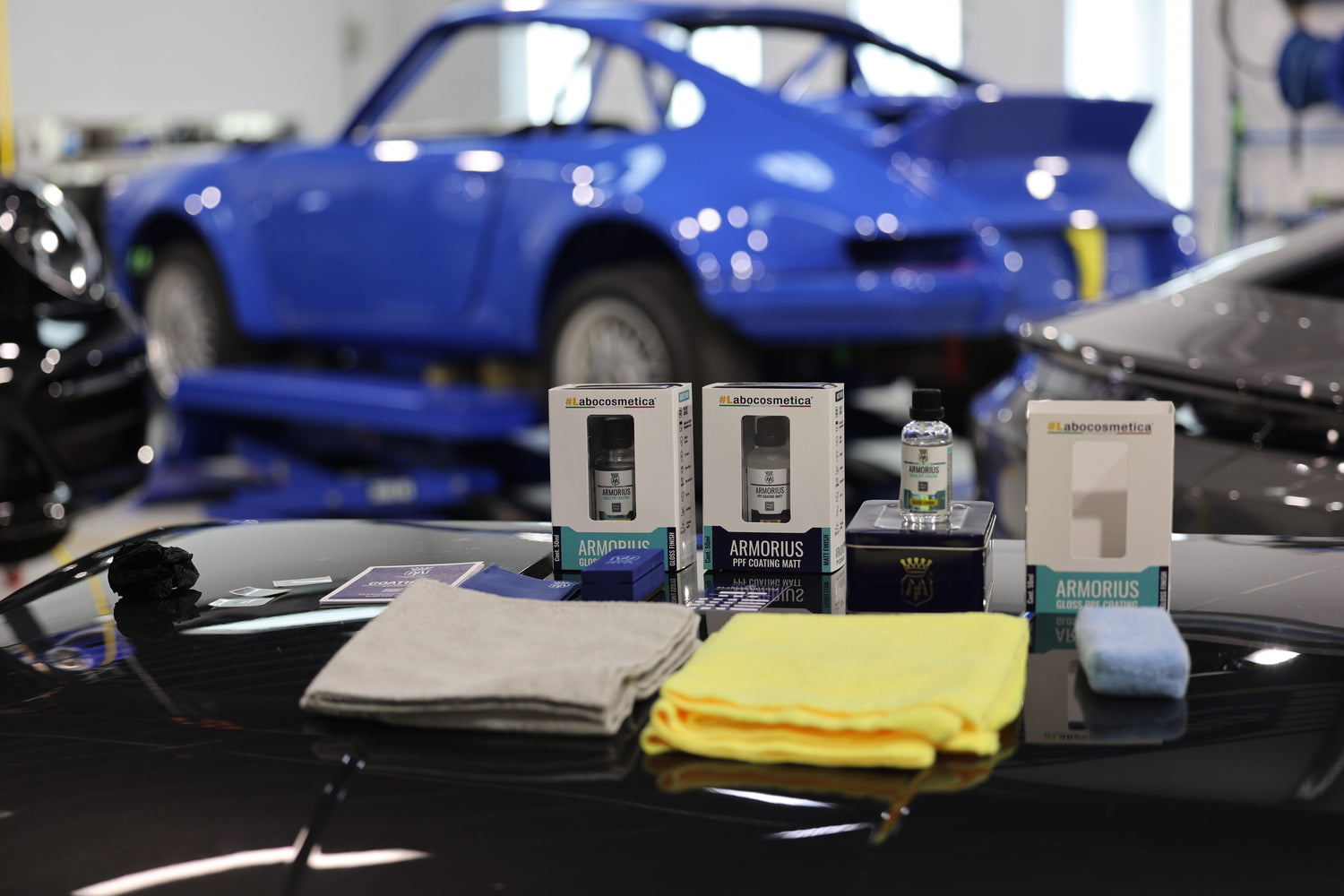
I have an industrial chemistry background — organic and inorganic. Over the years I've studied and tested more brands than I can count. After all of it, two earned a permanent spot in our studio: Labocosmetica and Feynlab. Below is the honest reasoning behind that decision — and the marketing claims I refuse to put my name to.

The claims I won't repeat
Before any honest comparison, the noise has to be cleared away. Three claims dominate the ceramic coating market and all three are misleading or flat-out false.
"Lifetime" or "10-year" warranties. No coating made today survives that long under real driving conditions. Polymer chemistry doesn't cooperate with marketing promises. UV exposure, road salt, contaminant impact, wash technique and temperature cycling all degrade ceramic networks over time. Anything labelled "lifetime" is leaning on a warranty that is functionally impossible to claim against.
"10H" or higher hardness ratings. The industry-standard pencil hardness test (ASTM D3363) maxes out at 9H. There is no 10H pencil, no 11H, no 12H — those grades simply do not exist in the standard. Anyone claiming above 9H has either invented the test or is using a non-standard custom pencil that no laboratory recognises. It's a number designed to look bigger than the competitor's number and nothing more.
Mohs hardness confused with pencil hardness. These are entirely different scales. The Mohs scale runs 1 (talc) to 10 (diamond) and measures mineral scratch resistance. The pencil hardness scale runs 6B (soft) to 9H (hard) and measures coating film hardness. A "9H" pencil-rated ceramic coating sits at roughly Mohs 3–4 — about the same hardness as window glass. Neither rating tells you how the coating will perform in the real world, which is why we don't lead with either.
White-labelled coatings dressed up as a "premium brand." Plenty of "exclusive" coatings in this market are repackaged stock from a third-party formulator, with a new logo and a 400% markup. If a brand can't tell you who manufactures their chemistry and how, that's the answer.

Why coating durability is a moving target
Here's the part the marketing team doesn't want printed: I can make almost any quality ceramic coating fail within weeks, and I can stretch the same coating well past its rated lifespan. The variable isn't the coating — it's exposure.
A weekend car kept in a clean garage, washed with the right pH-balanced shampoo and dried with clean microfibre, will outlast almost any warranty written. The same coating on a daily driver parked under bird-laden trees, washed at a roadside touchless tunnel with high-alkaline pre-soak, exposed to coastal salt air and 40°C summer heat, will degrade in a fraction of the time.
This is exactly why a "5-year warranty" tells you almost nothing on its own. It's measuring the coating in a vacuum, not on your vehicle.
Why we trust Labocosmetica
They warrant by kilometres, not just years. Labocosmetica's flagship professional coating, HPC PRO, is rated for up to 48 months or 60,000 km — whichever comes first. That dual metric is the most honest specification I've seen in the industry. It acknowledges that a garage queen and a fleet vehicle live different lives and need different expectations. The kilometre figure is the part competitors won't print, because it commits them to performance under actual exposure.
They label coatings by their physical-vs-chemical bond ratio. Labocosmetica is the only manufacturer I know of that publishes the chemistry split openly: STC is 70% physical / 30% chemical. SAM is 80% chemical / 20% physical. HPC sits over the top as a hybrid polysilazane overcoat. That sounds like jargon, but it means we can interview a client about their use case — daily driver, garage queen, fleet, show car — and select the bond profile that suits how they actually drive. No competitor gives us that level of customisation.
The chemistry is PFAS-free. Labocosmetica's entire coating range is free of per- and polyfluoroalkyl substances — the "forever chemicals" being phased out across multiple jurisdictions for environmental and health reasons. That decision was made by their formulators long before regulation forced anyone's hand.
The chemists are reachable. When I have a question about a specific surface, an unusual paint system, or a compatibility concern, I can put it directly to Labocosmetica's technical team and get a real chemistry answer back. That kind of access doesn't exist with most brands. It changes how confidently we apply their products.

You can browse the full Labocosmetica range on our store at alphadetails.com.au/collections/labocosmetica.
Why we trust Feynlab
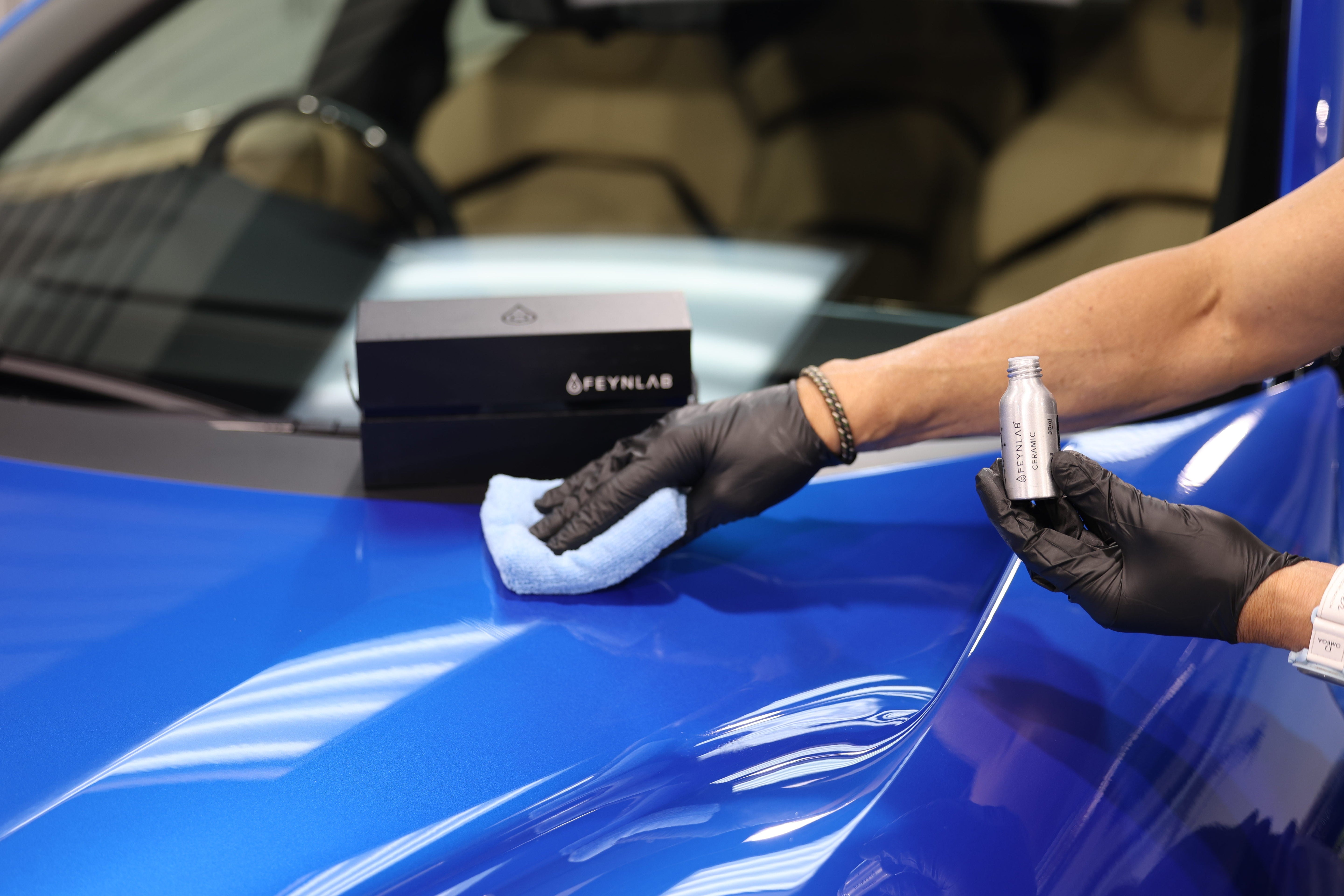
They manufacture in-house, and they were one of the first. Feynlab was an early specialist in self-healing ceramic chemistry — long before the rest of the industry caught up. Their formulations come out of their own laboratory, not a contract manufacturer's vat. That matters because it means the chemistry is owned, refined, and improved generation by generation rather than purchased off a shelf and rebadged.
They under-promise and over-deliver. You won't find Feynlab printing "lifetime" warranties or fictional hardness numbers. Their published durabilities — 12 months on Ceramic Lite, 3–4 years on Ceramic V2, 5 years on Ceramic Plus and Heal Lite, 7 years on Heal Plus — are realistic and conservative. In our studio they routinely hit or exceed those figures because the chemistry is built for the spec, not the marketing.
The Self-Heal range is a category of its own. Heal Plus, applied correctly, builds a film up to roughly 10 microns in a single pass and 15 microns when layered. When the surface is heated above 60°C — a sunny afternoon, a heat gun, or a hot wash — fine swirl marks and micro-scratches in the coating itself flow back into a smooth film and disappear. That is a real, repeatable property of the polymer chemistry, not a marketing animation. We've watched it happen on customer cars across years.
Their chemists are reachable too. Same story as Labocosmetica — when we have a technical question, the answer comes from someone who actually formulated the product. That's increasingly rare.

How we choose between them for your car
The honest answer to "which is best?" is: best for which car, driven how, parked where. That's the conversation we have at the studio before we recommend anything.
Daily driver, exposed to the elements. Long-haul commuters, vehicles parked outside, tradespeople who can't avoid the supermarket carpark. We usually steer toward Labocosmetica HPC PRO — the kilometre-rated warranty matches the use case, and the polysilazane chemistry holds up well against contaminant impact and chemical exposure.
Garage-kept enthusiast vehicle, occasional drives. Show cars, weekend GTs, that kind of thing. This is where the chemistry-split logic of Labocosmetica's STC and SAM coatings really earns its keep — we can dial up the chemical-bond percentage on a vehicle that won't see the kind of physical impact a daily takes.
Owner who wants the swirl-free finish to stay swirl-free. Black cars, dark metallics, anyone obsessive about the finish staying mark-free between washes. This is Feynlab Heal territory. Heal Lite for sensible budgets, Heal Plus for the ultimate self-healing thickness.
Maximum protection, no compromise. Combination work — paint protection film on impact zones plus a ceramic coating over the top, or layered coatings. We'll talk through the layering options and explain what each layer does chemically rather than just naming products.

What "best" actually means
The best ceramic coating in Australia in 2026 isn't a single product. It's the right chemistry, applied correctly, on a properly prepared surface, by someone who understands what's happening at the molecular level and chose the product because of that — not because a sales rep paid for the privilege.
That's why our shortlist is two names long. Labocosmetica and Feynlab are run by chemists, manufacture their own chemistry, publish honest specifications, and improve their formulations every cycle. Everything else we apply, we apply for a specific reason — but those two are the foundation.
If you want to talk through what's right for your vehicle, get in touch via the studio. We'll inspect the paint, ask the right questions about how you actually use the car, and recommend the coating that matches — not the one with the biggest number on the box.

Browse the coatings range on our store: Labocosmetica at Alpha Details · Feynlab at Alpha Details. Or read our deep-dives on each line: Decoding the Feynlab Ceramic Coating Range and The Labocosmetica Range Properly Explained.

Leave a comment
This site is protected by hCaptcha and the hCaptcha Privacy Policy and Terms of Service apply.